
Struggling with a stubborn belt buckle is something almost everyone has dealt with at some point. Ratchet belts were supposed to fix that by replacing holes with a track, but many still don’t feel as smooth or easy to use as they should.
That’s exactly the gap US9918522B2 tries to close. It redesigns the buckle with angled notches for cleaner locking, a front-facing lever that makes release simpler, and a reversible track so the belt works from either side.
The patent is currently part of a dispute between Bobrick Washroom Equipment and Y. Stern Engineering, which makes its technical design even more interesting to unpack. It isn’t the only attempt to improve fastening systems. From cargo straps and helmet buckles to snowboard boots and everyday belts, inventors across industries have been solving the same problem in different ways.
With the Global Patent Search tool, we can trace those ideas and see how each one pushed this mechanism forward.
Understanding Patent US9918522B2
US9918522B2 tackles problems most ratchet belts never fully solved, like uneven locking, awkward release angles, and tracks that only work one way. Instead of treating the belt as a simple strip with notches, this invention treats it like a mechanical system that must lock cleanly, release easily, and stay stable over years of bending and daily wear.
The belt uses angled notches on both sides, so it can be reversed instantly. A front-facing release lever sits near the buckle opening, which makes the release motion natural instead of forcing the user to twist their wrist. Inside the belt, a solid monolithic insert keeps the track rigid so the notches don’t deform over time.
The buckle itself relies on a spring-loaded tab that engages the notches with the right amount of pressure, and mechanical stops prevent over-rotation of the internal parts. Together, these features make the locking smoother, the release more predictable, and the belt more durable.
In simple terms, US9918522B2 takes familiar ratchet mechanics found in helmets, ski boots, cargo straps, and power tools and adapts them into a belt that’s easier to tighten, easier to open, and strong enough to stay reliable on both sides.
The Key Features Of US9918522B2
1. Angled notch strip design: The belt includes a series of angled notches that lock into the buckle securely and smoothly.
2. Front-facing release lever: The release lever is positioned near the buckle opening, making it easier to access and operate.
3. Reversible notch tracks: The belt includes notch strips on both sides, allowing it to be worn in either direction.
4. Monolithic insert for strength: A solid internal insert sits between two belt layers, giving the belt extra rigidity and support.
5. Dual-sided ornamentation: Each side of the belt can have different textures or designs, enhancing both function and style.
In addition to these core features, the system includes a buckle with a spring-loaded ratcheting tab that prevents accidental release. Mechanical stops limit over-rotation of the internal parts.
The belt can also integrate with accessories like hangers for retail or home storage. Some versions are built with enhanced strength for uses like gun belts or outdoor gear.
Similarly, medical wearables face challenges in comfort and reliability. See EP4344633B1 and similar patents, improving diabetes monitoring devices through safer wearable designs.
Similar Patents To US9918522B2
To explore the technology landscape around US9918522B2, we used the Global Patent Search platform to identify patents with similar designs. These references focus on mechanical ratcheting systems, improved release mechanisms, and dual-sided belt configurations for reversible use.
1. US9277776B2
US9277776B2 is one of the closest mechanical cousins to US9918522B2. Filed by Kore Essentials in 2014, it takes a very practical look at how a ratchet belt should feel in everyday use. Instead of relying on holes, pins, or stiff tracks, the patent builds its system around angled notches, a spring-loaded tab, and a comfortable front-facing release lever.
Everything is positioned to make fastening and unfastening smoother without putting strain on the user’s hand.
What makes this filing interesting is how many thoughtful details are packed into it. The angled notches are sculpted with tapered and vertical walls for cleaner locking. The belt houses a monolithic internal insert so the notches don’t deform over time.
The buckle parts are supported with mechanical stops so users can’t over-rotate the mechanism and accidentally damage it. And just like the subject patent, the design supports dual-sided notch tracks, meaning the belt can be reversed and worn from either side without losing functionality.
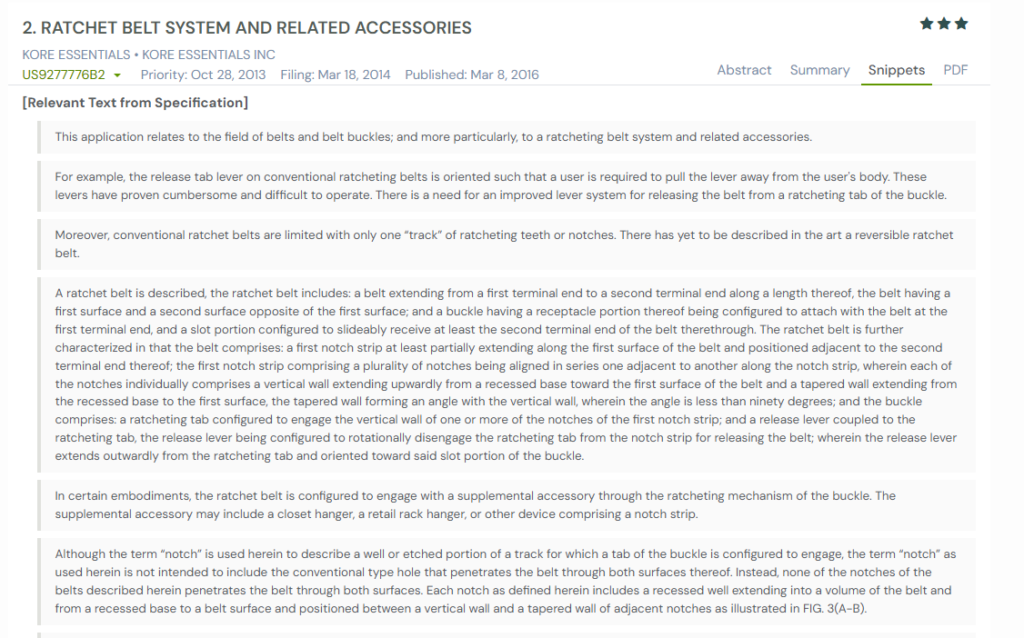
When you look at it alongside US9918522B2, the overlap becomes obvious. Both rely on notched tracks working with a spring-loaded engagement tab. Both place the release lever at the front where the thumb naturally rests. Moreover, both use a reinforced core to keep the belt rigid and long-lasting. In many ways, US9277776B2 already offered a near-complete version of what US9918522B2 later refines and adapts.
Why This Matters
US9277776B2 demonstrates that reversible ratchet belts were already being explored before US9918522B2. It shares nearly all functional components, from the release lever placement to monolithic track support. This makes it a key reference for understanding the development of advanced ratcheting belt systems.
For another example of engineering focused on precise locking and reliable motion control, US9498889B1 offers a dual-action knife mechanism that uses spring-powered movement and internal locking components to keep the blade stable in both open and closed positions.
2. US7207089B2
US7207089B2 comes from a completely different world, i.e., cargo securing. The mechanics it introduces feel surprisingly familiar when compared to modern wearable ratchet belts. The patent describes a bi-directional ratcheting system that can tighten in either push or pull mode. Instead of locking you into a single direction, the device uses a rotating drive shaft, selective engagement points, and swappable anchor ends so the user can control tension from whichever side feels more natural.
The engineering behind it is quite thoughtful. The ratchet wheel uses direction-oriented notches that engage with a spring-loaded pawl system. Cam profiles ensure the locking action feels smooth instead of jerky. The housing is built with parallel plates to keep everything aligned under heavy load. Even the strap can be wound from either end, which gives the mechanism a surprising amount of flexibility for a tool designed for trucks and cargo straps.
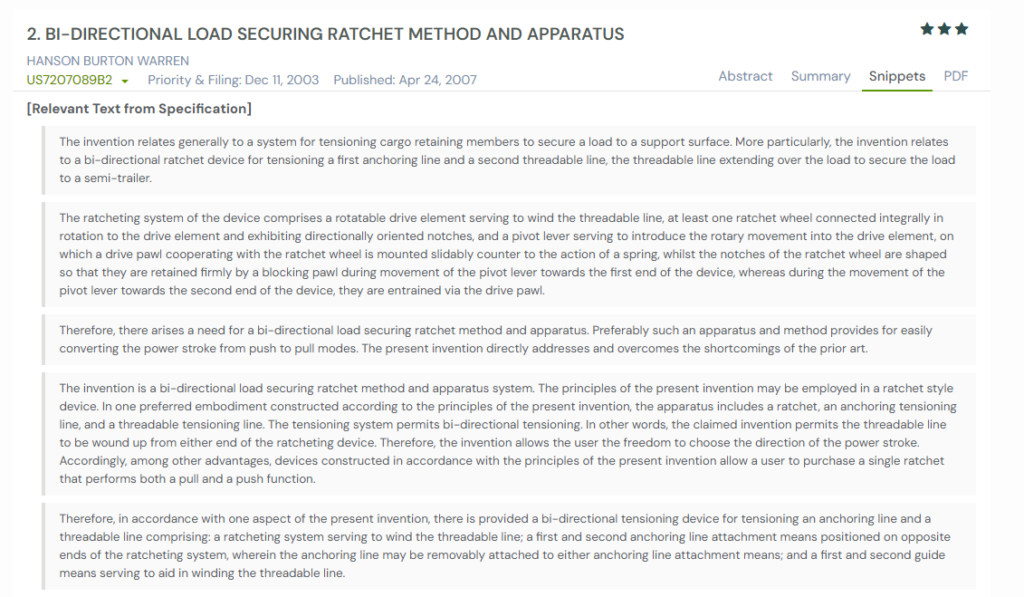
When you look at the flow of ideas, it becomes clear why this patent matters to the story of US9918522B2. Both systems rely on directional notches that define how the ratchet locks and moves. Both use spring-based engagement to keep the mechanism secure until manually released.
Why This Matters
US7207089B2 broadens the mechanical picture surrounding US9918522B2. It shows that the idea of reversible ratchet control wasn’t limited to fashion or personal gear. Engineers in industrial settings were already experimenting with directional notches, dual-mode tensioning, and user-friendly release mechanisms. This makes it an important historical reference when tracing how adaptable, reversible ratchet systems evolved across industries.
Mechanical control under tension shows up in other domains too, like the structural locking behavior covered in our US7146346B2 stress test, where secure engagement under vibration is a core requirement.
3. US5852852A
US5852852A filed by Salomon SAS goes back to 1997, long before reversible belt systems became popular, but the mechanics it introduces are still incredibly relevant. The invention was originally designed for snowboard boots, skates, and similar gear where users needed a strap that locked firmly yet could be released quickly, even with gloves on. The solution was a serrated strap paired with a lever-actuated ratchet that tightened smoothly and opened just as easily with one hand.
The design is clever. The strap threads through a fixed channel where the ratchet’s teeth catch the serrations and lock them in place. The more force you apply, the stronger the grip becomes thanks to the geometry of the teeth. A spring-loaded lever controls both locking and release, all built into a compact, molded piece that works well on flexible or curved surfaces. Even under heavy tension, the system uses torque-assisted disengagement to make release effortless.
The connection to US9918522B2 becomes clear once you look at the shared mechanics. Both systems depend on serrated or notched engagement rather than holes or pins and rely on spring-based locking for a smooth experience. Moreover, both strive for one-handed operation, giving the user precise control without needing additional tools or complicated mechanisms.
Why This Matters
Although intended for athletic gear, US5852852A showcases fundamental mechanical principles also used in belt systems. Its focus on comfort, reversibility, and torque-based release highlights the universality of ratchet-based designs. Like US9918522B2, it aims to give users better control with minimal effort.
4. BR102012001013A2
BR102012001013A2, published in 2013, comes from the world of safety helmets, but the mechanics it introduces feel surprisingly familiar if you’ve ever used a modern ratchet belt. The invention uses a toothed strap paired with a spring-loaded ratchet that locks the strap in place until the user activates an operating lever.
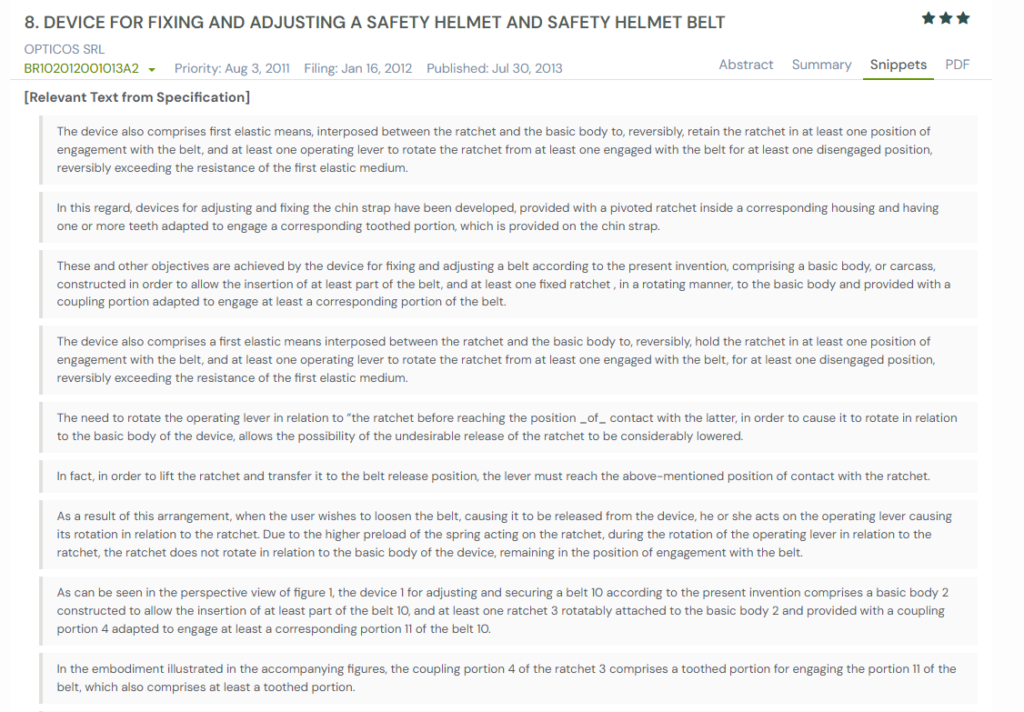
The device fits neatly into a compact housing and uses sawtooth-shaped teeth to create smooth, predictable engagement as the strap tightens. A spring keeps the system under constant pressure so it doesn’t slip accidentally, even under heavy movement or vibration. The lever and ratchet work in a dual-rotation pattern, giving the user precise control during both locking and releasing. The design is modular too, meaning the angle of engagement and the spring force can be tuned for different products or environments.
When you compare it to US9918522B2, the connection is clear. Both systems rely on toothed engagement rather than traditional holes or pins. Both use a spring mechanism to maintain secure locking until a deliberate release action is taken. And both prioritize user-friendly, one-handed operation, whether it’s for a belt, a helmet, or any wearable product where a secure fit matters.
Why This Matters
The patent shows how ratchet-based mechanisms don’t belong to just one industry. From helmets to belts to gear straps, designers keep returning to toothed engagement and lever-controlled release because they offer secure fastening with minimal effort.
You also see clever engagement-and-release engineering in systems far outside wearables, like the controlled magnetic locking behavior in US11766622B1, which shows how designers refine secure attachment even in compact consumer products.
5. DE8812045U1
DE8812045U1, published in 1988, comes from the industrial world of lashing straps, but the mechanics it uses feel surprisingly close to what we now see in modern reversible belt systems. The patent was designed for securing heavy loads, and its standout idea is a ratchet that can reverse strap engagement without any hardware changes. A user can thread the strap from either side, tighten it in the direction that feels most natural, and lock the hand lever at either end of the mechanism.
What’s interesting is how familiar the core engineering sounds. The system focuses on eliminating messy strap loops, giving cleaner tensioning, and reducing the chance of accidental slippage. All of this happens through a compact mechanical layout that supports different strap widths and remains stable even under strong forces. It behaves almost like a turnbuckle, allowing precise tightening from whichever direction the user prefers.
When you compare it with US9918522B2, the connection becomes obvious quickly. Both inventions lean heavily on directional reversibility, letting the strap or belt engage from either side. Both prioritize user-friendly control through a lockable lever and aim for a cleaner, safer fastening experience without complex reconfiguration.
Why This Matters
DE8812045U1 shows that the roots of reversible ratchet design go back much further than wearable accessories. Industrial load-securing systems were already experimenting with bi-directional engagement, safety-first locking, and loop-free tightening long before similar ideas reached fashion and consumer gear.
How To Find Similar Patents Using Global Patent Search
When evaluating technologies like US9918522B2, it is important to examine similar patents that may overlap in design, functionality, or mechanical features. The Global Patent Search platform simplifies this process by surfacing patents that share common elements, such as ratcheting mechanisms, notched belts, and adjustable locking systems.

Here’s how you can use GPS effectively:
1. Search using the patent number: Start by entering US9918522B2 into the GPS tool. You can refine your search using technical keywords like “reversible ratchet,” “dual-track belt,” or “spring-loaded buckle.”
2. Review key snippets: GPS shows you short, relevant excerpts from related patents. These highlight similar components or features, helping you quickly evaluate relevance without reading entire documents.
3. Dive deeper where needed: When a result looks relevant, open the document to study it further. You can compare how each formulation is built, how ingredients are stabilized, or how dosage is optimized for effectiveness.
4. Look beyond one field: GPS helps you trace patterns across different applications from dermatology and pharmaceuticals to natural product chemistry. You can see how the same principle is refined and reapplied in new directions.
Using GPS not only helps you uncover similar patents but also helps avoid costly legal missteps. Whether you are refining a product or planning an international launch, tools like Global Patent Search offer the insight needed to make informed, strategic decisions.
Disclaimer: The information provided in this article is for informational purposes only and should not be considered legal advice. The related patent references mentioned are preliminary results from the Global Patent Search tool and do not guarantee legal significance. For a comprehensive related patent analysis, we recommend conducting a detailed search using GPS or consulting
Frequently Asked Questions
1. What makes reversible ratchet belts different from traditional belts?
Reversible ratchet belts have notch strips on both sides of the strap, so they work in either direction. Traditional belts rely on holes and pins, meaning they can only be worn one way and offer fewer adjustment points.
2. Why do some belts use angled or serrated notches?
Angled notches improve how smoothly the buckle locks and releases. They guide the spring-loaded tab into place with less friction, which reduces wear, prevents accidental slips, and makes the tightening motion feel cleaner.
3. What causes belt buckles to wear out or fail over time?
Most failures come from weak internal tabs, poorly angled notches, or plastic inserts that deform with repeated stress. Modern designs like US9918522B2 use stronger monolithic inserts, better notch geometry, and controlled mechanical stops to avoid these issues.