In most cases, health monitoring only works when you remember to wear something like a watch, a band, or physically attach a sensor to your body.
But what if you do not want to attach devices to your body at all? That’s the idea behind US9549691B2.
Instead of relying on wearables or contact-based sensors, this patent reimagines health monitoring as an ambient capability, using wireless signals already present in a room to detect human activity.
This idea sits at the center of disputes involving Arbor Systems LLC v. Aerial Technologies, Murata Electronics North America, and Socionext Inc.
To understand how this approach emerged, we used the Global Patent Search platform to trace the earlier inventions that quietly led to it. But first, let’s understand this patent a bit more.
Understanding US9549691B2: How Wireless Signals Start Acting Like Sensors
Think about how WiFi works in your home.
Signals are constantly moving between routers, phones, laptops, and smart devices. You don’t see them, but they’re always bouncing around the room.
US9549691B2 asks a simple question: what if those same signals could tell you when someone moves, breathes, or suddenly stops moving?
That’s the heart of this patent.
The system uses standard IEEE 802 wireless transmitters and receivers and treats them like a Doppler radar. When a person moves, even slightly, the wireless signal reflecting off their body changes. Breathing causes tiny rhythmic shifts. A heartbeat creates micro movements. A fall causes a sudden, obvious change.
During a training phase, the system learns what normal looks like for a person. Like:
- How they usually move?
- How does their body position change?
- How their breathing patterns behave?
Later, during regular use, it compares live signals against the learned model.
If something feels off, like unusual stillness, erratic movement, or a sudden collapse, the system can flag it. So there are no cameras, no wearables, and no buttons to press. Just wireless signals quietly paying attention.
Key Features That Make This System Work Without Touch
- Uses regular wireless signals to sense movement, not just to send data.
- Detects breathing, heartbeat, body movement, and sudden changes like falls.
- Learns a person’s normal movement patterns before monitoring them.
- Works without wearables, cameras, or physical contact.
- Monitors continuously in the background without user action.
- Can trigger alerts or responses when something unusual happens.
What makes this patent different is not the technology itself, but the idea behind it. It treats the wireless signals already filling a room as a way to quietly understand what’s happening inside it.
When we tracked the work of 65 wearable health monitoring companies, we found that innovation largely centered on improving sensor accuracy, battery life, and data transmission while keeping devices attached to the body. Read our findings here.
Earlier Patents That Paved the Way for Wireless Monitoring
The idea of sensing people without touching them has been taking shape across different fields for years. Some patents focused on motion detection, others on radar signals, and a few on health monitoring without wearables.
To trace how these ideas slowly came together, we used the Global Patent Search tool. Looking at related patents side by side helps reveal how separate solutions eventually converged into the system described here.
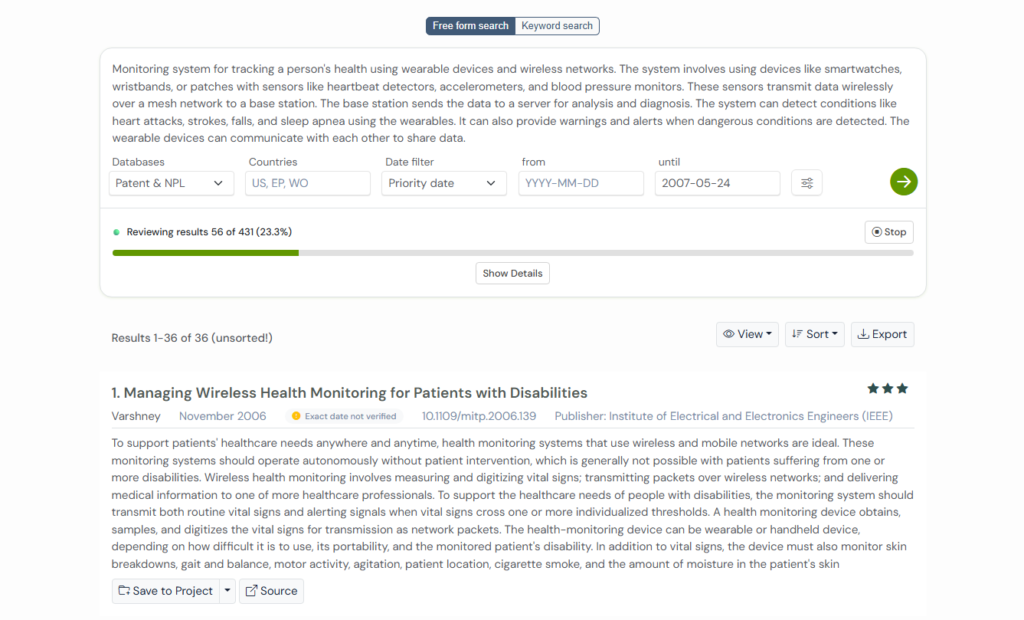
Let’s look at some of them.
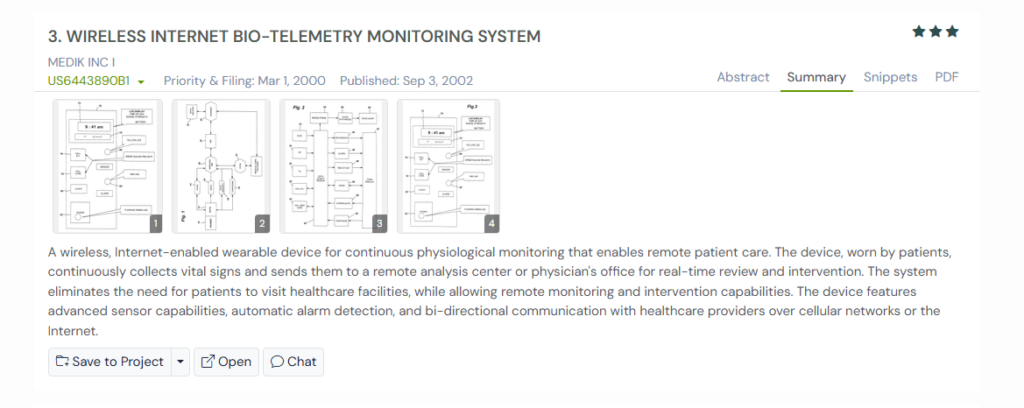
1. US6443890B1
US6443890B1 focuses on a clear step forward for its time. Vital signs monitoring should not stop just because a patient leaves the hospital.
The patent filed in 2000 by i Medik Inc. describes a wearable system that collects physiological signals like heart rate, oxygen levels, temperature, and ECG, then sends that data wirelessly over cellular networks and the internet to doctors or monitoring centers.
The idea, which was early in its time, was to let patients move freely while doctors stayed informed, without constant check-ins or clinic visits.
But the system still depends on contact. Sensors must be worn correctly. Batteries must stay charged. Devices must remain attached and working. If a sensor slips or is removed, monitoring pauses or fails.
Why this patent matters
US6443890B1 shows the transition from local, wired monitoring to mobile, connected health tracking. It solved the distance problem.
2. US2004030581A1
US2004030581A1, filed in 2003, represents a very ambitious phase in health monitoring. The idea here was simple. If you can measure everything, you can respond to anything.
The patent describes a wearable device packed with sensors. Heart rate, heart sounds, breathing, temperature, chemical levels, and even medication delivery. The device collects data, compares it to a personalized health profile, and can automatically alert doctors, family members, or emergency services. In extreme cases, it can even trigger medication delivery without waiting for human intervention.
Why this patent matters
US2004030581A1 shows how far designers pushed wearable health monitoring before hitting practical limits. It proves the desire for real-time, automated care was strong.
As step counting evolved from mechanical tools to electronic wearables, innovation accelerated rapidly. This broader look at wearable health monitoring shows how early ideas scaled into full-fledged medical and consumer devices.
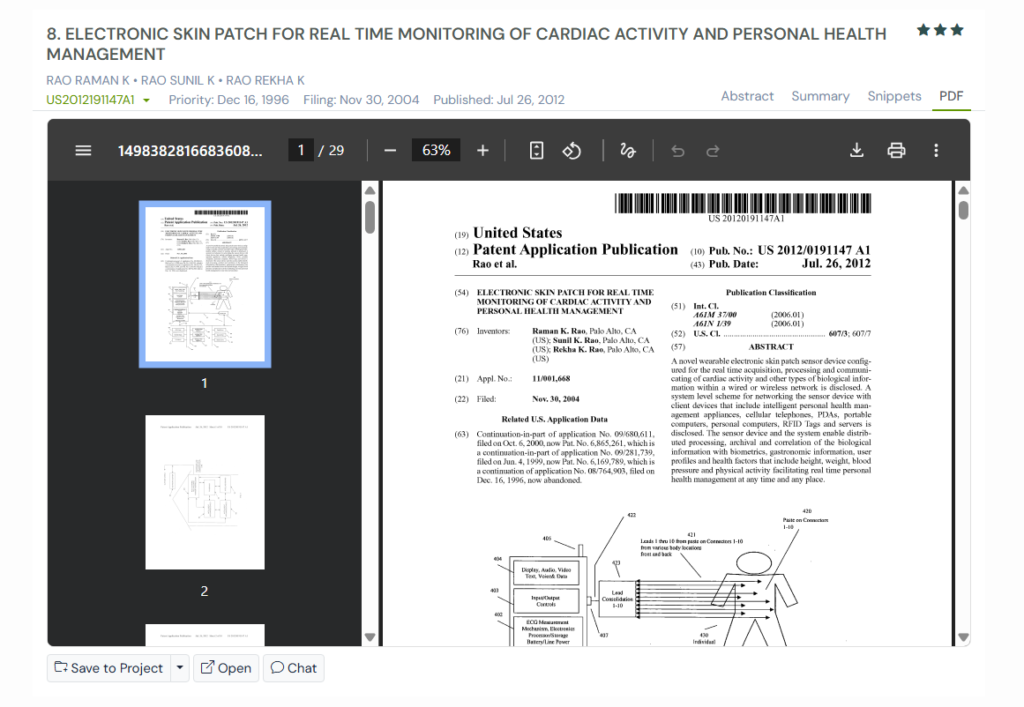
3. US2012191147A1
US2012191147A1, filed in 2004, takes health monitoring a step closer to the body. Instead of bulky wearables, this patent focuses on thin electronic skin patches that stick directly onto the skin.
These patches collect real-time data like ECG signals, blood pressure, pulse rate, and other health indicators. The information is stored, analyzed, and shared wirelessly with mobile devices, servers, or healthcare professionals.
A big part of the idea is correlation. Health data is not viewed alone, but connected with food intake, physical activity, location, and habits to help people manage their health proactively.
Why this patent matters
US2012191147A1 shows the push to make monitoring lighter, smarter, and more connected, while still depending on physical sensors.
From diagnostics to treatment planning, AI is changing how healthcare decisions are made. This deep dive into AI in healthcare explains where these systems are being used today.
4. US6264614B1
US6264614B1 focuses on a problem hospitals knew well. Patient data is only useful if it reaches the right person fast.
The patent filed by Data Critical Corp. in 1999 describes a system where medical data, especially heart activity, is generated using simple sensors and then transferred over the Internet to doctors or care providers.
A patient might hold a small heart monitor against their chest, connect it to a computer, and send real-time data for review. Doctors can then see what’s happening without the patient being physically present.
This system still depends on action. Someone had to hold the device, connect it, and trigger the transfer. Monitoring started only when the patient participates.
Why this patent matters
US6264614B1 helped establish the idea that remote flow of medical data was normal and reliable. US9549691B2 moves beyond that model by removing the need for manual sensing altogether, allowing the environment itself to detect motion and vital signs continuously.
5. JP2003109160A
Imagine an emergency where help is literally ten meters away, but no one knows yet. That’s the gap this Toshiba patent tries to close.
JP2003109160A, filed in 2001, is built around the idea of nearby rescue. Sensors on or inside the body track things like heart rate or body temperature. When something abnormal happens, a mobile terminal doesn’t just contact a server or call center. It also alerts nearby wireless devices using short-range radio, so someone physically close can step in immediately.
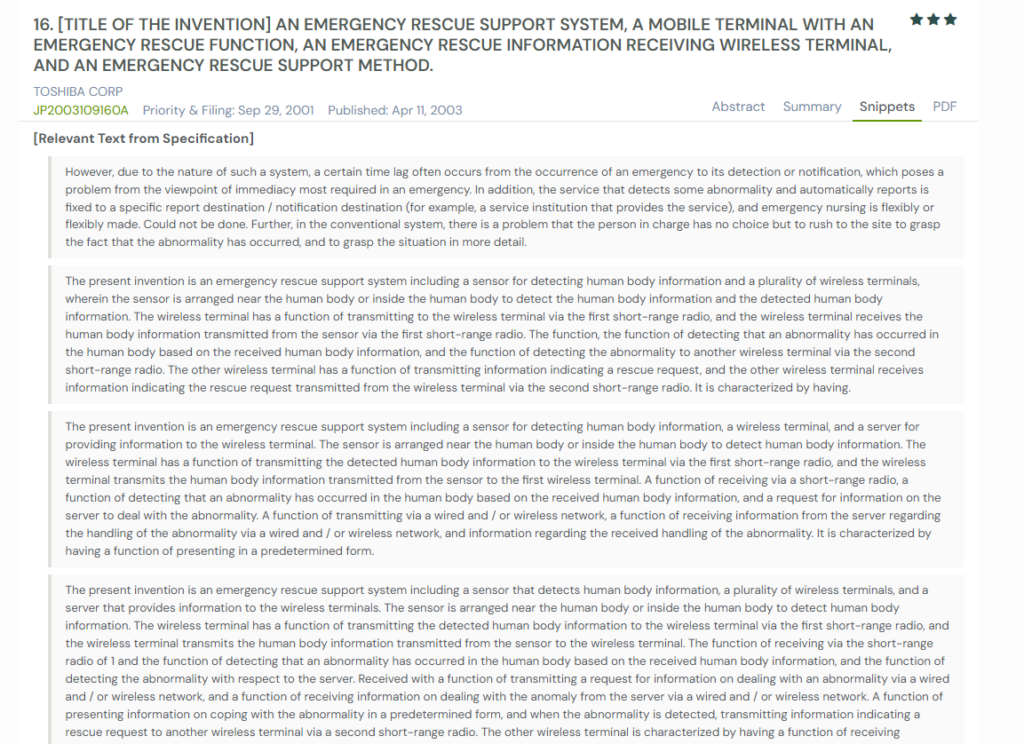
It’s less about long-distance monitoring and more about local awareness. Who is nearby? Who can respond fastest? What instructions should they see right now?
Still, the system depends on sensors being worn or implanted and thresholds being crossed before anything happens.
Why this patent matters
JP2003109160A shifts emergency care from centralized response to local action.
How These Earlier Systems Compare Side by Side
Looking at these patents together makes one thing clear. Each one solves a real problem of its time, but each also carries a dependency that limits how far monitoring can go.
Here’s how they stack up when viewed from the lens of contact, effort, and continuity.
| Patent | How monitoring works | What it does well | Where it still breaks | How it leads to US9549691B2 |
| US6443890B1 | Wearable sensors send data over cellular and internet networks | Enables remote monitoring outside hospitals | Requires sensors to be worn and powered | Shows the move from local to mobile monitoring |
| US2004030581A1 | Sensor-heavy wearable with alerts and medication delivery | Extremely detailed, personalized monitoring | Complexity, battery reliance, and constant body contact | Reveals the practical limits of all-in-one wearables |
| US2012191147A1 | Thin skin patches collect and transmit health data | Lighter, more comfortable than bulky wearables | Still depends on skin contact and adhesion | Pushes monitoring closer to the body, but not beyond it |
| US6264614B1 | Handheld sensors send heart data via computers and the internet | Fast data transfer to doctors | Requires manual action to start monitoring | Establishes remote data flow as normal |
| JP2003109160A | Body sensors trigger local and remote emergency alerts | Speeds up nearby rescue response | Reactive and threshold-based, sensor-dependent | Highlights the need for earlier, passive detection |
What changes with US9549691B2 is not the goal, but the assumption. Instead of asking people to carry, wear, press, or attach something, it treats the wireless environment itself as the sensor.
Seeing the Bigger Picture With Global Patent Search
Reading one patent at a time explains what was built, but it rarely explains why ideas evolved the way they did. That’s where Global Patent Search helps.
Instead of treating patents as isolated documents, GPS lets you follow how concepts like wearables, remote monitoring, and emergency detection slowly changed across decades and industries.

How to use Global Patent Search for this kind of analysis
- Start with the core patent: Enter US9549691B2 to surface related filings and research papers across around wireless sensing, Doppler radar, and health monitoring.
- Sort by relevance, not just date: This feature brings forward patents solving similar problems you want to explore in the prior art, even if they come from different domains.
- Read summaries or snippets: Short summaries or snippets reveal intent faster than claims or diagrams.
- Trace backward through earlier filings: You can then move through all the surface patents to understand how ideas like body sensors, skin patches, and remote alerts evolved.
Seen this way, US9549691B2 doesn’t feel sudden; it feels inevitable.
If you want to understand how technologies actually evolve, not just how they’re described, try the Global Patent Search tool and explore the full story behind the inventions that shape modern systems.
Frequently Asked Questions
1. Can WiFi really detect breathing and heart movement?
Yes, wireless signals change slightly when they bounce off a moving body. Small movements like breathing and heartbeats create tiny shifts in the signal. With the right settings, these changes can be detected and tracked without touching the person, which is why WiFi-based sensing is gaining attention in health and safety research.
2. Is wireless health monitoring safe for daily use?
Wireless monitoring systems use the same low-power signals already present in homes, such as WiFi. They do not add new radiation sources or increase exposure beyond normal household levels. Because there is no physical contact, they also avoid skin irritation, discomfort, or infection risks linked to wearables.
3. How accurate is contactless health monitoring compared to wearables?
Contactless systems are not meant to replace medical-grade devices. They are best at tracking patterns like movement, breathing rate, or sudden changes. Wearables may offer more precise readings for specific metrics, but contactless monitoring excels at continuous, passive observation without relying on user behavior.
4. Where is contactless monitoring commonly used today?
It is increasingly used in elder care, smart homes, sleep tracking, fall detection, and security systems. Hospitals and assisted living facilities also explore it to reduce patient discomfort while maintaining awareness of movement or inactivity, especially during nighttime or recovery periods.
Disclaimer: The information provided in this article is for informational purposes only and should not be considered legal advice. The related patent references mentioned are preliminary results from the Global Patent Search tool and do not guarantee legal significance. For a comprehensive related patent analysis, we recommend conducting a detailed search using GPS or consulting a patent attorney.