
Imagine: you’re walking through a stadium during a concert, and your phone buzzes with a food coupon for the nearest stall. Or you’re in a shopping district, and an app shows you deals from stores right around the corner. That’s not luck, it’s location-based content delivery at work.
Behind that seamless experience sits US8977247B2, a patent currently assigned to H2 Intellect LLC that turned geographic boundaries into digital real estate. Filed in 2013, it allowed sponsors to own virtual zones, ensuring that only their ads or content reached users inside those areas.
The concept quickly became a building block for geo-fenced advertising. Today, it’s also at the heart of an ongoing litigation that underscores how valuable this idea remains in mobile marketing.
To explore where this innovation came from and how similar ideas evolved over time, we traced its connections using the Global Patent Search (GPS) tool.
Breaking Down the Idea Behind US8977247B2
At its core, US8977247B2 is about giving brands a way to claim digital territory. Think of it like dividing a map into invisible zones, each one reserved for a specific sponsor who controls what content shows up when users enter that area.
Here’s how it works. App developers register their apps with a central content delivery platform. The platform defines precise geographic perimeters, say a neighborhood, a stadium, or a city block, and assigns each zone to a sponsor.
When a user’s phone enters that zone, the app automatically pulls in the content reserved for that sponsor. That means no competing ads, no overlap, just exclusive delivery tailored to the user’s location.
What makes this patent stand out is its blend of control and personalization. It doesn’t just send location-based ads; it ensures that advertisers can reserve digital space the way brands once bought billboard slots.
Breaking Down the Core Features of US8977247B2
1. Geographic Perimeters: The platform defines specific areas like a city block, shopping mall, or stadium and treats them as exclusive digital zones. Each zone is tied to a single sponsor.
2. Application Registration: Only approved apps can connect with the system. These apps act as channels, requesting content whenever a user enters a reserved area.
3. Target Location Detection: The system identifies a user’s location through their mobile device or another reference point and matches it with the predefined zones.
4. Exclusive Sponsorship Model: Sponsors can claim entire regions so their content appears exclusively within those boundaries. No competitor overlap, no shared visibility.
5. Intelligent Content Tracking: Each interaction is tagged with a request ID. This lets the platform monitor engagement, deliver follow-up content, and refine future targeting.
This patentmarked the moment when maps met marketing, and data started driving who sees what, where, and when.
Did you know? The precision behind geo-fenced advertising began with navigation patents like US9549388B2, which introduced boundary awareness and offline mapping for better content delivery. Read our patent audit of US9549388B2 here.
Earlier Ideas That Shaped Location-Based Content Delivery
Every big innovation stands on the shoulders of earlier ideas. US8977247B2 is no different. Before it drew its virtual borders for content delivery, several patents had already explored how technology could blend geography, data, and control to create better user experiences.
Some tackled how systems detect location. Others looked at how data travels between devices or how content can be personalized in motion. Each one, in its own way, helped shape the foundation for targeted, location-aware engagement.
Here’s how a few of those earlier inventions connect to the story of US8977247B2.
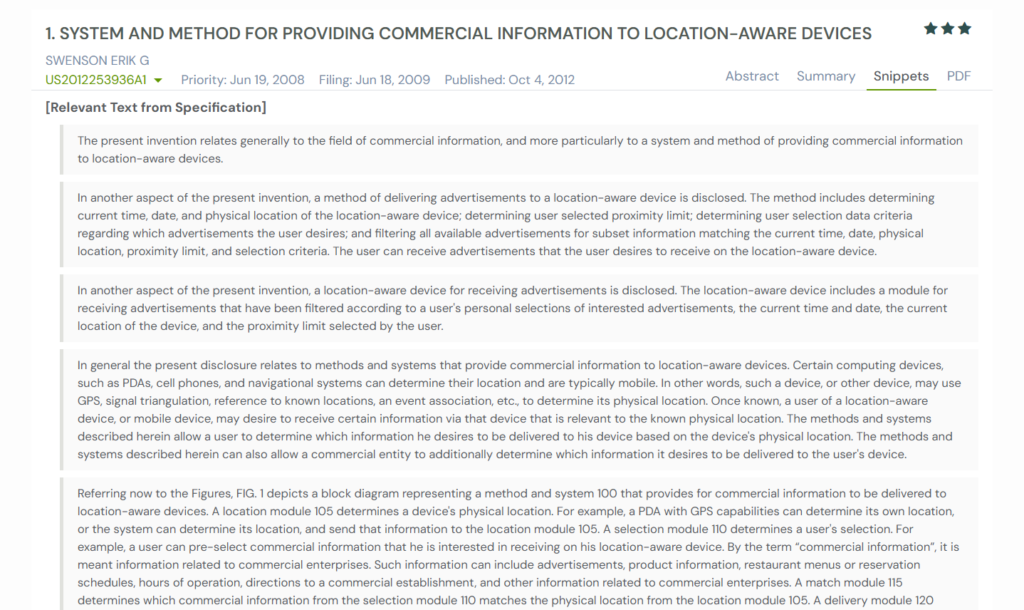
1. US2012253936A1 – System and Method for Providing Commercial Information to Location-Aware Devices
Imagine walking through a new city and your phone instantly shows you nearby cafés, discounts, or store updates only for the places you actually care about. That is the problem patent application US2012253936A1 tried to solve back in 2012. It introduced a smart system that filtered ads and commercial information based on your real-time location, personal preferences, and even the time of day.
Instead of sending random ads to everyone, it gave users control, letting them choose what kind of offers they wanted and within what distance. The result was a more personalized and less intrusive way to connect businesses with potential customers.
The idea connects closely with US8977247B2, but with a key difference. While this patent focused on user-driven filtering, US8977247B2 added sponsor-based exclusivity by assigning specific geographic areas to particular advertisers.
The Bigger Picture
The patent marked an early shift from mass advertising to location-personalized engagement. It laid the groundwork for US8977247B2, which took the concept further by making location-based delivery more structured and commercially exclusive.
A closely related case involving intent-driven search and content selection is HyperQuery LLC’s litigation around US9529918B2. Our article breaks down how search queries, user intent, and dynamic app recommendations have become central issues in more than a dozen ongoing lawsuits.
2. US9615347B1 – Location Positioning Engine System and Method
Did this ever happen to you: you were walking into a shopping mall and your phone instantly gets a message from a nearby store offering a discount. You did not search about this before, but it appeared as you stepped inside their zone. That is what US patent 9615347B1, granted in 2017, made possible. It introduced a smart system that uses indoor positioning signals such as beacons and wireless networks to pinpoint a customer’s exact location within a store or premises.
Once the system knows where you are, it delivers content, offers, or messages mapped to that specific spot. Merchants can even draw content bubbles, meaning digital zones that trigger promotions when someone walks through them. It was an early and impressive step toward hyper-local, behavior-aware marketing.
The Bigger Picture
US9615347B1 built the bridge between digital advertising and real-world location signals. It inspired systems like US8977247B2 that turned location targeting into exclusive, sponsor-based experiences.
Recommended Read: The evolution of targeted engagement extends beyond geography. US8246454B2 reimagined television ads as interactive experiences, a step toward the participatory ad models driving today’s location-aware systems. Explore our patent audit of US8246454B2 here.
3. US2008195457A1 – Methods and Computer Readable Media for Location Based Targeted Advertising
In 2008, BellSouth envisioned mobile advertising that could think on its feet. Their patent application described a system that analyzed a user’s live location, local time, and situational context to trigger highly relevant offers the moment opportunity struck.
By combining GPS or cell signal data with user profiles, the platform sent out highly relevant promotions in real time. Advertisers could set filters like demographics, interests, or even time of day to control who received their messages. The system made advertising feel timely and contextual rather than random or spammy.
The patent connects closely with US8977247B2. While BellSouth’s system used user profiles and proximity to deliver tailored ads, US8977247B2 expanded the concept by giving specific sponsors exclusive access to defined geographic zones.
The Bigger Picture
US2008195457A1 helped move digital marketing from broad targeting to precise, location aware engagement. It showed how relevance and timing could turn simple mobile ads into meaningful, action-driven experiences that US8977247B2 later transformed into exclusive, sponsor-controlled delivery.
For another example of how location data is used to tailor what users see online, you may want to explore our coverage of US8078498B2, which breaks down how e-commerce platforms display store information and product availability based on a user’s location.
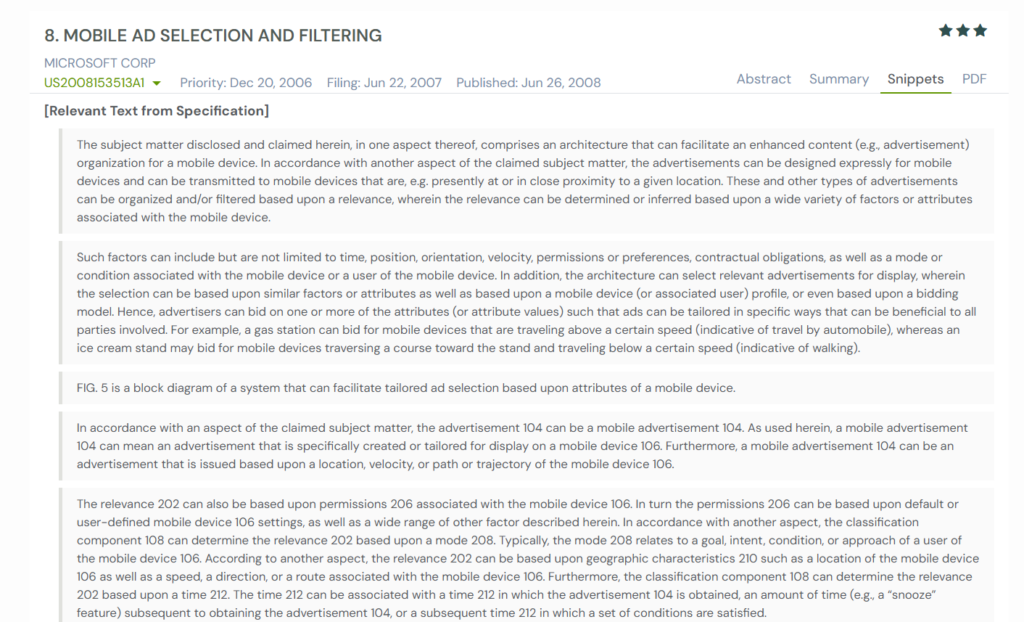
4. US2008153513A1 – Mobile Ad Selection and Filtering
As mobile networks grew denser, relevance became the real challenge. Microsoft’s 2008 patent tackled this by introducing a framework that filtered and selected ads using specific criteria.
For instance, instead of sending generic promotions, it filtered and selected ads based on details like where the user was, how fast they were moving, the time of day, and their preferences. Advertisers could even bid to reach specific users.
The patent also prioritized privacy. The targeting happened without sharing personal data with advertisers, keeping users in control while still ensuring precision marketing.
This approach ties directly to US8977247B2, which built upon the same idea but introduced exclusivity, allowing sponsors to own specific geographic zones for delivering their content.
The Bigger Picture
US2008153513A1 turned location-based ads into something personal and purposeful. It showed how smart filtering could make marketing feel helpful, not intrusive.
A closely related innovation is Fall Line’s US9454748B2, which also uses location-aware logic to tailor digital experiences. Our analysis highlights how GPS-linked data collection and personalized content have become central in ongoing patent disputes.
5. JP2011511342A – Personalized Location Based Advertising
In 2011, Sony imagined a world where your phone wouldn’t just know where you are, it would know what you care about.
The japanese patent focused on combining two things that changed mobile marketing forever: user profiles and real time location data. Instead of just showing ads based on where someone was, the system filtered them twice. First by who the user was, and then by where they were. This meant users saw only the most relevant ads, tailored to their preferences and immediate surroundings.
It used GPS and mobile networks to identify precise coordinates and then searched an ad database to match offers that aligned with the user’s habits, interests, and location. The result was advertising that felt useful, not intrusive.
The Bigger Picture
JP2011511342A marked a major step toward human-centered advertising. By merging personalization with geography, it set the stage for future systems like US8977247B2 that transformed location awareness into an exclusive, data driven engagement model.
Location plays a critical role in relevance, an idea that also appears in US9639608B2 , which focuses on delivering recommendations and promotions based on a user’s physical context.
Recommended Read: The precision behind every geo-fenced ad starts with GPS. Our deep dive into its invention uncovers the scientists, patents, and breakthroughs that made location-aware marketing possible. Explore the story of GPS here.
A Side-by-Side Look at the Patents That Built Location-Aware Advertising
A quick look at related patents shows how different inventors approached location-based advertising before US8977247B2.
| Patent No. | Title | Key Focus | Core Mechanism | Connection with Subject Patent (US8977247B2) |
| US2012253936A1 | System and Method for Providing Commercial Information to Location-Aware Devices | Delivering commercial information or ads to users based on time, date, location, and preferences. | Filters ads using user-selected proximity and preference criteria, ensuring only relevant promotions are shown. | Introduced the concept of time and proximity-based ad delivery that later evolved into exclusive zone targeting in US8977247B2. |
| US9615347B1 | Location Positioning Engine System and Method | Determining precise handset location and delivering content within defined boundaries. | Uses geofencing within merchant premises and personal profiles to deliver context-specific ads. | Influenced zone-based delivery models in US8977247B2 by defining ad boundaries linked to user movement and merchant areas. |
| US2008195457A1 | Methods and Computer-Readable Media for Location-Based Targeted Advertising | Targeted advertising using location, time, and subscriber profiles. | Matches advertisements dynamically based on GPS data, subscriber behavior, and advertiser rules. | Strengthened the real-time personalization approach that US8977247B2 built upon for sponsor-controlled regions. |
| US2008153513A1 | Mobile Ad Selection and Filtering | Intelligent ad filtering for mobile devices. | Uses user profiles, speed, and direction to select or filter ads for higher relevance and privacy. | Inspired the selective sponsorship approach in US8977247B2, focusing on precision and privacy in mobile ad delivery. |
| JP2011511342A | Personalized Location Based Advertising | Personalized mobile ads combining user data and GPS signals. | Performs two-step filtering based on profile data and real-time location to deliver highly relevant ads. | Provided the foundation for user-personalized, geography-specific engagement models perfected by US8977247B2. |
Mapping the Bigger Picture with Global Patent Search Tool
Every patent tells part of a story, but only when you see how it connects to others does the full picture emerge.
That’s where the Global Patent Search tool comes in. It helps trace the evolution of an idea, showing how one innovation inspires the next across industries and timelines.
Here’s how GPS makes that discovery easier:
- Start from any patent: Type in a number like US8977247B2 or describe it briefly, and GPS instantly finds related inventions dealing with location-based services, advertising, or mapping systems.
- Spot meaningful links: You’ll see concise snippets from claims and abstracts that reveal how different inventors tackled similar challenges.
- Explore deeper layers: Open the full documents to understand design shifts, new use cases, or even how older ideas got repurposed in newer tech.
- Connect industries: GPS often uncovers overlaps between unexpected domains like advertising, retail analytics, and navigation. You can check them out to understand how technology evolved or use the sort by relevance feature to find more patents related to the domain and idea you are keen on discovering.
By turning scattered patents into connected insights, GPS helps researchers and analysts follow how ideas travel, from concept to courtroom, and beyond.