Think about how natural cross-device ads feel today. You look up something on your phone and, a little later, your smart TV quietly serves an ad that reflects the same interest. It feels smooth, almost expected, but this kind of connected experience didn’t happen by accident.
US8677398B2 is one of the early patents that made this shift possible. Instead of treating each device in your home as a separate universe, it created a way for them to talk to each other through the shared network. A search on your phone could become a signal that shapes what appears on your TV, set-top box, or any other connected screen.
On paper, it looks like a straightforward technical flow. In practice, it underpins patterns that many large ad-tech and social platforms now depend on. That’s also why it appears in infringement suits involving companies such as TikTok, Meta, Lotame, and Amazon.
To understand why this single patent is drawing so much attention, we used Global Patent Search (GPS) to trace earlier related ideas and the ripple effects this concept created across the ad-tech ecosystem. Before we dive in, let’s understand this patent in more detail.
Understanding Patent US8677398B2
US8677398B2 is built around a simple but powerful idea i.e. your devices shouldn’t act like strangers. If you do something on one screen, another screen on the same network should be able to pick up that activity and respond in a relevant way.
The US patent US8677398B2 describes a setup where your actions on one device such as a phone tap, a page view, a search, or any interaction, are captured and turned into meaningful signals.
These signals help the system understand what happened, who it relates to, and what to do with that information. From there, the insight is passed to another device that can react based on the user’s intent or behaviour.
It’s essentially a blueprint for creating a connected ecosystem, where devices coordinate with each other instead of acting like separate islands. That’s the part that eventually influenced modern advertising, cross-device personalization, and multi-screen experiences we take for granted today.
Key Features of US8677398B2
US8677398B2 breaks the whole cross-device idea into a simple, organized flow. Here’s what it focuses on:
1. Noticing user activity on one device: The system pays attention to what the user is doing, including clicks, views, or any interaction that matters.
2. Linking behaviour to the right user for accurate ad matching: It doesn’t just collect events. It connects them to the right user or session so responses stay accurate.
3. Passing that information to another device: Once the system knows what happened, it shares the relevant details with another device on the same network.
4. Triggering personalized content or ads on the second device: That second device uses the shared information to update, recommend, or act in a way that matches the user’s behaviour.
5. Making the whole experience feel connected: The ultimate goal is to create a smooth flow between devices, the kind where users move across screens without losing context.
When you put it all together, US8677398B2 isn’t just describing a feature. It’s outlining the foundation of the cross-device world we now live in.
The push toward relevance wasn’t limited to cross-device triggers. Location-aware systems were evolving in parallel, as seen in innovations like US8977247B2 on location-based advertising, where physical context shaped what appeared on a user’s screen.
Five Similar Patents Worth Noticing
Once you understand what US8677398B2 tries to solve, the next step is to see what else exists around it. Cross-device behaviour didn’t grow from a single idea. It took several inventions, each adding its own twist.
Using the Global Patent Search tool, we gave the patent number as input. The tool gave us patent references that follow a similar theme to the subject patent.
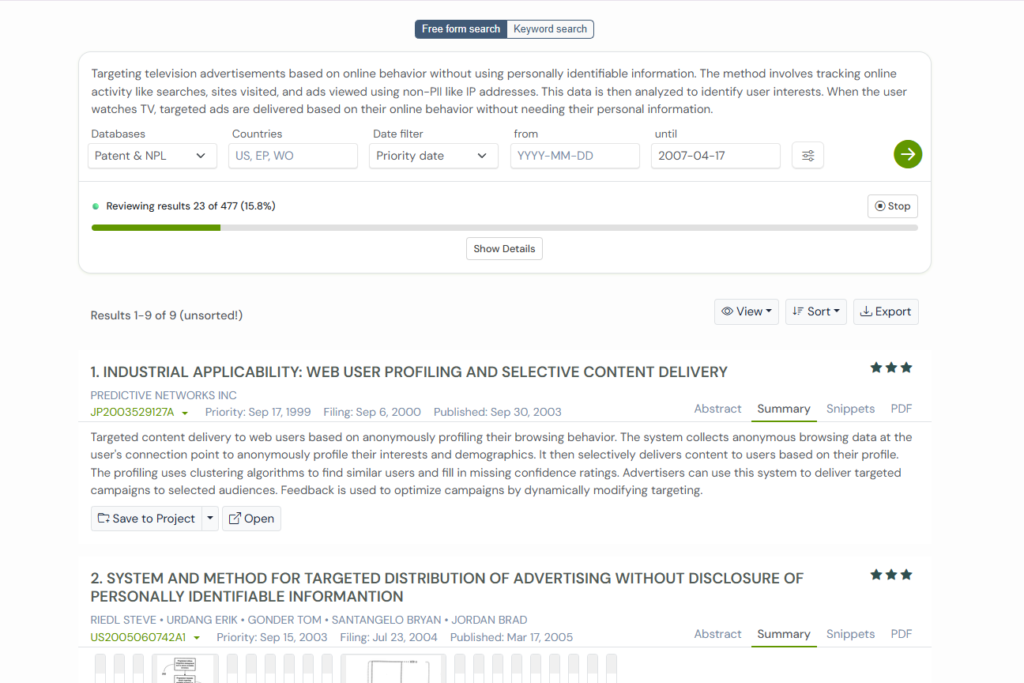
Let’s explore some of the findings.
1. US2006212353A1 – Targeted Advertising System and Method
Filed in 2006 by 121 MEDIA Inc., US2006212353A1 takes a deep look at how advertising can become more relevant without disrupting the user. Instead of placing generic ads, it studies what a user is browsing in real time.
Every page carries signals like keywords, metadata, URL patterns, and the system collects these quietly at the ISP level as traffic flows through the network.
The core idea is simple: understand what the user is doing, send that information to an ad server, and return an ad that actually fits the context. A built-in context reader analyses browsing patterns, while a matching engine selects the right ad based on categories, rules, and advertiser goals. All of this happens without requiring the user to install anything or change their behaviour.
US2006212353A1 connects to US8677398B2 through the way both patents treat live user activity as a meaningful signal. US8677398B2 uses that signal to trigger actions across devices. This patent uses it to refine what appears on the same device. In both cases, the system observes behaviour, interprets it, and turns it into a personalised response.
Why It Matters in the Larger Context
The patent marks an important stage in how digital systems started treating user behaviour as a live signal.
Before cross-device coordination existed, ad tech relied heavily on page-level cues and ISP-level insight to personalise what a user saw. The patent shows that early push toward real-time adaptation, i.e., systems reacting the moment a user does something.
This kind of real-time context shaping also appears in US9130900B2, where assistants adapt instantly to what the user is doing.
2. US2008028066A1 – System and Method for Population-Targeted Advertising
Filed by Yahoo in 2006, the patent explores a different angle of targeted advertising. Instead of focusing on what a single user is doing at the moment, it studies the entire crowd visiting a webpage.
The idea is simple: every site attracts a certain mix of people, and that mix can be used to predict what kind of ad a visitor is most likely to respond to. This is possible even if the system doesn’t know anything about that specific person.
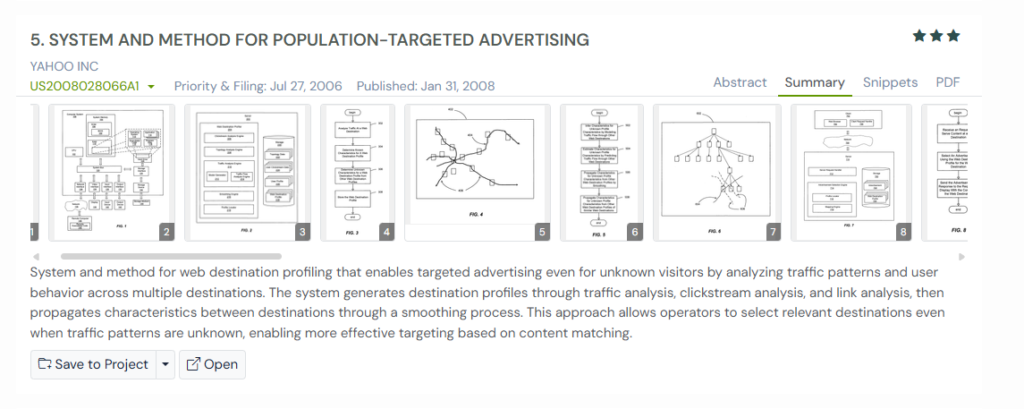
To make this work, the system builds what it calls a web destination profile. It looks at who typically visits a page or a site, the interests they tend to share, and how different groups behave.
Some of this information comes from clickstream data, some from user profiles, and some from patterns learned through machine learning. Once the system understands the page’s usual audience, it picks ads that fit that population rather than trying to guess the details of one unknown visitor.
This ties back to US8677398B2 through the way both patents rely on observed behaviour to drive a personalised response. US8677398B2 uses real-time activity to trigger actions across devices, while this Yahoo patent uses group-level patterns to shape what a user sees on a single device.
Both are built on the belief that behaviour, whether individual or collective, can be turned into smarter, more relevant experiences.
Why This Patent Matters in the Larger Ecosystem
It shows how early ad-tech moved from guessing user interests to analysing real behaviour at scale. That shift laid the groundwork for modern systems that blend individual signals, population patterns, and cross-device activity to create seamless, personalised engagement.
You’ll see similar themes in our audit of US9549285B2, where wireless content delivery and mobile-side control are central to making display systems work smoothly even when devices don’t share a common network.
3. US20090006210A1 – Advertisement Providing System and Method
US20090006210A1 was filed in 2007 and looks at how advertising can adjust to what a user is interested in at that very moment.
Instead of sticking to old, static profile data, it introduces a system that updates user preferences in real time by watching what they read or interact with across email, blogs, messengers, and other online services.
As two people exchange data, the system identifies what each person seems most interested in and inserts an ad that reflects those interests instantly.

To make this possible, US20090006210A1 uses a pair of constantly updated databases, one for user preferences and one for available ads. It studies the user’s recent browsing history, identifies which topics are gaining attention, and pulls an ad that aligns with those shifting behaviours.
Everything happens quietly in the background, so the ad a user sees matches their current mindset, not their old habits.
US20090006210A1 overlaps with US8677398B2 because both inventions rely on immediate behavioural signals. While US8677398B2 uses those signals to sync actions across devices, US20090006210A1 uses them to refresh preference data and choose the next best ad.
Each one turns live user activity into a personalised response, just in different ways.
Why US20090006210A1 Matters in the Larger Ecosystem
US20090006210A1 captures the shift from fixed, registration-based advertising to systems that move with the user. This real-time, behaviour-driven approach became a major building block for modern personalised and cross-device ad experiences.
Secure interaction between handheld devices and external systems shows up in many disputes as well, especially in patents focused on web-based user access control. One example is the infringement suit around US10114905B2, where customizable authorization scheme is at the center of multiple cases.
4. US20050038698A1 – Targeted Advertisement with Local Consumer Profile
US20050038698A1 came in 2003 with an interesting twist: instead of building giant ad databases, why not let each user’s computer build its own profile?
The invention logs what a user does on their machine, like the sites they browse, the searches they run, the apps they open, and even how long they stay on certain pages. All of this activity is stored locally and turned into a consumer profile that lives right on the device.
To make this work, US20050038698A1 uses a set of instructions inside the computer’s storage. These instructions organise browsing and usage data, update the profile over time, and compare incoming ads to the user’s behaviour.
An ad is shown only when its target profile aligns with what the user has actually been doing. Because the matching is done locally, the user keeps full control, they can edit or delete information from their profile, and no external server has access to their activity unless they choose to reveal it.
US20050038698A1 connects with US8677398B2 through its reliance on real, observable behaviour. US8677398B2 uses those behavioural signals to coordinate actions across devices, while US20050038698A1 uses them to decide which ads deserve to appear on a single device.
Both systems turn live activity into meaningful context, just applied in different ways.
Why US20050038698A1 Matters in the Larger Ecosystem
US20050038698A1 highlights an early attempt to personalise advertising without sacrificing user privacy. By keeping the intelligence on the device, it showed that targeting didn’t always require big data collection.
If you’re interested in another personalization-focused patent currently in litigation, our deep dive into Fall Line’s US9454748B2 shows how dynamic website customization based on user behavior is becoming a major legal battleground.
5. US2002029267A1 – Target Information Generation and Ad Server
US2002029267A1, filed in 2001, focuses on building richer, more complete user profiles by observing how people move across different websites and online services. Instead of relying on one site’s limited view of a user, the invention gathers behaviour from cobrand environments. By capturing activity at that intermediary layer, the system can see a much broader picture of a user’s interests.
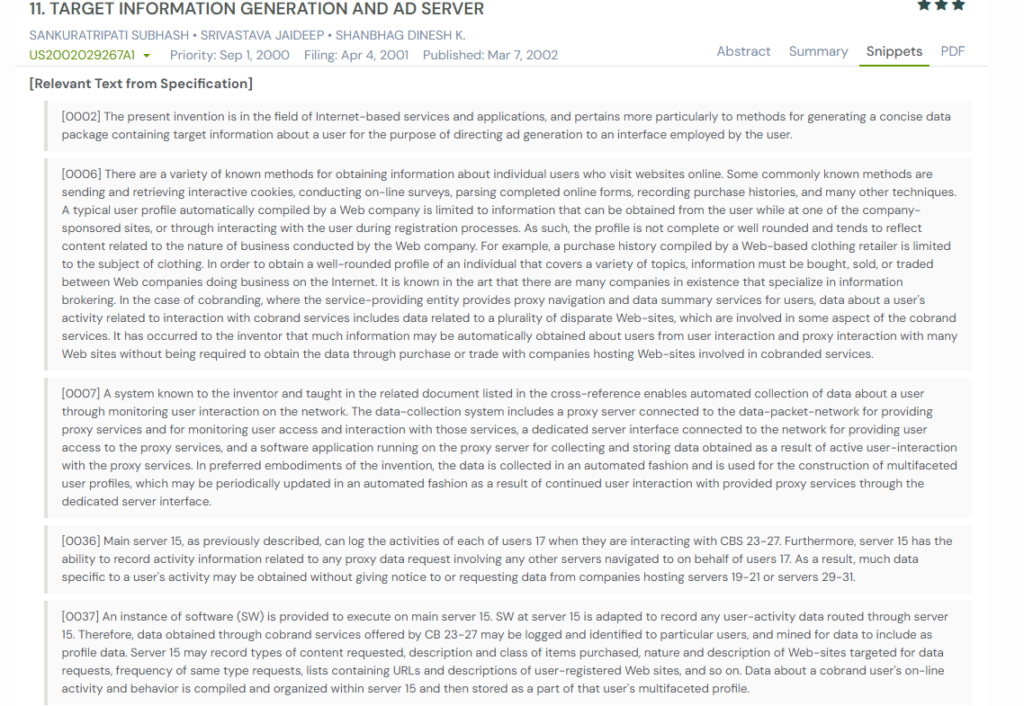
US2002029267A1 uses a proxy server that logs interactions across many sites, collects data like pages viewed, purchases made, categories browsed, time spent on content, and even repeat patterns.
All this information is automatically organised into a multifaceted profile that updates itself over time. The system can then condense that rich profile into a small, targeted data package, essentially a summary of what the user cares about, and use it to serve more relevant ads.
US2002029267A1 connects to US8677398B2 through its use of behavioural signals as triggers. US8677398B2 focuses on using activity to coordinate responses across devices, while US2002029267A1 uses the same idea to build a more complete, constantly evolving profile of a single user across multiple sites. Both rely on tracking real actions rather than static registration information, and both turn those actions into meaningful output.
Why US2002029267A1 Matters in the Larger Ecosystem
US2002029267A1 reflects an important shift. Instead of relying on isolated data from one website, it aggregates behaviour from many touchpoints to create a deeper understanding of the user. That evolution toward richer, cross-context profiles helped pave the way for modern systems that blend signals across platforms, devices, and sessions.
Side-by-Side Look at the Patents
Now that we’ve walked through each patent, it helps to see how they line up next to the subject patent and next to one another.
A simple side-by-side view makes the differences clearerwhat each patent observes, how it uses that information, and how closely it aligns with the core idea behind US8677398B2. Let’s take a look.
| Patent | Core Focus | Overlap with US8677398B2 | Key Contribution |
| US2006212353A1 – Targeted Advertising System & Method | Uses real-time browsing signals (keywords, metadata, URLs) collected at the ISP level to deliver context-specific ads. | Both rely on immediate user behaviour. This patent uses it to choose ads; US8677398B2 uses it to trigger coordinated actions across devices. | Introduced one of the earlier systems that treated browsing behaviour as a live signal rather than a static profile input. |
| US2008028066A1 – Population-Targeted Advertising | Builds a web destination profile using crowd behaviour to determine which ads fit the typical audience of a page. | Both convert behavioural data into personalised actions. Here it’s at the population level; US8677398B2 applies it at the individual action level. | Helped shift ad-tech from guesswork to statistical modelling based on group behaviour and clickstream patterns. |
| US20090006210A1 – Advertisement Providing System & Method | Updates user preferences in real time by analysing what the user is interacting with across emails, blogs, and other services. | Both depend on live behavioural updates. This one refreshes preference data instantly; US8677398B2 uses real-time signals to coordinate multi-device responses. | Showed the evolution from registration-based ads to systems that adapt dynamically to shifting user interests. |
| US20050038698A1 – Targeted Advertisement with Local Consumer Profile | Builds a private, device-side consumer profile using the user’s browsing, search, and app usage data. | Both transform real actions into meaningful context. Here it’s used locally for ad matching; US8677398B2 applies those signals across devices. | Early demonstration that personalisation didn’t require centralised data collection, privacy-centric targeting. |
| US2002029267A1 – Target Information Generation & Ad Server | Gathers and organises behaviour across many sites (via proxy services) to create rich, multifaceted user profiles. | Both rely on behaviour rather than static data. This patent uses cross-site patterns; US8677398B2 uses cross-device activity. | Advanced the idea of holistic profiling by blending interactions from multiple web environments, not just one. |
Seeing these five patents together helps explain why US8677398B2 is now part of multiple active infringement suits, including recent filings like AlmondNet Inc. v. Criteo Corp. and AlmondNet Inc. et al. v. Mediaocean LLC et al..
Earlier inventions captured behaviour in different ways, but none handled real-time, cross-device coordination the way US8677398B2 does. That difference and the overlap in behavioural signals, is exactly what the courts are examining.
By mapping similar patents, GPS makes it easier to understand what came before, what may overlap, and why this patent is at the centre of today’s disputes.
How the Global Patent Search Tool Connects the Dots
Every patent reveals a small part of how personalised digital systems came to life. But the full picture appears only when you connect those ideas.
That’s where the Global Patent Search tool becomes useful. It helps show how early attempts at contextual ads, population modelling, proxy-based profiling, and local device intelligence gradually evolved into the real-time cross-device systems described in US8677398B2.
Here’s how GPS helps you explore that journey:
- Start with one idea: Enter a patent number like US8677398B2 or describe a concept you’re searching around, for eg. real-time behaviour-based coordination. GPS instantly surfaces similar inventions, from ISP-level tracking systems to machine-learning-driven audience models.
- Follow the chain of progress: Most results includes relevant snippets showing how an older patent overlaps with the newer one. It could be live browsing signals, user-profile updates, or cross-site behavioural capture.
- See evolution in action: With the tool, you can move across years of innovation and watch how targeted ads, profile generation, and multi-device triggers slowly merged into one connected ecosystem.
- Discover cross-industry links: Sorting by relevance surfaces patents more to your interest. It could be from adjacent domains like data analytics, mobile sync, device-level privacy systems, all of which shaped the overall shift toward real-time personalisation. You can learn more about the feature here.
By bringing these insights together, the Global Patent Search tool turns scattered technical details into a clear timeline of how modern behaviour-driven systems evolved.
If you’d like to explore the tech landscape and find how earlier patents shaped an invention, try the GPS tool yourself!
Disclaimer: The information provided in this article is for informational purposes only and should not be considered legal advice. The related patent references mentioned are preliminary results from the Global Patent Search (GPS) tool and do not guarantee legal significance. For a comprehensive related patent analysis, we recommend conducting a detailed search using GPS or consulting a patent attorney.
Frequently Asked Questions
1. What makes real-time personalisation different from traditional targeting?
Traditional targeting relied on static profiles or registration information. Real-time personalisation adapts instantly, using what the user is doing right now to shape the content or response.
2. How do behaviour-driven systems understand what a user is interested in?
Behaviour-driven systems observe signals like browsing activity, clicks, app usage, search terms, or time spent on different pages. These patterns help the system guess what the user might want or what context they’re currently in.
3. How do behaviour-driven systems protect user privacy?
Privacy depends on the implementation. Some systems store data locally, others anonymise or encrypt it, and few only use short-lived identifiers instead of permanent tracking IDs.