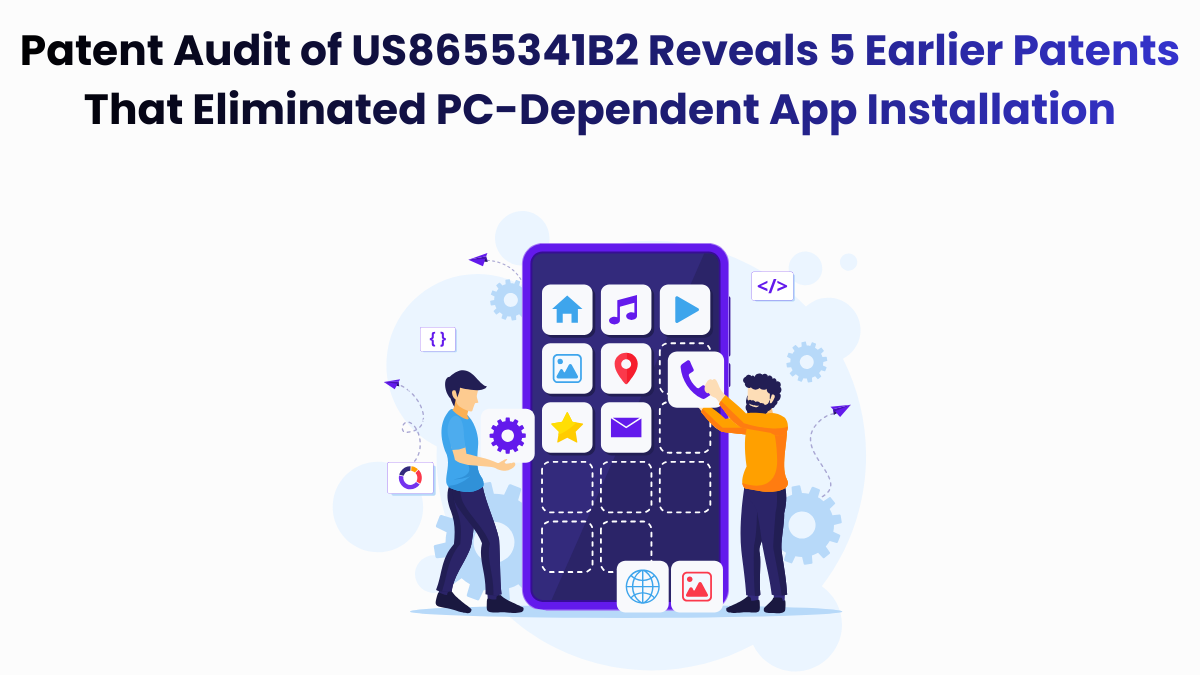
Years ago, installing a mobile app wasn’t the one-tap experience we’re used to today. Back then, every phone model behaved differently. Something as simple as sharing an app with a friend could turn into a headache.
Different devices supported different formats, network speeds varied a lot, and many phones had limited storage or inconsistent Java support.
US8655341B2 was created for that world. Instead of forcing users through complicated steps, it turns the phone itself into the center of everything. You can invite friends directly from your contact list, download the right version automatically, open an account, make payments, and use the service without ever touching a PC. The phone becomes the whole ecosystem.
The patent is also part of an active case in the Western District of Texas, so to understand how this idea evolved, we used the Global Patent Search (GPS) tool to trace earlier inventions that worked toward easier app distribution and mobile-only onboarding.
But first, let’s clearly understand what US8655341B2 enabled.
Understanding Patent US8655341B2
US8655341B2, filed in 2009, is built around a straightforward idea: if people already have a mobile phone with internet access, that phone should be able to do everything on its own.
The patent focuses on giving users a way to install an app, invite others, manage their account, and access services directly from the device they carry every day.
At the heart of the invention is a simple flow. The app looks at the user’s contact list, identifies friends who aren’t using the service yet, and sends them an invitation automatically. When someone accepts, the system figures out the correct version for their phone and delivers it instantly. Behind the scenes, the server handles account creation, payments, authentication, and even call routing.
The result is a fully mobile experience where the phone becomes both the starting point and the distribution engine.
Key Features of US8655341B2
US8655341B2 patent turns a scattered, device-dependent world of mobile apps into one simple, connected flow. Here are the key features of this patent:
- The app reads part of the user’s contact list and helps send installation invites, creating a built-in viral distribution loop.
- When someone accepts an invite, the server detects their device type automatically and sends the correct app version.
- The mobile app works like a light remote terminal, sending encrypted requests while the server handles the heavy processing.
- The system is designed to use Java commands that work across most phones, reducing the need for multiple device-specific versions.
- Each new user’s app repeats the invitation cycle, allowing the application to spread smoothly from phone to phone.
All these pieces combine into a system where the user never has to leave their phone to join, explore, or share the service.
A similar direction appears in US9965237B2, which describes real-time communication between handheld devices and multimedia screens. Users can select on-screen items using a profile-based cursor and get supplemental data on their phone.
Five Similar Patents Worth Noticing
Once you understand what US8655341B2 is trying to solve, the next natural step is to look at ideas that came before or moved in a similar direction. Mobile app distribution wasn’t a breakthrough of its own. It grew through many small innovations around sharing, onboarding, device compatibility, and user-driven growth.
Using the Global Patent Search tool, we wanted to surface earlier patents that touched on the same theme. Each one tackles a part of the problem that US8655341B2 later brings together in one unified flow.

Let’s explore some of them.
1. US2003147369A1
Filed in 2002, US2003147369A1 looks at a problem that was very common in the early mobile era: installing an app on a portable device wasn’t very easy. Most users still had to download the app to a PC, connect their device with a cable, and run a manual sync.
For anyone without a computer, the process simply stopped there. Wireless installation existed in theory, but slow bandwidth and unstable connections made it unreliable in practice.

This invention introduces a cleaner, server-driven approach. The device begins with a simple handshake, shares basic details about its model and current state, and the server responds with the right packet size and the right version of the app.
Even the list of installable applications is generated intelligently based on memory, battery, and what’s already present on the device. Behind the scenes, vendors and service providers can upload new applications directly to the server, making wireless distribution more flexible.
US2003147369A1 connects to US8655341B2 through their shared goal of removing PC dependency. While our subject patent focuses on viral growth through contact lists and full mobile onboarding, this earlier invention tackles seamless wireless delivery and device-aware installation.
Why It Matters in the Larger Ecosystem
This patent marks an important turning point in treating mobile phones as capable, independent clients rather than accessories tethered to a PC.
Its focus on automatic version detection, stable wireless transfers, and server-side intelligence helped establish the foundation for modern over-the-air app installs.
2. CA2387328A1
Published in 2003, CA2387328A1 looks at a common limitation of early mobile devices. Applications on a phone were usually fixed, and updating them meant reinstalling software or downloading new files. This invention shifts more control to the server so the device can stay updated without frequent manual installs.
Instead of storing everything on the handset, the phone requests a dynamic list of applications from a remote server. The server builds the menu in real time, and the device interacts with applications hosted across different servers.
A small virtual machine on the SIM executes commands sent from the server, which allows new apps, alerts, or actions to appear on the phone without replacing the existing software.
CA2387328A1 aligns with US8655341B2 by reducing the effort required to install or update applications. This earlier patent shows how remote application control can keep devices updated with minimal friction.
Why It Matters in the Larger Ecosystem
The patent hints at a future where phones rely on server intelligence rather than constant local updates. This idea supports the kind of seamless, mobile-first distribution model described in US8655341B2.
If you’re interested in cross-platform compatibility, US7774762B2 explains how legacy software can run on modern systems using a capsule system that mimics the original environment without rewriting code.
3. US6665867B1
Published in 2003, US6665867B1 addresses a common challenge in distributed systems. Software often needed to be manually installed on every device that wanted to use it, and updates required repeating the same steps again.
For large networks, this created constant maintenance work and left many devices running outdated code.

This patent introduces a way for software to move through a network on its own. When a device needs a certain feature or processing capability, the required code can be fetched automatically from a known source and installed without the user doing anything.
Instead of relying on static applets restricted by the Java sandbox, the system sends both data and the code needed to process that data as a single package. If a device does not already have the necessary resources, it retrieves them using the provided links and updates itself on the spot.
US6665867B1 aligns with US8655341B2 in its push toward reducing manual installation work. While the subject patent focuses on viral sharing and mobile-only onboarding, this invention focuses on automatic code delivery across devices, ensuring every component can update itself when needed.
Why It Matters in the Larger Ecosystem
The patent represents a step toward software that distributes and maintains itself. This idea eventually shaped modern concepts like auto-updates, cloud-delivered app components, and lightweight clients that fetch code only when required.
For another example of mobile systems performing heavy lifting behind the scenes, US10032156B2 describes a SIM-based framework that authenticates users and securely routes financial transactions through a central operator.
4. US2007004391A1
Filed in 2005, US2007004391A1 comes from a time when mobile data networks were growing quickly, but the apps running on them didn’t have a reliable way to communicate with the services they depended on.
Every app seemed to have its own rules, its own server setup, and its own workaround for network limitations. As a result, even simple interactions often felt fragile.
The approach described in this patent rethinks how data should move across a mobile network. Instead of forcing an app to connect directly to every service it needs, the phone sends its messages to a peer server designed to act as a stable middle layer.
That server then handles the connection to the destination system, keeping the mobile side simpler and more consistent. A lightweight protocol keeps both ends speaking the same language, and the system can even wake up an app automatically through SMS, WAP Push, or HTTP when new information arrives.
US2007004391A1 fits into the broader journey toward smoother mobile experiences. While US8655341B2 focuses on how apps spread and install themselves, this patent focuses on making sure those apps can actually talk to the systems behind them without breaking.
Why It Matters in the Larger Ecosystem
The patent strengthened the foundation for dependable mobile services by introducing a structured communication path between devices and backend applications. That reliability made it possible for mobile services to evolve into the always-on, responsive systems we expect today.
5. US2006230104A1
US2006230104A1, filed in 2006, looks at a challenge that many early mobile services struggled with. Users wanted quick access to apps, digital rewards, and mobile content, but the experience often required constant network connectivity.
Whenever the signal dropped or the server was slow, even simple features stopped working. For loyalty programs, mobile coupons, or lightweight apps, this created real friction.

The patent offers a different approach. Instead of asking the phone to rely on the server for every action, the server sends a predefined server configuration to the client. Once received, the phone can run much of the application on its own.
It can simulate server functions, display the full interface, and handle user actions even without a live connection. The configuration can be refreshed or replaced during runtime, so the device stays updated without waiting for a full reinstall.
US2006230104A1 contributes an important idea to the larger story around US8655341B2. Where the subject patent focuses on spreading mobile applications easily, this one focuses on letting those applications continue working smoothly, even when the network environment is unstable or offline.
Why It Matters in the Larger Ecosystem
By shifting part of the server logic onto the device, the patent made it possible for mobile apps to stay responsive and functional with limited bandwidth or temporary disconnections.
If you’re tracking how wireless systems optimize performance, EP3016464B1 shows how small cells adapt measurement patterns so devices can detect signals more efficiently in dense network environments.
How These Patents Stack Up Against US8655341B2
To see the bigger picture, it helps to place all the related patents side by side. Each one solves a different part of the mobile-app problem, whether it’s installation, wireless delivery, offline capability, or communication reliability. Looking at them together makes US8655341B2’s contribution much clearer.
Here’s a quick overview of how the ideas compare.
| Patent | Core Focus | Connection to US8655341B2 | Key Contribution |
| US2003147369A1 | Stable wireless delivery of applications without relying on PC syncing. | Both aim to remove PC dependency and automate version handling for users. | Introduced server-side intelligence for device detection, packet sizing, and clean wireless installation. |
| CA2387328A1 | Dynamic menus and remote application control through a virtual machine on the device. | Shares the goal of reducing friction in updating and accessing applications. | Showed how devices could stay updated through server-driven logic instead of reinstalling apps. |
| US6665867B1 | Automatic distribution of code and data across networks. | Similar focus on simplifying deployment across many devices with minimal user effort. | Proposed software that updates and propagates itself where needed, reducing manual maintenance. |
| US2007004391A1 | Reliable communication channel between mobile devices and backend systems. | Complements US8655341B2 by enabling smooth app-to-server interactions once the app is installed. | Created a structured routing layer and push-activation model for mobile services. |
| US2006230104A1 | Letting the device simulate server functions for offline or low-connectivity use. | Supports the broader goal of frictionless user experience, even without stable connectivity. | Enabled apps to run independently by loading server configurations onto the device. |
How GPS Helps You Understand Patents Like This
When you look at mobile-app patents individually, each one seems to fix a different problem. One improves installation, another handles updates, and another manages communication. But once you see them side by side, the larger story of how mobile distribution evolved becomes clearer.
Global Patent Search makes that connection easy by pulling the most relevant references into one place so you can study the entire landscape without sorting through long PDFs.

Here is how you can use it effectively:
- Enter the patent number, and GPS instantly finds similar inventions in the same technical space.
- Scan the short snippets to see what each patent is trying to solve.
- Open the full text when you want to compare logic, flows, or implementation details.
- Use the sort by relevance feature to surface patents related to specific themes like viral distribution or wireless installation.
- Follow the chain of earlier ideas to understand how the subject patent builds on previous work.
GPS turns scattered information into a connected view of how mobile-app innovation developed.
If you want a faster, clearer understanding of how an idea grew across earlier work, run it through Global Patent Search and see the entire landscape unfold.
Try the tool today and see how much quicker your research becomes.
Related: Top AI Patent Claim Chart Generator for In-house IP Counsel in 2026
Disclaimer: The information provided in this article is for informational purposes only and should not be considered legal advice. The related patent references mentioned are preliminary results from the Global Patent Search tool and do not guarantee legal significance. For a comprehensive related patent analysis, we recommend conducting a detailed search using GPS or consulting a patent attorney.
Frequently Asked Questions
1. How did wireless installation improve the user experience?
Wireless installation allowed apps to be delivered directly to the device without cables or PC software. It reduced friction and let users install updates or new apps anytime, provided their network connection was stable.
2. What role does the server play in app onboarding and updates?
Servers can detect device type, choose the right app version, manage user accounts, and push updates or configuration files. This removes manual steps and keeps apps consistent across many phone models.
3. Why did older mobile systems rely heavily on push mechanisms like SMS or WAP Push?
Push channels allowed the network to wake an app or deliver new data even when the app was not running. This was essential for messaging, alerts, and background updates, especially on devices without modern notification systems.