

RFID has become the backbone of modern logistics, but it struggles in the very environments where it’s needed most. When tags are stacked or bundled close together, their antennas often block each other, making it nearly impossible to track large groups of items in real time. From poker chips in casinos to pallets in warehouses, interference has been a persistent weak link.
Patent US7714726B2 introduces a breakthrough: the semi-transparent RFID antenna. Instead of blocking surrounding signals, it lets most radio energy pass through while still harvesting enough to power communication. The result is a tag that continues to work even in dense stacks, enabling reliable bulk reading that traditional RFID designs can’t achieve.
The invention has already become the subject of litigation between NetMomentum LLC and Kyocera Group Global Network, underscoring its importance. But in this article, our focus is on the technology itself.
We will utilize the Global Patent Search (GPS) platform to compare it with similar patents that have reimagined how RFID systems handle interference and bulk reading.
Understanding Patent US7714726B2
US7714726B2 introduces a semi-transparent antenna designed for RFID tags. Unlike traditional antennas that block or distort surrounding signals, this design allows most radio energy to pass through while only collecting a small portion for communication.
The result is that multiple RFID tags can be placed close together, or even stacked, without interfering with each other. This makes it possible to track items like poker chips, documents, or currency in groups rather than one by one.
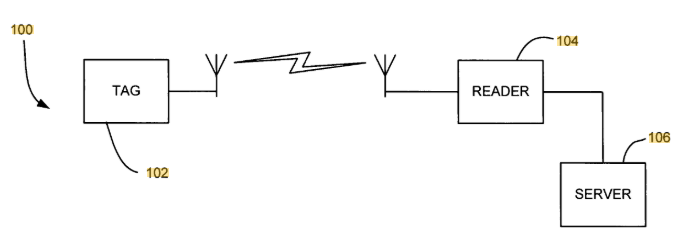
Source: Google Patents
The Key Features Of This Patent Are:
1. Semi-transparent antenna: The antenna lets most RF energy pass through instead of blocking it.
2. High resistivity materials: The antenna is built with sheet resistivity above 1 Ω/sq, often much higher.
3. High impedance design: The device operates with a total impedance greater than about 1000 Ω.
4. Efficient communication in stacks: Tags continue to work even when packed tightly together.
Other features include the use of conducting polymers, conductive pastes, or thin metal films to build antennas, as well as options for both passive and battery-assisted tags. The design also supports non-resonant antennas, backscatter communication, and variations in impedance depending on the thickness of the tagged objects.
Simply put, US7714726B2 provides a way to create RFID tags that work reliably in groups. It makes them especially useful in industries where stacked or bundled items must be tracked efficiently.
If you’re interested in how compact antenna designs compare across RFID systems, take a look at US7724143B2 and similar RFID antenna patents.
Similar Patents To US7714726B2
To explore the antenna design behind US7714726B2, we used the Global Patent Search tool to find similar patents. These references focus on how RFID tags can be read in bulk, especially when stacked together or placed near materials that normally block radio waves. Each takes a different approach to solving the challenge of interference and reliable communication.
1. US2005280512A1
This US patent, US2005280512A1, published in December 2005, introduces RFID tags designed to make it possible to read every carton in a stack, even those in the middle. The patent focuses on solving problems caused by materials like liquids or metals that block or absorb radio signals.
The solution is to equip each tag with two antennas connected by a transmission line. One antenna passes activation energy from the reader down the stack, while the other antenna helps return the tag’s data back up. By working in sequence, the tags create a chain that ensures all cartons in the stack can be detected.
Below are snapshots from the GPS tool showcasing how these patents map to the subject patent.

What This Patent Introduces To The Landscape
- RFID tags with two antennas and a connecting transmission line
- Energy passed from one tag to the next down the stack.
- Tag data returned through the sequence of antennas.
- Antennas positioned on carton edges for closer coupling.
- Batch reading is possible even with liquids or metals inside cartons
How It Connects To US7714726B2
- Both patents tackle the problem of reading stacked RFID tags.
- This patent uses energy propagation between antennas to keep signals alive.
- US7714726B2 uses semi-transparent antennas that let RF energy pass through naturally
- Each approach ensures tags work together instead of blocking one another.
Why This Matters
This patent shows that cartons in a pallet stack can be read without gaps. It highlights one way to overcome interference challenges in supply chains.
Related Read: See how US8587419B2 tackles blind spot detection with embedded sensors, echoing the same reliability challenges that US7714726B2 addresses in RFID systems.
2. ES2366915T3
This Spanish patent, ES2366915T3, published in October 2011, introduces RFID technology designed to read articles in a stack, even when some are hidden or blocked by materials such as liquids or metals. The invention focuses on solving the difficulty of capturing identifiers that are not in direct visual or radio line of sight.
The patent uses a transmission line placed near multiple RFID tags. This line carries both activation energy from the reader and identification signals from the tags. As a result, even tags buried deep in a stack, or those shielded by difficult materials, can be reliably activated and read.
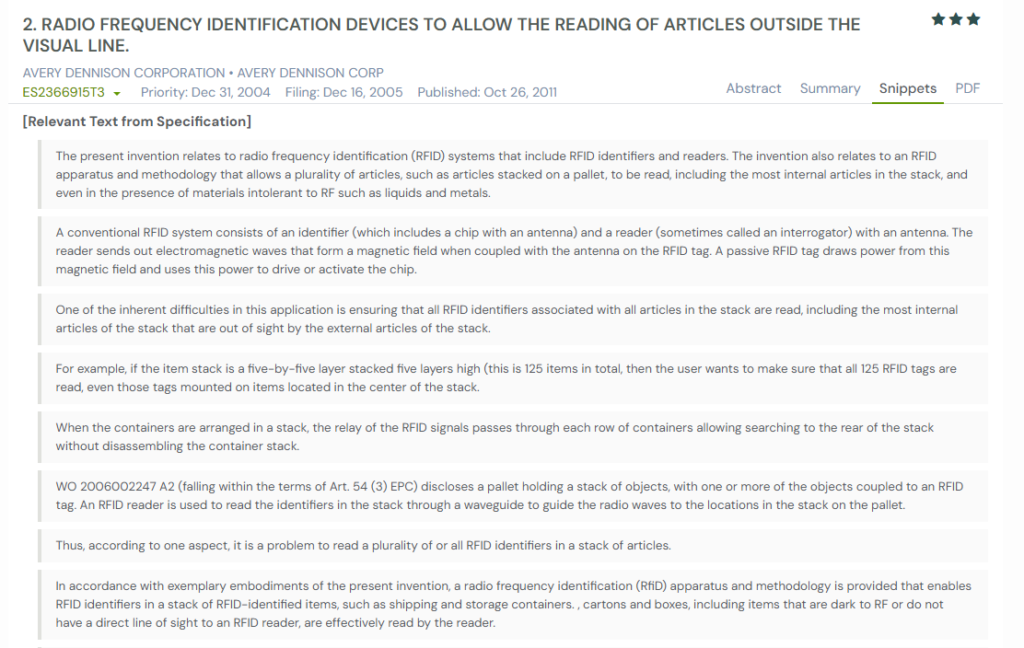
What This Patent Introduces To The Landscape
- Use of transmission lines to relay activation energy through a stack of items
- Ability to read tags without direct optical or RF line of sight
- Inter-article reading devices are inserted between stacks to strengthen coupling.
- Stacking antennas that pass signals from buried tags to the reader
- Amplifiers are added to transmission lines to boost both activation and return signals.
How It Connects To US7714726B2
- Both patents solve the problem of reading stacked RFID tags.
- ES2366915T3 uses transmission lines and amplifiers to carry signals across the stack
- US7714726B2 uses semi-transparent antennas that let RF energy pass naturally
- Each approach ensures hidden or internal tags remain readable in bulk operations.
Why This Matters
This patent highlights how transmission lines and signal boosting make deep or shielded tags visible to readers. It shows another path to achieving reliable RFID tracking in real-world logistics.
3. US7075437B2
This US patent, US7075437B2, published in July 2006, introduces an RFID relay device that helps signals reach tags buried inside stacks of containers. The invention addresses the problem of blocked or weakened signals when tags are placed deep within packaging or surrounded by materials that interfere with radio waves.
The patent proposes containers equipped with multiple antennas connected by transmission lines. One antenna picks up a reader’s signal and relays it through the container to another antenna, which then radiates the signal outward. This chain of antennas allows signals to pass deeper into stacks and ensures that even hidden tags can be reached.
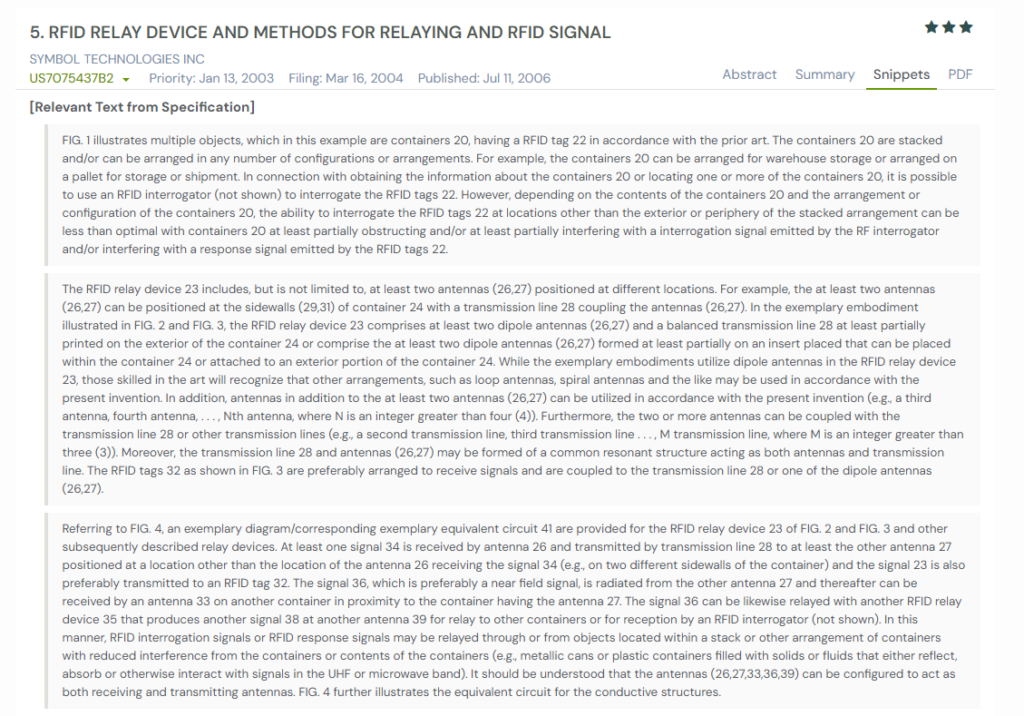
What This Patent Introduces To The Landscape
- RFID relay devices with at least two antennas linked by transmission lines
- Ability to pass signals across different sides of a container
- Relay structures that extend horizontally or vertically to cover stacked packaging
- Symmetrical and overlapping stacking arrangements are supported for better coverage
- Impedance-matching techniques that balance strong and weak signals for deeper reads
How It Connects To US7714726B2
- Both patents focus on improving tag readability in stacked or obstructed settings.
- US7075437B2 uses relay antennas and impedance control to push signals through stacks
- US7714726B2 uses semi-transparent antennas to minimize interference naturally
- Each design ensures tags remain accessible without rearranging containers.
Why This Matters
This patent demonstrates how signal relays and impedance control extend RFID readability. It shows another practical method for improving tag detection in warehouses and shipping.
4. US5936527A
This US patent, US5936527A, published in August 1999, introduces an RFID system designed to locate and track documents, files, and other objects in offices or warehouses. The invention focuses on making it easier to find individual documents among thousands, even when stored in drawers, shelves, or filing cabinets.
The patent uses low-cost RFID tags placed on the edges of documents. Local exciters are installed on shelves or drawers, which relay signals from a central host transceiver. When activated, the exciters send signals to the tags, and the host identifies the location of each tagged document. This setup allows offices to track items automatically without manually searching through files.
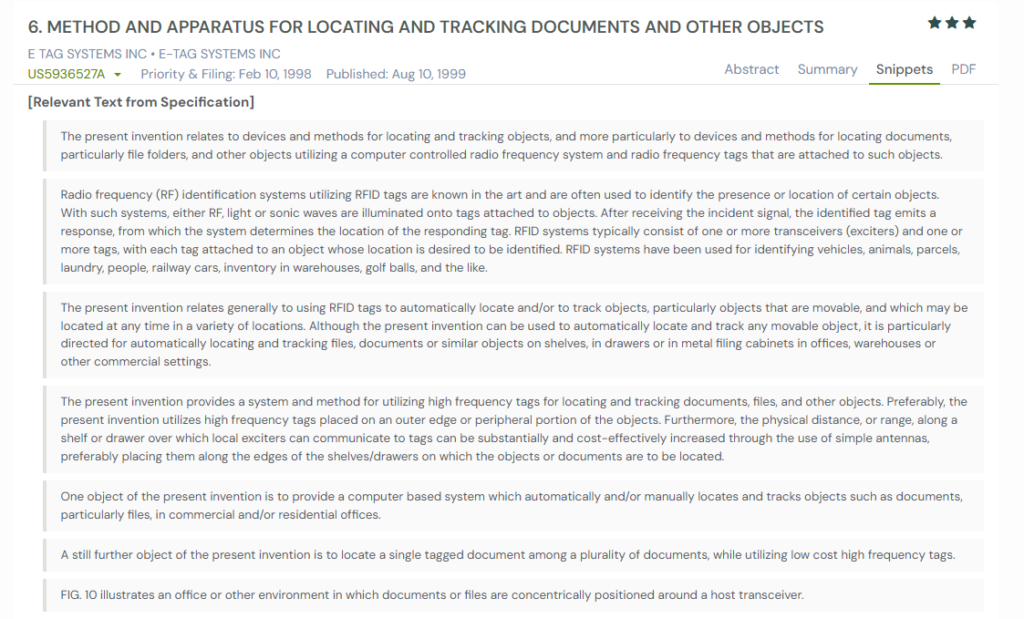
What This Patent Introduces To The Landscape
- Placement of high-frequency RFID tags on the edges of documents
- Use of local exciters in shelves or drawers to relay signals
- A central host transceiver controls communication with hundreds of tags
- Ability to locate a single tagged document among many
- Optional tracking of documents as they pass through doorways or exits
How It Connects To US7714726B2
- Both patents improve RFID performance when multiple items are grouped together.
- US5936527A focuses on documents stored in drawers or shelves
- US7714726B2 enables stacked objects like poker chips or currency to be read
- Each patent solves interference challenges in high-density environments.
Why This Matters
This patent shows how RFID can simplify office management by making documents instantly trackable. It reflects the broader push toward using RFID for efficiency in real-world environments.
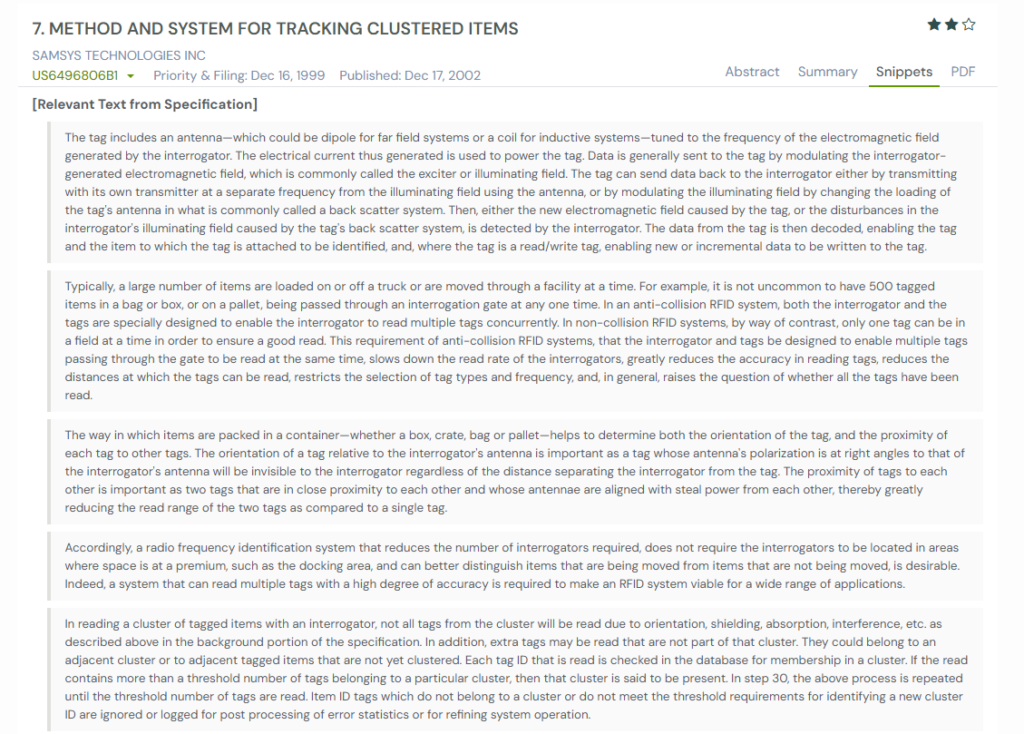
5. US6496806B1
This US patent, US6496806B1, published in December 2002, introduces an RFID method and system designed to track items grouped in clusters, such as boxes, pallets, or bags containing hundreds of tagged goods. The invention addresses the challenges of reading multiple RFID tags at once, especially when orientation, interference, or shielding reduces readability.
Instead of requiring every single tag in the group to be read, the system identifies clusters based on detecting a threshold number of tag IDs. If enough tags from a cluster are detected, the whole cluster is assumed to be present. This approach improves read accuracy, avoids false detections from nearby clusters, and reduces the need for multiple interrogators.
What This Patent Introduces To The Landscape
- A cluster-based method that confirms the presence without reading every single tag
- Ability to handle random tag orientations and reduce read failures
- Use of thresholds to distinguish between true clusters and stray tags
- Reduced the need for interrogators in space-limited areas like docks
- Improved accuracy in large-scale item movement and tracking
How It Connects To US7714726B2
- Both address the challenge of reading multiple RFID tags in close proximity.
- US6496806B1 focuses on cluster-based detection of items
- US7714726B2 enables semi-transparent antennas for stacked items
- Each solution minimizes interference and improves tag readability in bulk settings.
Why This Matters
This patent shows how clustering can solve the limitations of anti-collision systems. It highlights practical ways RFID can scale to manage hundreds of items at once.
Related Read: US9251332B2 on wireless RFID access systems shows how it focuses on overcoming signal reliability issues. It addresses how RFID performance can be preserved in environments with proximity challenges.
How To Find Similar Patents Using Global Patent Search
Studying patents like US7714726B2 becomes more valuable when you also look at similar technologies. This patent deals with semi-transparent RFID tags that maintain readability even in stacked arrangements.
The Global Patent Search tool helps uncover other RFID inventions with comparable features, showing how different designs approach the same technical hurdles. Instead of digging through hundreds of documents, GPS presents you with quick snapshots that highlight the essentials.

1. Start with the patent number: Enter US7714726B2 in the search bar. You can refine with terms such as “stacked RFID” or “semi-transparent antenna” to narrow results.
2. Read the snippets carefully: GPS displays small sections from similar patents, giving you instant insight into how antennas, circuits, or transmission methods are applied.
3. Identify overlapping functions: Some patents highlight antenna placement to minimize blocking, while others explore energy relays through multiple objects in a stack.
4. Compare problem-solving strategies: Different inventors address issues like interference, weak signals, or obstructed line-of-sight in unique ways. Comparing these shows the range of possible solutions.
5. Notice larger innovation trends: Repeated patterns, like improvements in logistics tracking, compact antenna structures, or integration with smart packaging, signal where RFID technology is heading.
Exploring similar filings also helps in understanding how these technologies move into the market. A licensee might secure rights to manufacture or distribute RFID tags based on a patent like this one, extending its reach commercially. At the same time, some RFID systems result from collaborations that lead to joint ownership, where multiple companies or inventors share rights and responsibilities for the invention.
Thus, using GPS gives a clear picture of how US7714726B2 fits within the broader RFID patent landscape and where future opportunities may arise.
Disclaimer: The information provided in this article is for informational purposes only and should not be considered legal advice. The related patent references mentioned are preliminary results from the Global Patent Search tool and do not guarantee legal significance. For a comprehensive related patent analysis, we recommend conducting a detailed search using GPS or consulting a patent attorney.