

Most people finish shaving and realize they missed a spot. The mistake isn’t skill or speed. It’s that shaving happens in the one place you cannot clearly see while doing it. Your hand, the device, and the angle all work against you at the exact moment precision matters.
US11297216B2 starts from that overlooked reality. The patent introduces an electric shaver with an integrated imaging system that shows the skin exactly where shaving is happening, in real time. Instead of relying on mirrors or memory, the user gets direct visual feedback while shaving.
This concept sits at the center of multiple disputes involving Volteon LLC against Geosolution i Goteborg AB, GoFleet Inc., Reolink Digital Technology Co., Ltd., and THINKWARE Corporation.
To understand how this idea took shape, we used the Global Patent Search platform to trace earlier imaging and device-integration concepts that led here.
Seeing the Skin From the Shaver’s Point of View
US11297216B2 begins with a quiet assumption. When a shaver touches the skin, the user cannot clearly see what is happening.
Your hand, or sometimes the device blocks the view. The closer the shave, the worse the angle becomes. Mirrors help, but only indirectly.
This patent fixes that by moving the viewpoint itself.
A small digital camera is built into the electric shaver and aimed at the exact area being shaved. It captures a close-up image of the skin and sends it to a display in real time. The display can be part of the shaver or a separate screen placed nearby, connected by wire or wirelessly.
Lighting is also built in, so the image stays clear even in low-light or foggy conditions. The system can also freeze a frame or zoom in, making it easier to catch missed hairs before moving on.
Nothing about the shaving mechanism changes. What changes is feedback. Instead of guessing, the user sees exactly what the shaver sees.
Key features of US11297216B2:
At its core, this patent adds visibility where shaving normally has none.
- Camera built into the shaver: A small digital camera is placed inside the shaver housing to capture the skin area being shaved from very close range.
- Real-time visual feedback: The captured image is shown live, so the user sees exactly what the blades are doing at that moment.
- Flexible display setup: The image can appear on a screen built into the shaver or on a separate display connected by cable or wirelessly.
- Dedicated lighting around the camera: Built-in light sources illuminate the skin, making details visible even in low-light or foggy environments.
- Zoom and image freeze options: The system can zoom in or freeze a frame to inspect tricky areas before moving on.
- Image processing support: In advanced setups, software can highlight remaining hairs or areas that still need shaving.
What makes this design stand out is not the technology itself, but where it is placed. By positioning the camera at the exact point of contact between the shaver and the skin, the patent turns shaving into a guided process rather than a trial-and-error routine.
A similar design philosophy shows up in US7609961B2, where a camera is integrated inside a vehicle lens to provide real-time visual feedback without altering the exterior appearance. The invention demonstrates how visibility can be added at the point of use without changing how the device looks or feels.
5 Earlier Ideas That Quietly Led to Camera-Guided Shaving
The idea of adding vision, lighting, and feedback to grooming tools had been forming for years through smaller, more focused inventions.
There were many earlier patents that explored pieces of the same problem. Some tried to improve visibility with lighting. Others experimented with cameras, displays, or electronic feedback in handheld devices. Each solved part of the puzzle, but none brought everything together in one place.
To trace how these ideas evolved, we used the Global Patent Search tool. Looking at earlier filings side by side makes it easier to see different approaches.
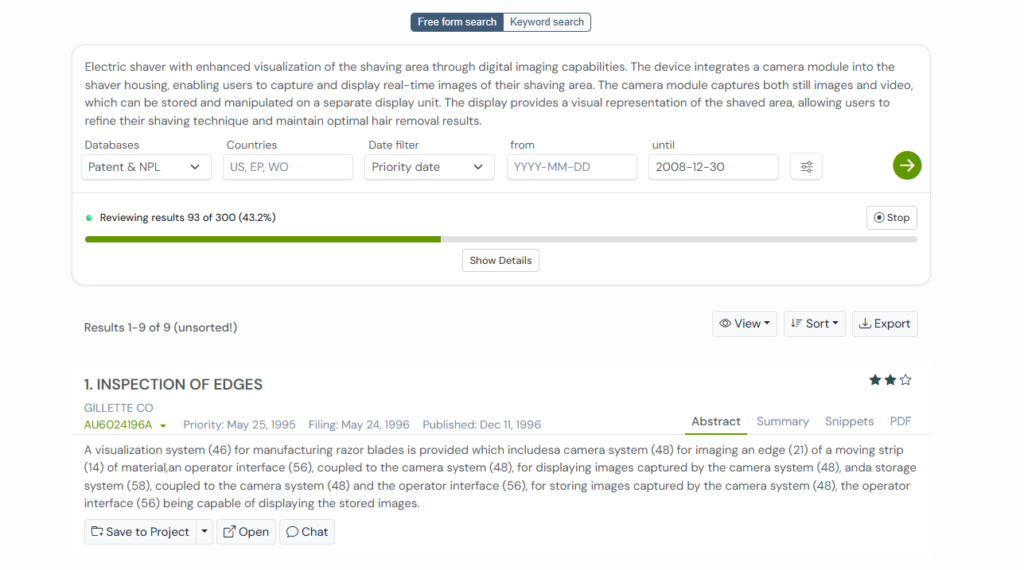
Some of them are discussed below.
1. KR20100055595A
KR20100055595A, filed in 2008 by Lim Kyu Nam, starts from a very practical frustration. Mirrors limit where and how you can shave. They force positioning, lighting, and space constraints that have nothing to do with the blade itself.
This patent solves that by putting a small camera directly on the shaver and sending the live image to a separate display. The display could be a compact LCD, a TV, a phone, or any external screen that is easy to look at while shaving. The goal was to let the user see the shaving area without needing a mirror at all.
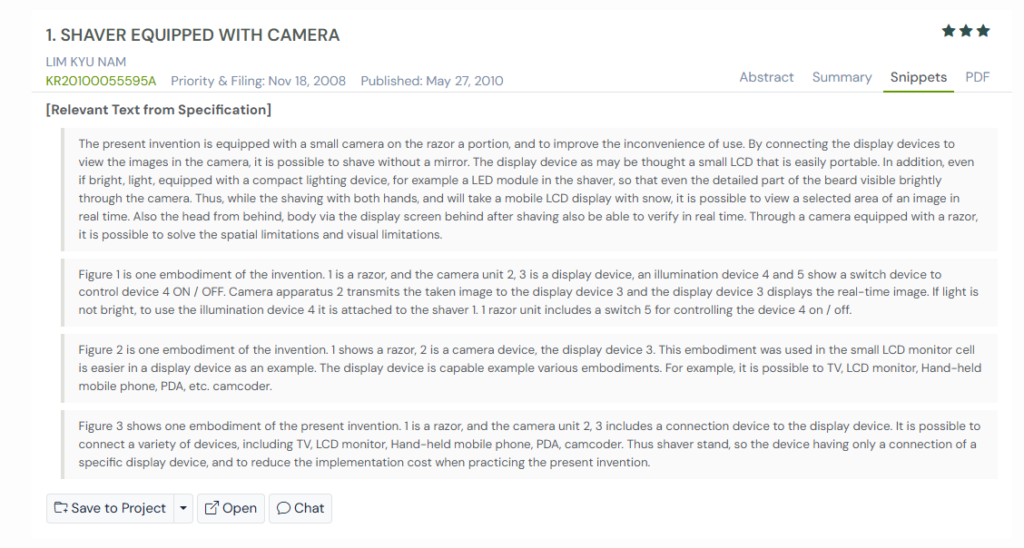
Moreover, an LED module is built into the shaver so fine beard details remain visible even in dim conditions. The user can shave with both hands while watching the image in real time, and even check hard-to-see areas like the back of the head after shaving.
Why this patent matters
This invention establishes the core idea that shaving visibility should travel with the tool, not depend on the room. It proves that camera-based feedback can remove spatial and visual limitations.
2. US6680748B1
This patent looks unrelated to shaving at first, but it quietly enables everything that comes later.
US6680748B1, filed by PIXIM INC in 2001, solves a core imaging problem. How do you use a single small camera to capture both live video and high-quality still images without adding bulk, storage overload, or power drain?
The answer is a multi-mode camera system built around a digital pixel sensor. In video mode, the camera captures continuous, lower-resolution footage that is light on storage. At defined intervals, it briefly switches modes to capture a high-resolution still image, then switches back. All of this happens using the same sensor, processor, and memory on a single chip.
Why this patent matters
This invention proves that one compact camera can switch roles instantly. It can show what is happening right now and also pause to capture detail when needed.
The idea of capturing what the user cannot actively monitor already exists in vehicle systems like US8319619B2, which describes a multi-camera setup that records everything around a car automatically, without manual input.
3. JP2009152894A
JP2009152894A, filed by Canon Inc. in 2007, focuses on how live images are displayed when precision matters. You see, when you zoom in to adjust focus or inspect details, you lose context. When you zoom out, details disappear.

Canon’s solution allows both views at the same time.
The system shows a full live image and an enlarged view side by side. The user can switch instantly between them or force the system to zoom in automatically when a precise action is detected, like focusing or fine adjustment. Everything updates in real time, with no lag between input and display.
Why this patent matters
This invention introduces the idea that live visual feedback should adapt to what the user is doing. That thinking carries directly into US11297216B2. A shaver-mounted camera needs to show the full area for orientation, then zoom in when detail matters.
Canon’s work shows how dynamic zoom, live switching, and user-driven focus can coexist without slowing the experience.
Dashcams offer a useful parallel. Their rise shows how continuous recording replaced human memory in environments where mistakes are only noticed afterward. The same logic applies to camera-guided shaving.
4. US2008309784A1
US2008309784A1, filed by Sanyo Electric Co. in 2008, focuses on camera systems embedded inside any mechanical devices that rotate or change position.
The core problem targeted is simple. When a device moves, the area you want to see keeps shifting, making orientation difficult for the user.
Sanyo’s solution places a camera near the moving or rotating part and uses image processing to generate a clear, guided display. The system highlights the area around the outer edge of motion so the user always understands where the device is pointing or rotating. As the mechanical part moves, the display updates in real time to reflect that movement.
In more advanced setups, multiple cameras capture different angles, and the system stitches those views together into a single, understandable display. Plus, visual guides, arcs, or overlays help the user track motion without confusion.
Why this patent matters
This invention shows how cameras can act as visibility assistants for tools and machines in motion. That idea directly supports later designs like US11297216B2, where the camera is mounted on a handheld device that constantly changes angle.
5. US5023719A
US5023719A, filed by Hughes Aircraft Co. in 1989, addresses a simple but powerful idea. Looking closely usually means losing context. Zooming out restores context but hides detail. This invention also refuses to choose between the two.

The system uses a single image sensor and processes its output to create multiple views at once. One view shows the full, wide-angle scene. At the same time, other portions of that same scene are magnified and displayed in higher resolution. Both appear together on the display, updated in real time.
Nothing new is captured. The same image data is reused and reprocessed to highlight what matters most, without interrupting the overall view.
Why this patent matters
This invention introduces the concept of simultaneous context and detail. That thinking carries directly into US11297216B2. A shaver-mounted camera needs to keep the user oriented while also revealing fine details.
A related design pattern appears in US9965237B2, which focuses on real-time interaction between a handheld device and a separate display through wireless communication. Instead of embedding all feedback into a single screen, the system allows live data to move fluidly between devices.
How These Earlier Patents Stack Up Side by Side
Seen individually, each patent solves a narrow visibility problem. Seen together, a clear pattern emerges. Over time, inventors kept moving closer to the same goal: giving users real-time visual clarity without adding friction.
| Patent Number | Core Problem Addressed | Key Idea Introduced | Connection to US11297216B2 |
| KR20100055595A | Mirrors limit where and how shaving can be done | Camera placed on the shaver with live external display | Establishes the foundational idea of seeing directly from the shaver |
| US6680748B1 | One camera cannot handle live view and fine detail efficiently | Single sensor switching between video and still modes | Enables real-time guidance with the ability to inspect detail |
| JP2009152894A | Zooming in causes loss of orientation | Full image and enlarged view shown together | Supports dynamic zoom without losing context during grooming |
| US2008309784A1 | Movement makes it hard to track what is being seen | Camera-based guidance for moving mechanical devices | Applies visual assistance to handheld tools that constantly change angle |
| US5023719A | Detail and context cannot be viewed at the same time | Simultaneous wide-angle and magnified views | Introduces the context-plus-detail concept used in shaver displays |
How Global Patent Search Connects These Ideas Over Time
Looking at these patents one by one explains what each invention does. What it does not explain is why certain ideas survived, combined, or quietly disappeared. That pattern only becomes visible when the patents are viewed together.
This is where Global Patent Search tool becomes useful. Instead of treating patents as isolated documents, GPS helps map how concepts like live imaging, zoom, motion guidance, and real-time feedback evolved across different industries before converging in systems like US11297216B2.

How to Use GPS for This Analysis:
- Start with the subject patent: Enter the main patent number – US1297216B2, in this case – to surface related inventions focused on imaging, visibility, and real-time feedback.
- Sort by relevance: Use the relevance sorting option to prioritize patents solving similar problems.
- Scan summaries first: Read short summaries to quickly understand what each patent is trying to improve before opening full specifications.
- Trace earlier filings: Move backward through cited and related patents to see how ideas like camera integration and dynamic display evolved.
- Compare approaches side by side: Identify which solutions focused on hardware placement, which emphasized image processing, and how later designs combined both.
GPS makes it easier to see invention as a process, not a moment. When you follow ideas instead of just patent numbers, the path to modern systems becomes much clearer.
Want to explore how technologies really evolved behind the scenes? Try the Global Patent Search tool today and see the full story unfold.
Frequently Asked Questions
1. Are camera-based grooming tools more accurate than traditional shavers?
They can be, especially for detailed areas. Camera-based systems provide live visual feedback, which helps users spot missed hair immediately. While the cutting mechanism may be similar, the added visual guidance improves consistency and reduces guesswork during close or difficult shaves.
2. Can improved lighting alone fix shaving visibility issues?
Better lighting helps, but it does not solve the core problem. Even in bright conditions, the shaver and hand block direct sight. Lighting improves clarity only when the area is visible. Camera-assisted views work because they remove the angle limitation entirely, not just the brightness issue.
3. Why is real-time feedback important during grooming tasks?
Real-time feedback allows corrections while the task is happening, not after it is finished. In grooming, this means fewer missed spots, less skin irritation, and faster completion. Seeing immediate results helps users adjust pressure, angle, and coverage before mistakes become noticeable later.
Disclaimer: The information provided in this article is for informational purposes only and should not be considered legal advice. The related patent references mentioned are preliminary results from the Global Patent Search tool and do not guarantee legal significance. For a comprehensive related patent analysis, we recommend conducting a detailed search using GPS or consulting a patent attorney.