

Every morning, you reach for the cap you want to wear, and somehow it’s never where it should be. It’s either at the bottom of a tilted stack, hiding under two others, or collecting dust in a corner. Over time, what starts as a small collection turns into a chaotic pile that refuses to stay organized. That’s the story of almost every hat collector ever.
US10273075B2 was designed to fix exactly this kind of everyday frustration. Instead of relying on bags, hooks or shelves that distort a hat’s shape, this patent introduces a structured, stackable storage box with a smooth sliding drawer and a magnetic assist feature that makes access surprisingly effortless.
With the Global Patent Search (GPS) tool, it becomes easier to see where this invention stands and how earlier ideas contributed to today’s cleaner, smarter storage systems.
Why US10273075B2 Even Exists in the First Place
When you look beyond the surface, US10273075B2 is really about designing a storage box that behaves predictably every single time you use it.
Instead of relying on loose lids or open shelves, the patent introduces a guided drawer mechanism that moves smoothly along built-in supports. These supports aren’t just there for structure.
They keep the drawer stable, stop it from tipping forward, and ensure it stops exactly where it should. Everything inside the box stays controlled, even if the user pulls the drawer a little too far or handles it in a hurry.
The second part of the design becomes clearer once you see how the units interact with each other. Stacking isn’t just about saving vertical space here. The patent uses angled surfaces, alignment features, and a magnetic assist that holds the lower door in place when another unit sits on top.
It’s a small detail, but it changes how the entire system functions. Instead of separate containers, the boxes essentially become a connected structure, where each one helps the next work more efficiently.
Key Features That Make This Box Actually Useful
Here are some of the key features that make US10273075B2 really useful:
- The drawer slides out smoothly, so instead of digging through a pile of caps, you just pull it forward and the caps stay neatly where they should.
- Inside the box, small supports guide the drawer and stop it from tipping forward. There are built-in stops that keep the drawer from coming out completely, which means you won’t accidentally pull it off its track when you’re in a hurry.
- When you stack two units, magnets from the upper box gently hold the lower door open.
- The entire system stacks securely using simple alignment features, so the boxes lock into place and don’t wobble or lean when placed one on top of another.
Together, these details turn a simple storage box into a system that finally treats your caps the way collectors always wished their storage could.
If you’re interested in how home devices evolved to manage dust and airflow, our piece on when air purifiers were invented offers helpful context.
How Earlier Ideas Help Us Understand This Invention Better
Before US10273075B2 introduced its smart mix of stacking, sliding, and magnetic convenience, other inventors were already trying to solve pieces of the same storage puzzle.
Some focused on better drawers, some on stackable containers, and others on apparel organization. Seeing these earlier ideas helps place this patent in the larger story of how storage solutions evolved.
The Global Patent Search Tool makes this comparison simple by highlighting the closest conceptual matches and showing quick snippets of how each invention relates.

Let’s explore some of them.
1. JPH1175923A
When you have multiple hats stacked on a shelf, chances are the one you want is usually trapped under a few others. And even if you manage to pull it out without collapsing the pile, dust settles on everything so quickly that the collection never looks fresh.
JPH1175923A, published in 1999, approached the problem by designing a transparent box with a hinged door that opens easily. Inside the box, hats are clipped to suspension cords that move freely from side to side. This keeps each hat separated, prevents dust from settling and makes it simple to take out the one you want without disturbing the rest.
The idea relates to US10273075B2 because both inventions focus on clean storage and convenient access. JPH1175923A uses hanging cords and clips, while US10273075B2 relies on a sliding drawer and stacking design.
Why this patent is important
It introduced a practical way to store hats in a dust-free container while still allowing users to see their collection and remove individual hats without hassle.
2. US2017231346A1
Keeping hats in good condition often comes down to one simple problem: most storage options flatten the brim or crush the crown. Traditional boxes and bags rarely match the hat’s shape, so even careful users end up with bent edges or dents they can’t fix later.
US2017231346A1, filed in 2016 by Dyson, approached the problem by building a container shaped specifically to hold a hat the way it was meant to sit. The design uses a top and bottom component that lock together, a rear door on hinges, and an interior formed to support both the brim and crown. The patent also includes mating components on the top and bottom surfaces, allowing multiple containers to stack securely.
US2017231346A1 relates to US10273075B2 as both inventions focus on clean storage, easy access, and protection from dust or deformation.
Why this patent is important
It introduced a protective, shape-supporting container with an early stacking mechanism, giving users a practical way to store hats without damaging them.
If you enjoy exploring how everyday items evolved through clever mechanical design, our breakdown of the selfie stick invention shows how simple consumer tools can become global innovations.
3. US2016106233A1
Some collectors want their items on display, but still protected from dust and daily wear. This patent application, explored how to give users a clean, organized way to store things like shoes without losing visibility or ease of access.
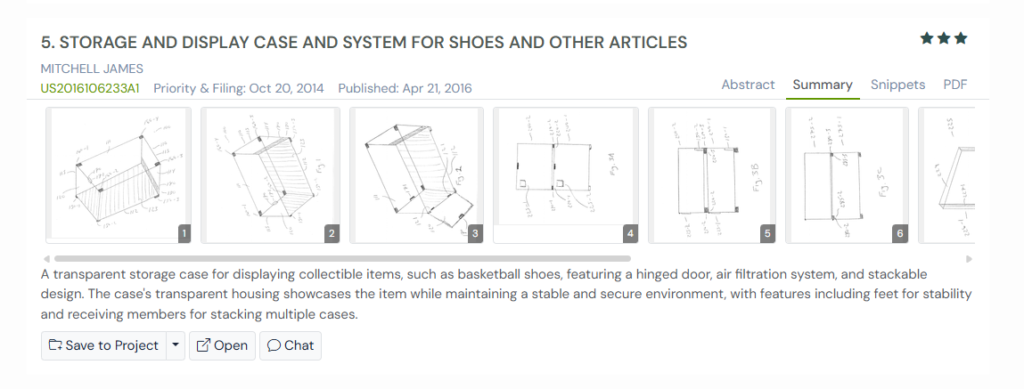
US2016106233A1, filed in 2014, describes a transparent housing with a hinged access door and a dedicated slot for air filters. The case includes feet on the bottom and matching receiving members on the top, allowing multiple units to stack securely.
These receiving members can be cavities, tacky surfaces, hook-and-loop materials or even magnetic components that prevent sliding.
US10273075B2 approaches stacking with a similar goal of stability but applies it to headwear using magnets, angled surfaces and a drawer system rather than a simple rectangular case.
Why this patent is important
It offered a versatile display case design that could be stacked safely, giving users a clean way to organize items while keeping them protected and visible.
Mechanisms that prevent uncontrolled movement appear in many products, including US9581272B2, which uses controlled expansion and support to stabilize daily-use devices.
4. US2010193393A1
Open-top storage bins are convenient at first, but they quickly become frustrating when you stack them. The moment boxes are placed on top of each other, the only way to reach what’s inside is to unstack everything. This patent took a different approach by adding a front access point so items could be removed or refilled without disturbing the boxes above.
US2010193393A1, filed in 2009, describes a storage box with parallel side walls, a rear wall and an open top, paired with a front flap that pivots outward. This flap lets the user access the contents even when the box is stacked. The design includes complementary shapes on the top and bottom so the boxes align securely when placed one above another, preventing sliding and making vertical storage more stable.
US10273075B2 also focuses on accessible storage within a stacked arrangement. While this patent uses a pivoting front flap and complementary floors for alignment, US10273075B2 uses a sliding drawer, angled surfaces and magnet-assisted door positioning to achieve a similar goal for headwear.
Why this patent is important
It introduced a practical stacking system with front access, allowing users to build vertical storage without losing convenience or stability.
5. US7147112B2
Different people store their hats in different ways. Some prefer shelves, other prefer hooks, while few try to use racks that don’t quite fit the shape of a cap. This patent approached hat storage from a much more structural angle by focusing on frames that can mount on walls, bars or doors while also stacking vertically.
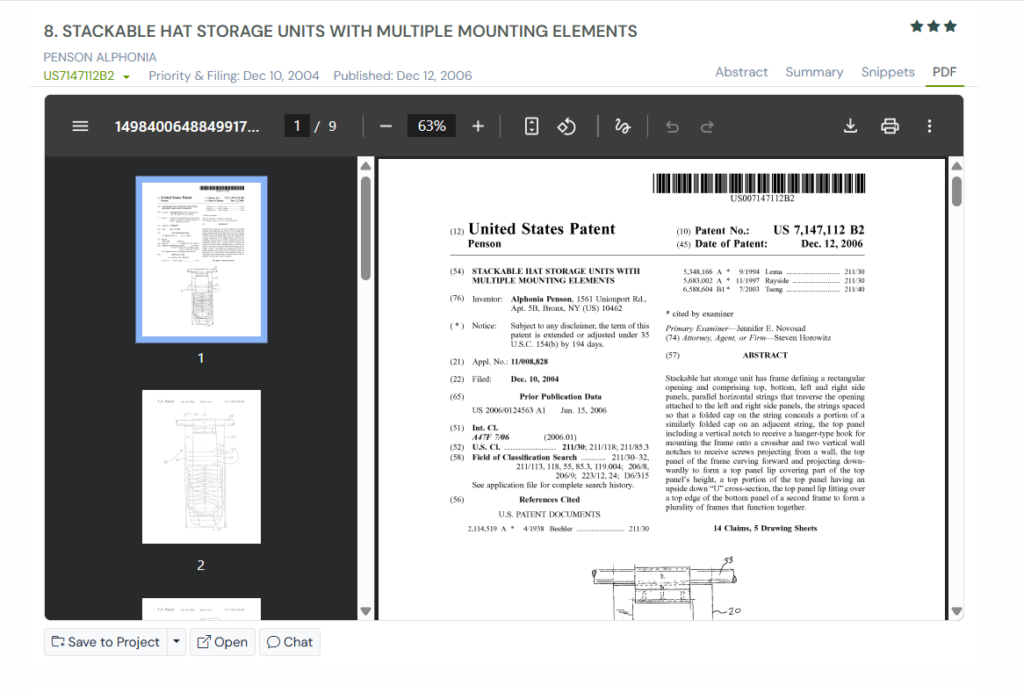
US7147112B2, filed in 2004, describes a rectangular frame with horizontal strings stretched across it. Folded caps rest on these strings in a staggered arrangement so each cap partly covers the one below it.
The top panel includes notches for hook-style mounting and also features a lip that fits over the top edge of another identical frame. This allows several units to stack securely into a tall assembly that can then be mounted as one combined structure.
Why this patent is important
It offered a flexible way to store and display many caps at once, combining stackability with wall or door mounting so users could adapt the setup to the space they had available.
You can see a similar emphasis on shape protection in US10834987B1, where the design focuses on keeping helmet interiors stable and supported to prevent injury.
How These Earlier Patents Compare Side by Side
Putting these inventions next to each other makes it easier to see how different ideas approached the same core challenge: keeping hats organized, protected, and easy to access. Each patent solves a slightly different part of the problem, and together they show how storage designs gradually evolved.
| Patent Number | Filed In / Year | Core Innovation | Connection to US10273075B2 | Practical Impact |
| JPH1175923A | Japan, 1997 | Transparent hat box with hinged door and hanging cords for dust-free access. | Similar aim of clean, easy hat access; uses suspended cords instead of a sliding drawer. | Helped users keep hats visible and protected without stacking hassles. |
| US2017231346A1 | US, 2016 | Form-shaped container that protects hat structure with locking parts and stackable mating features. | Shares structured protection and stacking goals but uses molded housing instead of a drawer. | Prevented brims and crowns from bending while enabling stable stacking. |
| US2016106233A1 | US, 2014 | Transparent display case with an air-filter channel and stable stacking using feet/receiving members. | Reinforces the idea of clear display and secure stacking; US10273075B2 adapts similar concepts for caps using magnets. | Provided a clean way to store items without sliding or dust buildup. |
| US2010193393A1 | US, 2009 | Front-access box with a pivoting flap and complementary top/bottom shapes for stacking. | Addresses the same challenge of access while stacked, though uses a front flap instead of a drawer. | Allowed vertical storage without losing accessibility. |
| US7147112B2 | US, 2004 | Wall-mountable frame with horizontal strings for stacking baseball caps. | Shares the stacking philosophy but focuses on open-frame display rather than enclosed storage. | Helped users display multiple caps in compact vertical spaces. |
Why GPS Makes Patent Research Easier Than Ever
When you’re studying a storage invention like US10273075B2, it helps to know what else exists in the same space, especially designs that use similar stacking systems, doors, flaps, or protective enclosures.

The Global Patent Search tool makes this easy by pulling together patents that share structural ideas, functional goals, or mechanical elements, even when they come from different inventors or industries.
Here’s how GPS supports a clean and efficient review:
- Start with the patent number: Enter US10273075B2, and GPS instantly surfaces patents with comparable features, everything from hinged doors and molded housings to stackable frames and guided supports.
- Read the smart snippets: To help surface relevant patents quickly, instead of digging through all of themGPS highlights short, meaningful excerpts so you can quickly see what overlaps in design, usability, or mechanical behavior.
- Open deeper links when needed: If something looks relevant, you can jump straight into the full document to compare how the structure is engineered, how movement is supported, or how stacking stability is achieved.
- Spot patterns across categories: GPS doesn’t limit you to hat storage. You may find related ideas in shoe organizers, display systems, shelf units, or other stackable containers. This helps you understand how one design principle evolves across different applications.
Using the Global Patent Search tool can save hours of manual searching and help you avoid blind spots when analyzing similar inventions, potential competitors, or prior art risks. It gives you a clearer, more connected view of the entire innovation landscape around your patent of interest. Try the tool today!
Frequently Asked Questions
1. Why do modern hat storage systems focus so much on structure and material?
Because hats lose shape easily. A well-designed storage unit supports the crown and brim so the hat doesn’t warp, flatten, or bend over time. Transparent, rigid materials also help protect hats from dust while letting you see what’s inside.
2. What makes stackable storage units better than traditional shelves or racks?
Stackable systems save vertical space and create a cleaner display. They also ensure that each hat stays in its own protected compartment, rather than being crushed or hidden under other items.
3. Why do some containers include air channels or filters?
Hats, especially those made of fabric or foam, can absorb moisture and odors. Small filter channels help with airflow so stored hats stay fresh without being exposed to open air or dust.
Disclaimer: The information provided in this article is for informational purposes only and should not be considered legal advice. The related patent references mentioned are preliminary results from the Global Patent Search tool and do not guarantee legal significance. For a comprehensive related patent analysis, we recommend conducting a detailed search using GPS or consulting