
| TL;DR: Traditional claim chart tools match keywords. AI patent claim charting tools like Global Patent Search (GPS) understand the meaning. GPS breaks claims into structured elements and gives you a structured first-pass mapping in minutes, so you can quickly see where support is strong or thin. You apply legal judgment—but you start with a faster, clearer analytical baseline. |
Automatic patent claim chart generation has existed for years. But most of it was mechanical. It matched keywords, not meaning.
As in-house counsel, you know that real claim charting is more nuanced. It is not just placing text into columns. You need to see how claims connect to each other, understand when different words describe the same idea, and quickly spot where the evidence is strong or weak. That is where traditional automation breaks down.
AI introduces a meaningful shift. AI patent claim chart generator by Global Patent Search analyzes context, not just words, and can detect conceptual matches across product documentation or prior art.
Still, no AI tool replaces an experienced searcher. It should be viewed as an additional analytical layer. In this article, we break down what truly matters when evaluating an AI patent claim chart generator.
Features to Look For While Selecting an AI Patent Claim Chart Generator
We did not want to publish another recycled feature list stitched together from comparison blogs. Instead, our goal was to show where an AI patent claim chart generator realistically fits within an existing IP workflow and what real advantage it can add.
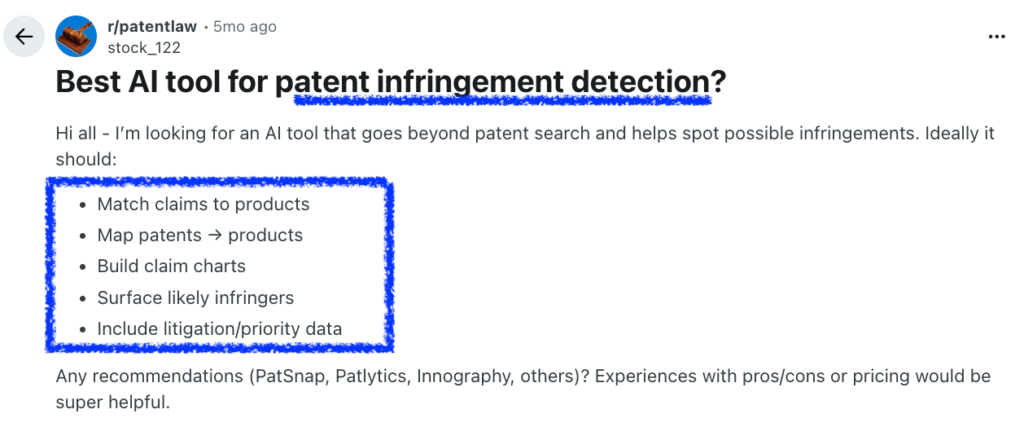
So rather than relying on vendor marketing pages, we looked at practitioner discussions on Reddit communities such as r/Patents, r/Patentlaw, and r/legaltech. We then aligned those practical needs with the features built into the GPS claim chart generator that directly support the intended Job-to-be-Done.
- Intelligent Claim Decomposition
- Accurate Claim Mapping
- Quick First Pass Analysis
- No Hallucinations
- Identification of Strongest Reference
- Ease of Use
- Confidentiality of Information
Time for a deep dive!
1. Intelligent Claim Decomposition
A strong AI patent claim chart generator should do more than split claims at semicolons. It must understand how dependent claims build on independent ones and preserve limitation inheritance so the full scope of the claim is captured, not just the added language.
Effective tools also break each limitation into smaller, meaningful components. This allows for more precise mapping and clearer evidence alignment of evidence.
For example, consider the limitation: “in response to clicking the button, a pop-up menu appears on the display.”
GPS segments it into distinct elements such as:
- in response to clicking
- the button
- a pop-up menu
- appears on the display
This deeper decomposition enables more granular mapping and reduces the risk of overbroad or incomplete matches.
2. Accurate Claim Mapping
An AI patent claim chart generator should go beyond surface keyword matching. Claims and product documents rarely use identical language. What matters is whether the underlying concept aligns.
But accuracy is not just about semantic similarity. It is about controlled validation. For example, in GPS:
- Claims are first decomposed into discrete limitations.
- A primary model generates an initial mapping.
- A secondary review layer evaluates whether the mapping is logically sound.
- Explicit, partial, or no support is clearly marked.
- Users can request alternative text from the reference, regenerate the mapping, or suggest refinements.
This layered approach improves reliability. It does not eliminate the need for professional review, but it provides a structured, defensible starting point rather than a loose AI draft.
3. Quick First Pass Analysis
Not every claim chart needs to be litigation-ready at the outset. In many situations, the immediate question is whether a theory is even worth pursuing.
A professionally prepared claim chart can take several hours per claim and cost $3,000-$8,000per patent. That level of effort makes sense once a matter is serious. It does not make sense for early screening. For instance, check the use case below:
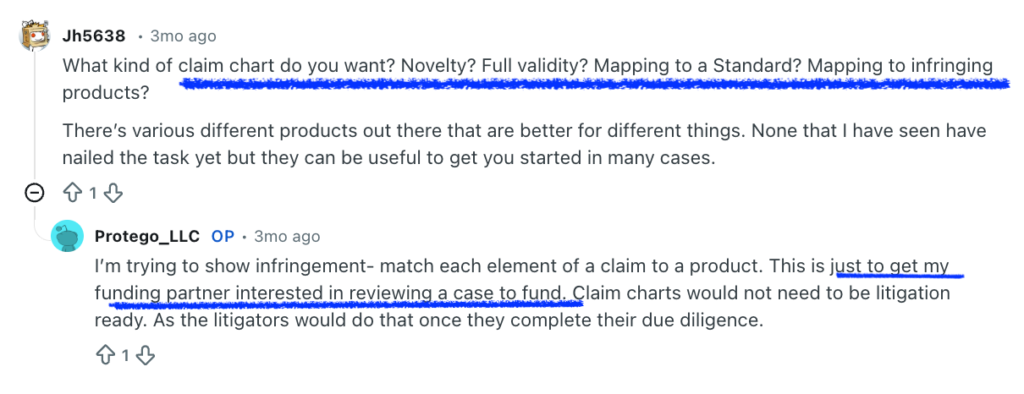
GPS generates structured claim charts in minutes. Counsel can test multiple references, review the mappings, and complete a disciplined manual pass within a few hours.
The result is a faster, more cost-effective first filter — before committing full legal resources to deeper analysis.
4. No Hallucinations
Large language models can generate confident but incorrect outputs. So, the doubt expressed in the following Reddit discussion is understandable.
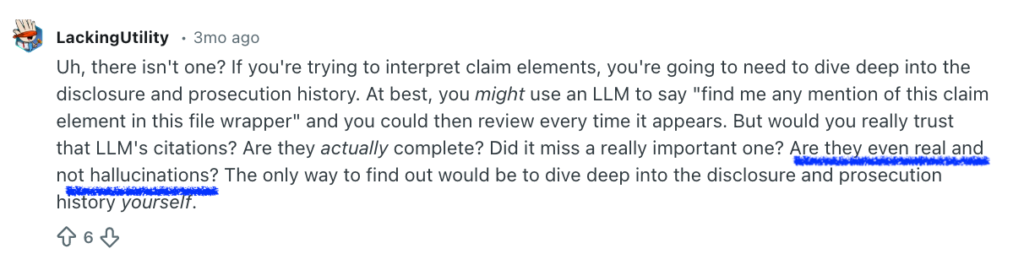
However, in claim charting, hallucination is unacceptable. Every cited passage must actually exist in the reference.
A reliable AI patent claim chart generator should not simply trust the model’s output. It must validate it.
In GPS, any text extracted by the AI is automatically cross-checked against the source document. If the quoted passage does not exist verbatim in the specification or reference, it is rejected. In addition, users remain in control — reviewing, regenerating, or refining mappings as needed.
AI should assist analysis, not invent support. Verification layers and human oversight are essential to maintain credibility and defensibility.
5. Identification of Strongest Reference
A strong AI patent claim chart generator should not only map limitations. It should help you see, at a glance, which reference is strongest overall.
GPS enables this by allowing comparison with multiple references via its Disclosure Matrix, available in horizontal and vertical views.
In the horizontal view, you compare how multiple references perform against each claim limitation. This shows whether support is concentrated in one reference or scattered across many.
In the vertical view, you assess one reference at a time to see how many claim elements it covers.
The strongest reference is typically the one that checks the majority of boxes across key limitations. The matrix makes that clear instantly, without manual tallying.
6. Ease of Use
A practical AI patent claim chart generator should reduce friction, not add more workflow steps.GPS provides clear visual markers for each mapping: Explicit, Partial, or None. Each claim element is color-coded against the corresponding excerpt from the reference, allowing counsel to immediately assess the strength of support without scanning dense text blocks.
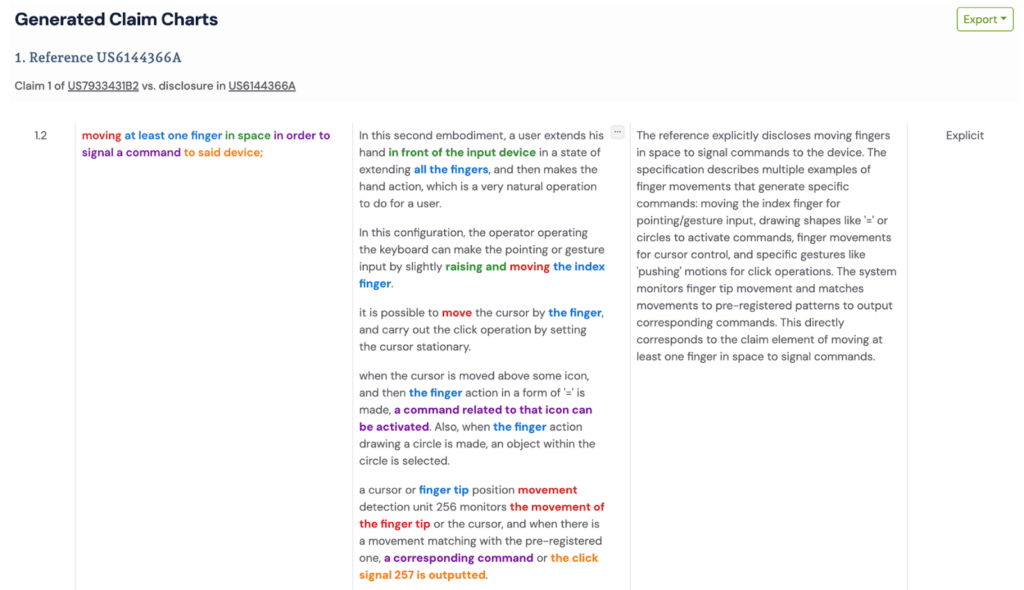
Equally important is search-to-chart continuity. After conducting a prior art search in GPS, users can move directly into the disclosure matrix using the most relevant references already identified. There is no need to manually download PDFs, track patent numbers, or switch between disconnected tools.
The experience remains contained within a single analytical workflow.
7. Confidentiality of Information
For IP and legal teams, confidentiality is non-negotiable. Any AI tool handling draft claims, infringement analysis, or litigation strategy must protect that data.
GPS is SOC 2 Type II compliant, ensuring controlled access, encrypted data handling, and strict safeguards. Client data is never used to train public models.
Security is built into the workflow, not treated as an afterthought.
While the feature list gives you a fair idea of what to look for in an AI patent claim charting tool, we strongly vouch for GPS.
What Makes GPS an Excellent AI Tool for Automating Claim Chart Generation in 2026
No AI tool can replace the judgment of an experienced patent professional. GPS is not built to do that. It is built to support early-stage decision making.
When counsel needs to quickly assess the strength of prior art or test an infringement theory, GPS generates structured, semantically mapped claim charts in minutes. The output is designed to inform strategy, not to be filed in court. Final review and litigation-ready refinement remain with the attorney.
IP teams who have used GPS consistently appreciate the accuracy of its semantic mapping and structured limitation analysis.
GPS does not allow independent user sign-ups. Request access, and our team will revert to you via email.
Frequently Asked Questions (FAQs)
1. How do AI Tools Improve Patent Claim Chart Accuracy and Speed?
AI tools transform the claim charting process by automating labor-intensive manual tasks and applying advanced semantic analysis to uncover connections that traditional keyword searches often miss.
i) Speed Through Automation
- AI automatically splits patent claims into discrete elements or limitations. No manual copy-paste.
- Each element is mapped against prior art, product specs, or standards within seconds.
- Charts export directly to Word or Excel with structured formatting and color cues applied.
ii) Better Matches Through Semantic Analysis
- Tools analyze meaning, not just keywords. Different terminology describing the same concept can still be matched.
- Unsupported or thinly supported elements are flagged so gaps are visible immediately.
- Each mapping includes cited passages pulled directly from the reference to enable fast verification.
iii) Higher-Level Strategic Leverage
- AI produces a structured first-pass chart that serves as a reviewable analytical baseline.
- Legal teams spend time validating arguments and refining positions instead of building tables.
- Multiple interpretations of ambiguous language can be surfaced early, improving infringement or invalidity assessment.
2. Is there a GPT for Patent Claim Charting?
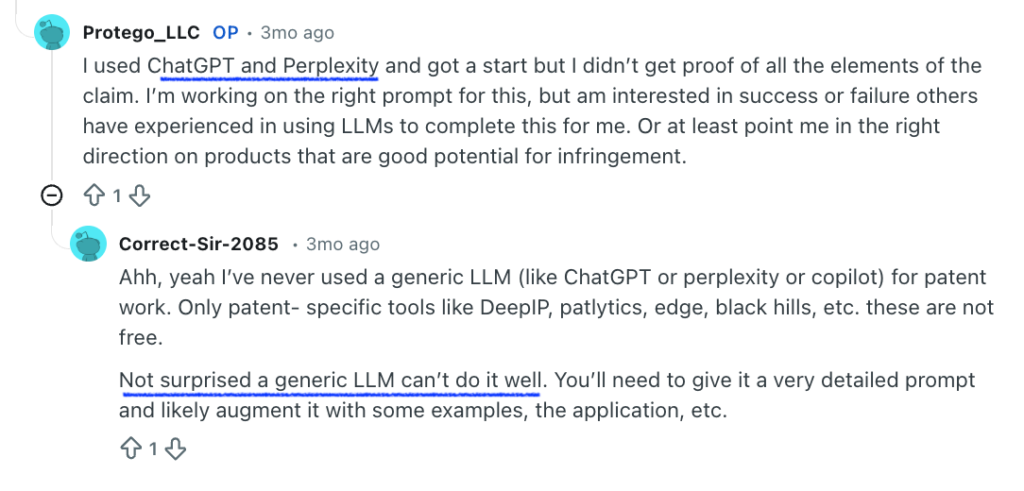
A general-purpose GPT can generate something that looks like a claim chart. But it cannot deliver the level of rigor, traceability, and structured analysis that a purpose-built AI claim charting tool is designed for.
Patent practitioners do not just need a formatted table. They need defensible limitation mapping, citation-backed evidence extraction, gap visibility, and structured support for infringement or invalidity positions.
3. Is Trying Paid AI Tools for Claim Chart Mapping Helpful or Do You End Up Doing it Manually?
Yes, it’s worth trying paid tools but don’t take our word for it. The real question is not whether you will still review the output manually. You will.
The real question is: what mindset do you bring to new technology?
If your starting position is:
- AI will hallucinate.
- I will end up redoing everything.
- It cannot understand technical nuances.
- It is not worth the cost.
Then you should not try any AI tool. No technology performs well when used reluctantly or defensively.
But if your mindset is different, the answer changes.
If you believe professional workflows evolve, you will explore new tools.
If you recognize the R&D behind purpose-built systems, you will assess them thoughtfully.
If you accept that progress comes from experimentation, you will give innovation a fair chance.
For instance, A&O Shearman began piloting Harvey AI in 2023, giving thousands of its lawyers access to the platform at a time when many firms were still cautious. The tool was not perfect. But the firm chose to experiment early and integrate it into real workflows.
Two years later, that experimentation evolved into a profit-sharing partnership on agentic AI tools jointly developed with Harvey. What began as controlled adoption became strategic leverage.
That is the difference a mindset makes.
4. Can Global Patent Search AI Help With 5G Patent Claim Chart Creation?
Yes, but through the right tool.
Mapping a patent against 5G standards (like those from 3GPP) is very different from mapping against another patent. Standards documents are massive (often thousands of pages), and most generic claim charting tools struggle with that scale.
In Global Patent Search:
- Claim Charting Tool → Designed for patent-to-patent (prior art) mapping
- Essentiality Checker → Built for mapping patent claims against standards like 5G or Wi-Fi
You are welcome to give the Essentiality Checker a try!
5. Can GPS Generate Patent Infringement Claim Charts?
Yes, GPS allows mapping patent claims to products by allowing uploading of product specification manuals or technical documents in PDF format in the claim chart generation module. However, it won’t show litigation data, as it is not purpose-built for that.