
In oil and gas operations, gate valves take a constant beating. High-pressure fluids mixed with sand and debris move through them every day.
Over time, this wears down the inside surfaces, especially near the seals. When that happens, flow becomes uneven, sealing gets unreliable, and valves need repair or replacement sooner than expected.
That problem is what US11105426B2 focuses on. The patent describes a gate valve that uses a smooth protective sleeve inside the flow path. The sleeve shields critical internal surfaces and seals from erosion, while keeping the internal diameter the same from end to end.
The patent is currently part of ongoing litigation between Valveworks USA, Inc. and Bestway Oilfield, Inc., underscoring its importance in real-world applications.
To understand how this design fits into earlier valve innovations, we use the Global Patent Search (GPS) tool to explore related inventions and prior ideas.
What Actually Happens Inside the Valve
Picture a gate valve sitting on a frac line. Every time fluid moves through it, it is carrying sand, chemicals, and pressure that never really lets up. The fluid does not just pass through once. It keeps hitting the same internal edges, the same transition points, over and over again. Those are the spots where damage usually begins.
In a typical valve, the flow meets small steps inside the bore. A seat ends, the valve body begins, and seals sit right in between. Even tiny changes in diameter create turbulence. Sand collects, metal slowly erodes, and seals start losing their shape.
US11105426B2, filed in 2019 by Valveworks USA, looks directly at that weak point. Instead of redesigning the whole valve, it adds a smooth protective sleeve across those internal transitions. The sleeve lines up perfectly with the surrounding bores, so the flow stays straight. The sleeve takes the wear, not the valve body or the seals. Over time, that simple change helps the valve keep its shape, sealing, and performance in harsh oilfield work.
Key Features of US11105426B2
The patent focuses on small design changes that make a big difference in how a gate valve holds up under harsh oilfield conditions.
- A smooth protective sleeve lines the inside of the valve to shield metal surfaces and seals from sand, debris, and high-pressure fluid.
- The internal diameter stays the same across the valve body, seat, and sleeve, allowing full-bore flow without restriction.
- The sleeve covers high-wear transition areas where erosion usually starts in traditional gate valves.
- Seals are protected from direct fluid impact, helping them last longer and maintain a tighter seal.
- The sleeve has no openings or gaps, so fluid cannot bypass or attack vulnerable internal parts.
Together, these features help the valve handle extreme operating conditions while keeping flow smooth and predictable.
Similar challenges around surface degradation and controlled material removal appear in other domains as well, including electropolishing technologies like those explored in EP4249647A1, where precise surface treatment is used to limit erosion, oxidation, and uneven wear under aggressive operating conditions.
To see where these ideas came from, it helps to look back at earlier valve designs that tried to solve erosion, sealing, and flow problems in different ways.
Looking Back at Earlier Valve Innovations
The problems this patent addresses did not appear overnight. Long before this design, engineers were already trying to reduce wear inside valves, protect sealing areas, and keep flow as smooth as possible under tough operating conditions.
To understand how these ideas evolved, we use the Global Patent Search tool to trace earlier patents that tackled parts of the same problem. Looking at these inventions side by side helps reveal how small improvements over time led to the full-bore protective sleeve design described here.
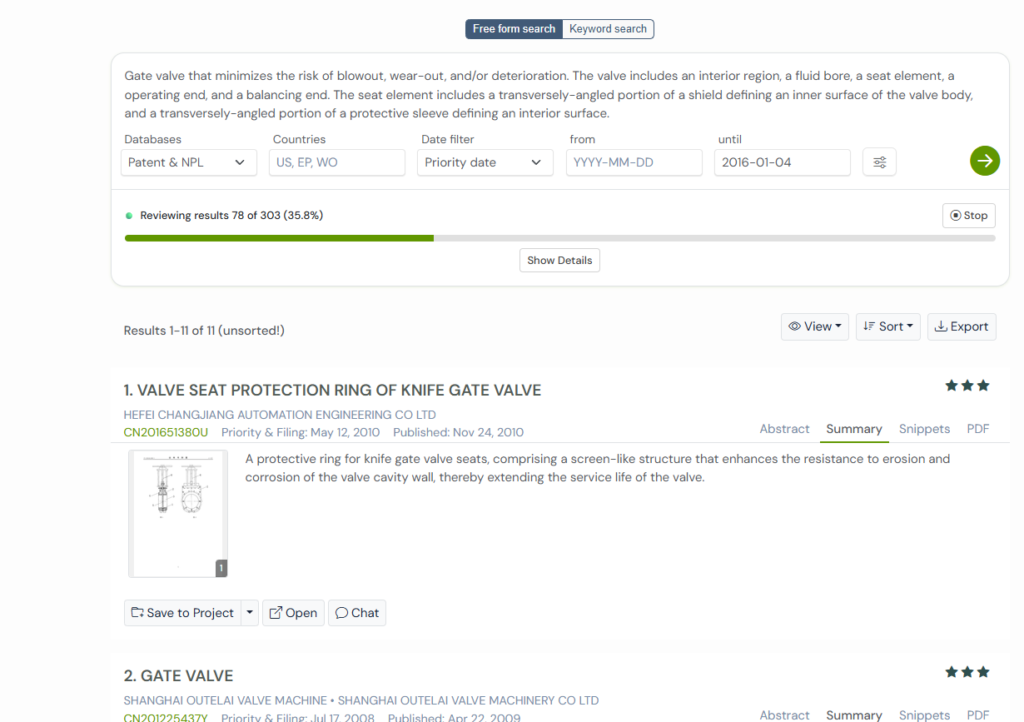
Let’s explore some of the similar innovations.
1. CN201651380U
What happens when abrasive fluid keeps scraping the inside of a knife gate valve? In many oil, slurry, and industrial flow systems, the valve cavity wall takes the most damage. Sand, corrosive liquids, and repeated opening and closing slowly eat into the metal. Once that surface wears out, the entire valve body often needs replacement, which drives up maintenance cost and downtime.
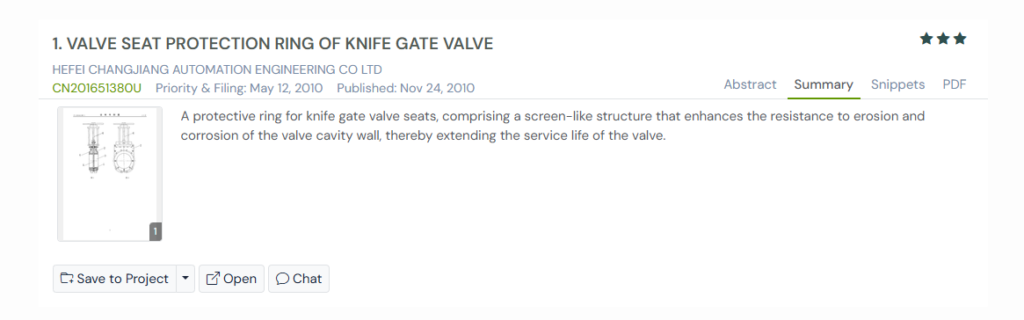
That problem is what CN201651380U, filed by Hefei Changjiang Automation Engineering Co. Ltd., tries to address. The patent introduces a valve seat protection ring placed inside the valve cavity. Made from wear-resistant materials like polyurethane or hard alloy, the ring acts as a sacrificial layer. It protects the cavity wall from erosion and corrosion. When the ring wears down, it can be replaced on its own without changing the valve body or seat.
This idea connects directly to US11105426B2. Both patents focus on protecting internal valve surfaces from abrasive flow. While this earlier design shields the cavity wall using a protective ring, the subject patent builds further by adding a full-bore protective sleeve.
Why It Matters in the Bigger Picture
This patent represents an early step toward treating internal valve protection as a replaceable feature rather than a permanent part of the valve body.
2. CN201225437Y
In many industrial systems, the biggest challenge with gate valves is not constant flow, but what happens when the valve moves. Opening and closing a valve in slurry or ash-filled pipelines causes sudden flow changes. Those moments create turbulence, pressure spikes, and direct impact on the valve plate and sealing surfaces, which is where most long-term damage begins.
That operating reality is what CN201225437Y, filed by Shanghai Outelai Valve Machinery Co. Ltd., focuses on. The patent introduces a gate valve design that adds abrasion sleeves inside the valve body and hardened, wear-resistant layers on the valve plate and sealing areas. These components strengthen the exact surfaces exposed during valve actuation. Since the sleeves and layers are separate parts, they can be replaced when worn, avoiding the need to rebuild the entire valve.
This connects to US11105426B2 through a shared goal of protecting high-wear internal zones. While this earlier patent focuses on strengthening moving and sealing surfaces, the subject patent advances the idea by maintaining a constant full-bore flow path while adding internal protection.
Why It Matters in the Bigger Picture
This design highlights how valve durability can be improved by reinforcing motion-related wear zones.
Similar pressure-driven behavior shows up in other fluid-handling systems as well, including expandable hose designs like those described in US9581272B2, where internal components respond dynamically to pressure changes rather than resisting them with rigid structures.
3. CN2106272U
What if a valve did not rely on just one sealing surface to do all the work? In high-pressure and high-temperature systems, even a small crack or groove on a sealing face can cause leaks and force the valve out of service. Once that sealing area is damaged, traditional valves often have no backup and no easy way to recover.
That concern is addressed in CN2106272U, filed in 1991. This patent describes a gate valve type globe valve that uses a double-layer valve seat and multiple sealing surfaces. During closing, the valve behaves partly like a gate valve, gradually narrowing the flow path.
Annular grooves on the sealing surface help expand the fluid and reduce pressure, which lowers the scouring force on the seals. The design also introduces a sleeve-type valve seat, making it possible to replace worn seats instead of scrapping the entire valve body.
This connects to US11105426B2 through the shared idea of protecting critical sealing areas using internal components. While this earlier patent relies on layered sealing and pressure reduction, the subject patent advances protection further by using a full-bore sleeve.
Why It Matters in the Bigger Picture
This patent shows an early move toward redundancy and replaceability in valve internals, helping extend valve life and influencing later designs that combine protection with long-term serviceability.
4. CN201265689Y
Some valve designs are built around one simple goal: make the parts that touch the flow easy to replace. Instead of strengthening the entire valve body, engineers focus on lining the flow path with components that can take the load and be swapped out when needed.
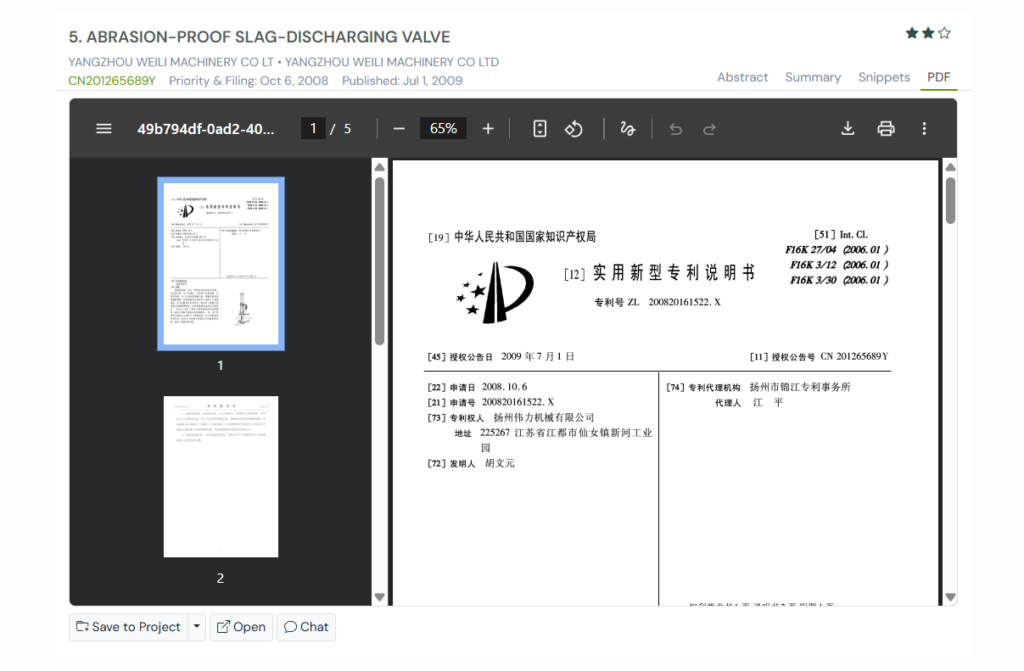
That thinking shows up clearly in CN201265689Y, filed by Yangzhou Weili Machinery Co. Ltd. in 2008. The patent describes a slag-discharging valve that uses wear-resistant inner sleeves at both the inlet and outlet of the valve body.
It also adds a wear-resistant valve plate and a tapered sleeve at the outlet that matches the angled rear surface of the valve plate. This alignment improves sealing while keeping the valve structure simple and service-friendly.
This approach connects to US11105426B2 through the shared idea of using internal sleeves to protect critical flow regions. The later patent takes this further by ensuring those protective elements maintain a constant, full-bore flow path across the valve.
Why It Matters in the Bigger Picture
This patent reflects a shift toward modular, replaceable internal components, an idea that directly influences modern full-bore valve designs focused on durability and long-term serviceability.
This broader push toward durability also appears in other engineering domains, such as the development of self-healing materials, where surfaces are designed to recover from damage rather than fail permanently under repeated stress.
5. US4949939A
What if a valve seat could be protected only when it actually needed protection? Instead of leaving sealing surfaces exposed all the time, this design asks a different question: can a valve actively shield its seats during operation and move that protection out of the way when it is not required?
That idea is explored in US4949939A, filed in 1989 by Edward M. Almada. The patent describes gate valves that include movable seat protectors placed on both the upstream and downstream sides of the valve seats.
These protectors can slide into position to cover the seats while fluid is flowing through aligned openings in the protectors. When protection is no longer needed, the protectors retract into the bonnet area. The design allows valve seats to be shielded from wear and erosion and replaced easily without changing the entire valve.
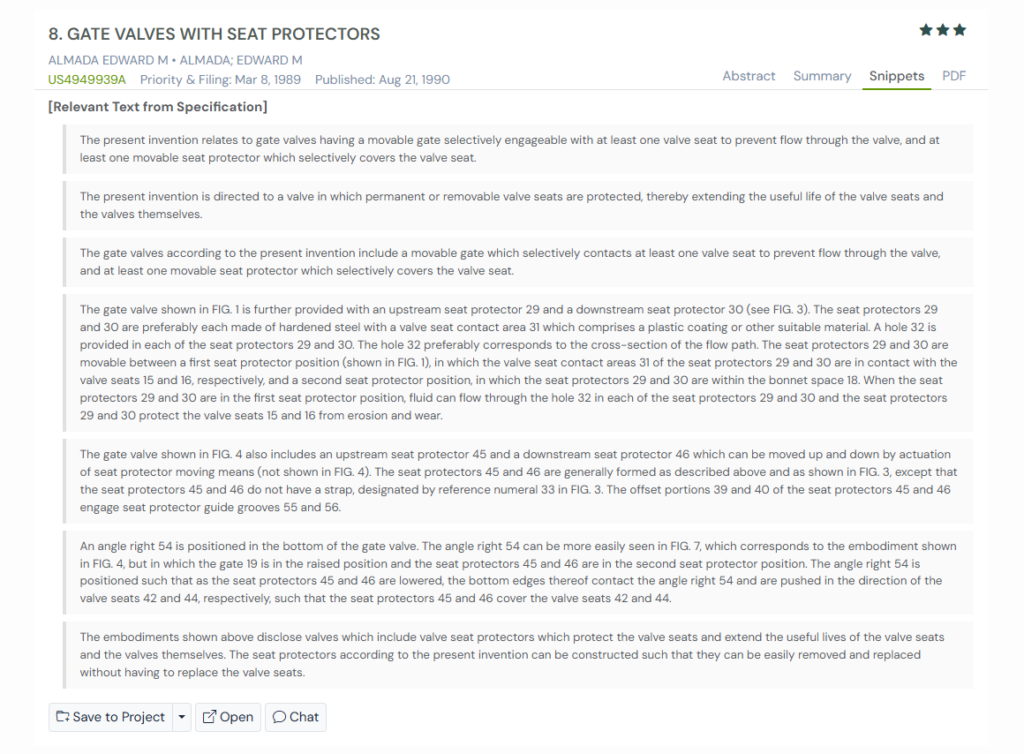
This concept connects to US11105426B2 through the shared focus on protecting valve seats to extend valve life. While this earlier patent relies on movable components to cover the seats, the subject patent simplifies protection by using a fixed full-bore sleeve that continuously shields internal surfaces without adding moving parts.
Why It Matters in the Bigger Picture
This patent represents an early attempt to actively manage valve seat wear, influencing later designs that aim to protect critical internal areas while keeping valve operation simpler and more reliable.
With these earlier designs in mind, it becomes easier to compare how each patent approached internal protection, sealing, and flow, and how those choices stack up side by side.
A similar principle of managing internal structure to reduce wear can be seen in this patent audit of US8033079B2, which explains how terrazzo tiles achieve durability while remaining thin and seamless.
How These Valve Designs Compare Side by Side
Each of these patents tackles durability and protection from a different angle. Some focus on replaceable parts, others on sealing redundancy or movable protection. Putting them next to each other makes it easier to see how valve design thinking evolved and where US11105426B2 stands apart.
| Patent | Core Idea | Protection Method | Replaceable Components | Impact on Flow | Connection to US11105426B2 |
| CN201651380U | Protect valve cavity walls | Fixed protective ring inside cavity | Yes, ring is replaceable | May introduce internal transitions | Early use of sacrificial internal protection |
| CN201225437Y | Reduce wear during valve movement | Abrasion sleeves and hardened valve plate surfaces | Yes, sleeves and layers | Flow affected during actuation | Protects high-wear zones but not full-bore |
| CN2106272U | Add sealing redundancy | Double-layer valve seats with grooves | Yes, sleeve-type seats | Reduces pressure locally | Focuses on sealing protection rather than flow consistency |
| CN201265689Y | Modular internal lining | Inlet, outlet, and tapered wear sleeves | Yes, multiple internal parts | Flow geometry varies | Moves toward sleeve-based internal protection |
| US4949939A | Active seat protection | Movable seat protectors | Yes, removable protectors | Openings aligned but moving parts | Protects seats intermittently |
| US11105426B2 | Continuous internal protection | Fixed full-bore protective sleeve | Yes, sleeve protects body and seals | Constant full-bore flow | Combines protection with uninterrupted flow |
How GPS Helps Make Sense of Valve Patent Evolution
Looking at valve patents one by one only tells part of the story. The real value comes from seeing how ideas connect, where they overlap, and how newer designs build on earlier attempts.
That is where Global Patent Search (GPS) becomes useful. Instead of digging through long documents, GPS is the best patent analysis tool that helps you understand the broader design journey behind innovations like full-bore protective valves.

Here’s how you can use GPS effectively:
- Enter a patent number to quickly find related valve and flow-control inventions.
- Scan concise summaries to understand what each patent is really trying to solve.
- Compare older patents and non-patent literature to see how protection, sealing, and flow concepts evolved.
- Sort results by relevance to focus on specific themes like erosion control or sleeve-based designs.
- Trace how one idea leads to another across different time periods and applications.
If you want a clearer and faster way to explore patent landscapes like this, try Global Patent Search and see how much easier patent research can be.
Also read: Top AI Patent Claim Chart Generator for In-house IP Counsel in 2026
Disclaimer: The information provided in this article is for informational purposes only and should not be considered legal advice. The related patent references mentioned are preliminary results from the Global Patent Search tool and do not guarantee legal significance. For a comprehensive related patent analysis, we recommend conducting a detailed search using GPS or consulting a patent attorney.
Frequently Asked Questions
1. Why is full-bore flow important in gate valves used in oil and gas operations?
Full-bore flow allows fluid to pass through the valve without any reduction in internal diameter. This helps maintain consistent pressure, reduces turbulence, and prevents sand or debris from accumulating inside the valve. In high-pressure oilfield operations, full-bore flow also lowers erosion and improves overall system efficiency.
2. How do protective sleeves help extend the life of gate valves?
Protective sleeves act as a barrier between the flowing fluid and the valve’s main structural components. Instead of abrasive particles wearing down the valve body or seals, the sleeve absorbs most of the damage. Since sleeves are easier to replace than valve bodies, maintenance becomes simpler and more cost-effective.
3. What causes internal valve components to wear out faster in abrasive flow conditions?
Wear accelerates when fluids carry sand, slag, or solid particles at high velocity. Sudden changes in bore diameter, sharp internal edges, and turbulence increase the scouring effect on metal surfaces. Over time, this leads to erosion of sealing areas, loss of sealing integrity, and reduced valve performance.
4. How does a smooth internal flow path improve valve performance?
A smooth internal flow path minimizes turbulence and pressure drops as fluid moves through the valve. This reduces mechanical stress on internal surfaces and seals. By keeping the flow straight and uninterrupted, valves operate more predictably, experience less erosion, and maintain consistent performance under demanding operating conditions.