
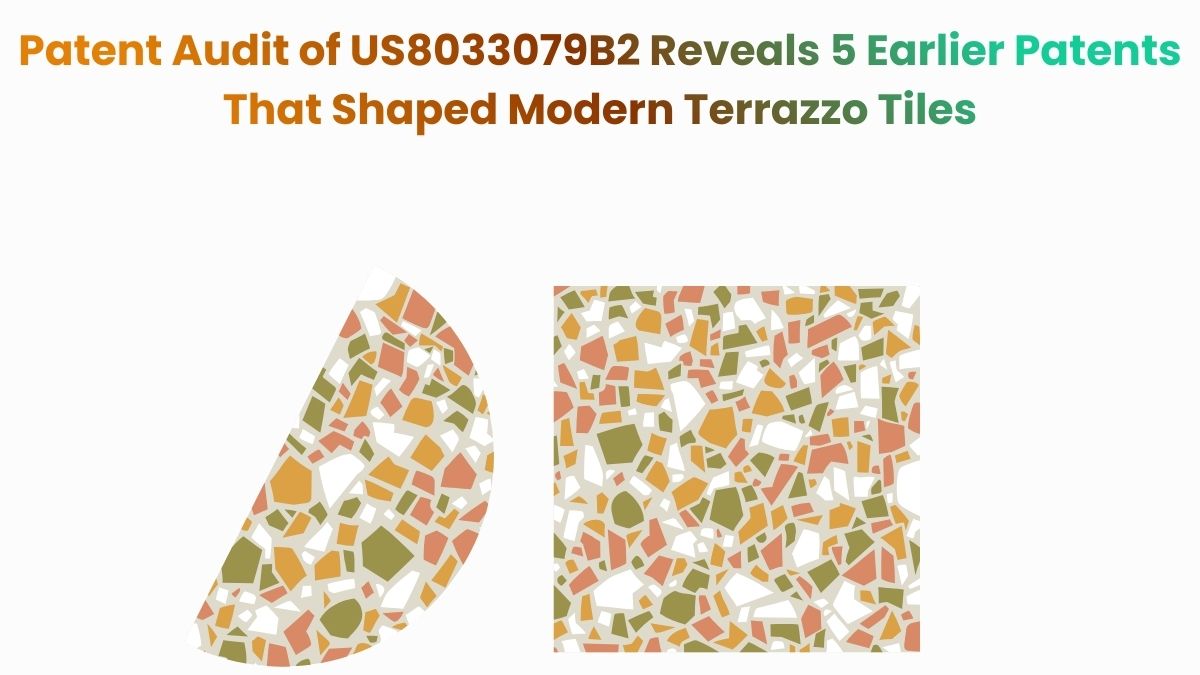
For a long time, terrazzo floors have been popular because they last long and look clean and seamless. But building them has always been difficult. Traditional terrazzo floors are poured directly at the site. They take time, create a mess, and need highly skilled workers to get the surface right.
To avoid this, many tried using terrazzo tiles. But that created new problems. The tiles were thick, hard to polish, and once installed, the grout lines made the floor look broken instead of smooth.
The inventor, John H Sich came up with a way to fix this exact problem. The US8033079B2 patent describes how terrazzo tiles can be manufactured to be thin, polished without cracking, and installed to create a floor that appears and feels as a single continuous surface. This method is commercially important and is part of active litigation, including Floorazzo Tile, LLC v. Nurazzo, LLC.
To understand how this idea developed, we used the Global Patent Search tool. Our intent was to trace earlier inventions that tried to solve similar problems around terrazzo tiles and seamless flooring.
What US8033079B2 Actually Changes
At its core, US8033079B2 is about control. Earlier terrazzo tiles failed because too much was left to chance. Stone chips were mixed randomly. Tiles had to be thick to survive polishing. And once installed, grout lines made the floor feel stitched together instead of seamless.
This patent flips that approach. Instead of mixing everything at once, the process is staged. First, a resin mixture with fillers and color is poured into a very shallow mold. Only after that are the stone chips added. Gravity does the rest. Most of the stone chips naturally sink to one side of the tile.
After curing, that stone-rich side becomes the top surface. The tiles are then ground and polished using a system that keeps constant pressure on them, so even very thin tiles do not crack or bend. Once installed, the tiles are grouted with the same resin material and polished again. The result is a floor that looks poured, even though it is built from tiles.
Key Features Behind US8033079B2:
- The tile is made by pouring resin first and adding stone chips later, so most stones naturally settle on one side.
- The side where most stones settle becomes the top surface of the tile after polishing.
- The tiles are made very thin by using shallow molds, which saves material and reduces weight.
- A special polishing setup keeps the tile supported at all times so it does not crack or bend.
- The tiles are installed with very narrow gaps and filled with grout made from the same resin.
- After final polishing, the floor looks like one continuous surface instead of separate tiles.
Once you understand what this patent makes possible, the next step is to look at how earlier inventions tried to solve parts of the same problem.
Electropolishing is not something most people think about every day, but it plays a quiet role in industries like aerospace, medical devices, and precision manufacturing. EP4249647A1 is one patent that explores a different way of handling this process.
Earlier Patents That Shaped This Idea
US8033079B2 did not appear out of nowhere. Before this method was introduced, many inventors were already trying to improve terrazzo tiles, flooring systems, and seamless surfaces.
To understand how these earlier efforts connect, we used the Global Patent Search tool to map patents that addressed similar challenges. GPS helps surface related inventions, shows what problems they were trying to fix, and reveals how those ideas slowly moved the industry toward thinner tiles and more seamless flooring systems.
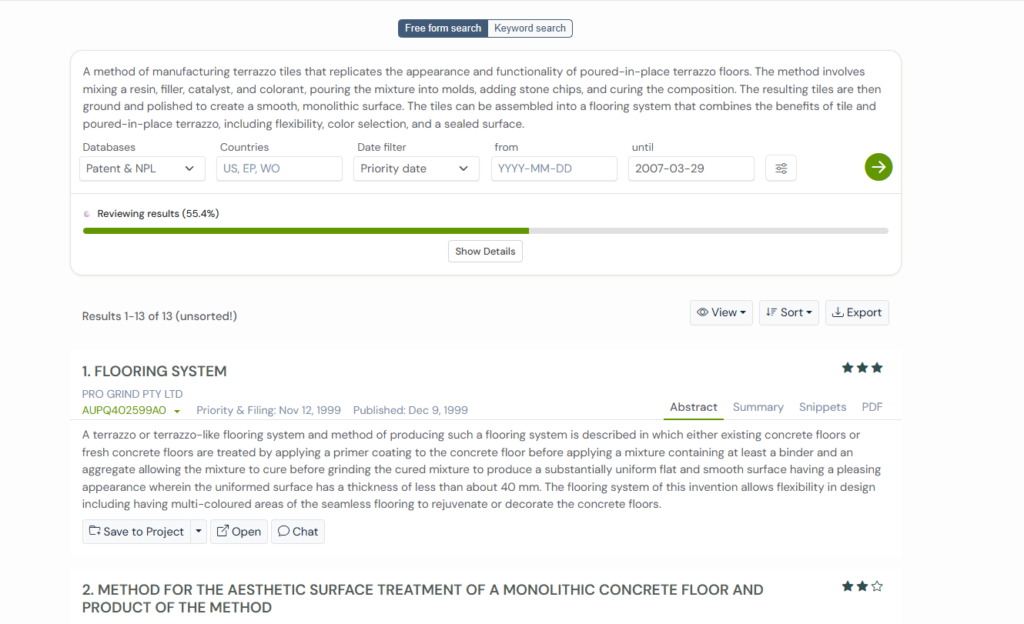
Now, let’s look at some of the earlier patents that helped shape the path leading to US8033079B2.
1. US2004159073A1
This patent looks at a very common problem in large buildings. Plain concrete floors are strong, but they don’t look good. To improve the appearance, builders usually add tiles, coatings, or terrazzo layers on top. That adds cost, time, and extra labor.
US2004159073A1, filed by LPL Enterprises in 2003, takes a different approach. Instead of adding something later, it changes how the concrete floor is finished while it is being poured. Decorative stone chips are spread directly onto the surface of the wet concrete. These stones are then pressed into the top layer before the floor fully cures.
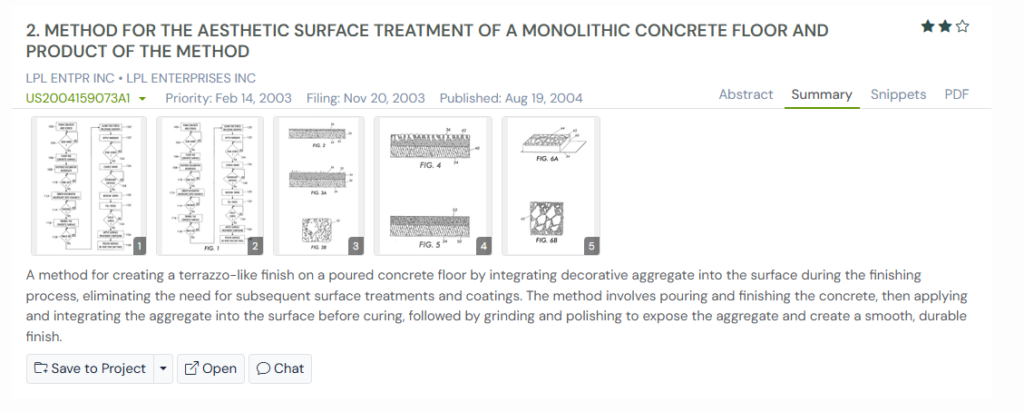
Once the concrete hardens, the surface is ground and polished. This exposes the stones and creates a terrazzo-like look, but the floor remains a single, poured slab with no tiles and no grout lines.
This patent connects to US8033079B2 through the shared goal of achieving a seamless, terrazzo-style surface. The difference is that this earlier invention stays fully poured-in-place, while US8033079B2 moves that same visual idea into factory-made tiles that can be installed faster and with less on-site work.
Why It Matters
This patent showed that a terrazzo-like surface could be created directly within a concrete floor without adding tiles or coatings. That idea later influenced ideas like those covered in US8033079B2, which achieved the same seamless look using factory-made terrazzo tiles instead of poured concrete.
2. US2003230041A1
This patent focuses on a different problem with terrazzo floors. Traditional terrazzo had to be poured at the site. That made installation slow, expensive, and difficult to manage for large areas. Builders wanted a way to make terrazzo floors faster without losing the clean, seamless look.
US2003230041A1, filed in 2003, proposes making terrazzo panels in advance, away from the construction site. Instead of pouring terrazzo directly on the floor, a large terrazzo surface is created, cured, ground, and polished in a controlled setting. After that, the surface is cut into panels of fixed sizes.
These panels are designed to lock together using grooves along their edges. This helps align the panels during installation and reduces visible seams between them. Once installed, the panels create the appearance of a continuous terrazzo floor, but with far less on-site labor.
This patent connects to US8033079B2 through the shared idea of prefabrication. Both move terrazzo work away from the job site and into a factory setting. US8033079B2 builds on this by making the tiles thinner and by using resin-based grout and polishing to further reduce visible joints.
Why It Matters
This patent showed that terrazzo floors could be prefabricated instead of being poured on-site, which reduced time, cost, and labor.
Innovations in materials are not limited to surface finishing alone. A similar shift can be seen in the rise of self-healing materials, where patents trace how coatings and composites evolved to repair damage automatically instead of relying on manual intervention.
3. JPH0724849A
This patent looks at a basic manufacturing issue in artificial stone panels. When stone chips are mixed with liquid resin, the stones are much heavier than the resin. During curing, this difference often causes uneven settling, air bubbles, and warping, especially in thin floor panels.
JPH0724849A, filed in 1993 by Aica Kogyo Co, focuses on controlling the resin mixture itself. It defines specific ranges for resin thickness, stone size, and filler materials so that stone particles stay evenly distributed while the panel cures. Instead of using opaque fillers that dull the surface, it uses transparent fillers like silica powder. This helps keep the stone texture visible and natural-looking.
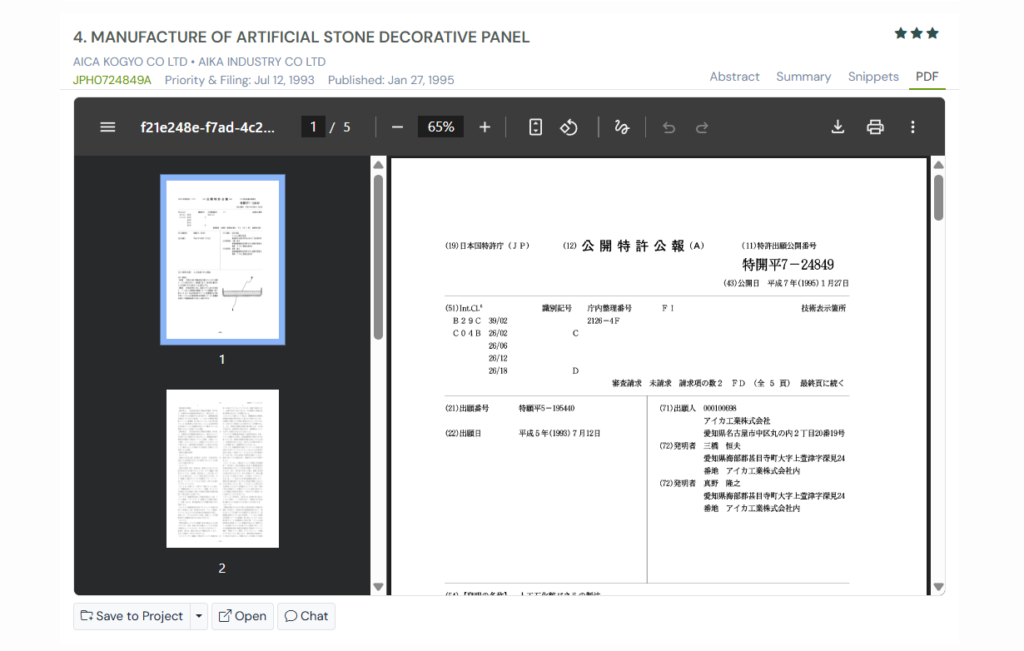
The process also includes vibration to remove trapped air, followed by staged curing and surface polishing. These steps help produce a flat panel with a smooth, stone-rich surface and fewer defects like bubbles or bending.
This patent overlaps with US8033079B2 in how it deals with stone settling inside resin. Why It Matters
This patent showed how controlling resin flow and stone settling could prevent warping and uneven surfaces. That same idea of managing how stone behaves inside resin later appears in US8033079B2, where stone settling is used deliberately to improve the visible surface of terrazzo tiles.
4. US5849124A
This patent comes from a time when designers wanted more control over how resin-based floors looked. Existing epoxy floors worked, but they were hard to apply evenly, difficult to color consistently, and limited in color options. Matching one floor section with another was especially tricky, even when using the same materials.
US5849124A, filed by Colorston in 1995, focused on solving this by working on the stones before they ever touch the resin. The stones are first mixed with liquid colorant, dried, and only then combined with epoxy resin. This makes the color more accurate and repeatable. The stone-and-resin mix is poured onto the floor, leveled, sealed with additional epoxy layers, and left to harden. The system can be used as a poured floor or cast into sheets and cut into tiles.

The patent also describes making decorative flooring panels and logos. Divider strips could be used to separate areas, different colored stone mixes are poured into each section, and multiple epoxy layers are applied to seal and smooth the surface. The result is a detailed, decorative composite floor with controlled color and finish.
This patent overlaps with US8033079B2 in its use of stone mixed with resin to create decorative flooring. However, while US5849124A focuses on color control, surface sealing, and poured or sheet-based systems, US8033079B2 moves toward thinner, factory-made terrazzo tiles.
Why It Matters
This patent showed how resin and stone systems could be carefully controlled for appearance and consistency.
Material behavior inside a product often matters as much as the final surface. A similar principle appears in EP3835470B1, where controlled internal structure in surgical sutures improves performance, much like how resin and stone distribution shape terrazzo tile quality.
5. CN1098390A
The CN1098390A patent looks at a very practical problem in construction. Natural granite looks premium, but it is heavy, expensive, and difficult to work with. Cutting, transporting, and installing granite tiles takes time and increases cost, especially for large wall and floor projects.
CN1098390A, filed in 1994, offers a lighter alternative. Instead of using full granite slabs, it uses leftover granite scraps mixed with polyester resin and curing agents. This mixture is poured into molds, allowed to cure at room temperature, and then cut into tiles. The result is a tile that looks like granite but is much easier to produce and handle.
The patent also focuses on durability. Additives such as light stabilizers and liquid paraffin improve resistance to wear and sunlight, making the tiles suitable for both walls and floors. Because the process uses waste granite and simple molding, production costs are significantly reduced.
This patent overlaps with US8033079B2 in its use of stone particles embedded in resin and molded into tiles. However, CN1098390A is mainly about imitating the appearance of granite, while US8033079B2 focuses on how stone settles, how thin tiles can be polished safely, and how those tiles are installed to create a seamless, terrazzo-style floor.
Why This Patent Matters
This patent showed that resin-bound stone tiles could replace heavy natural stone in many applications.
A comparable emphasis on long-term durability under abrasive conditions can be seen in US11105426B2, where uninterrupted internal flow helps reduce cumulative wear inside gate valves.
How These Earlier Patents Compare to US8033079B2
Each of the earlier patents we looked at tried to solve a specific problem around stone flooring. Some focused on poured concrete, others on prefabrication, color control, or resin behavior. None of them solved everything at once.
Looking at them side by side makes it easier to see how US8033079B2 brings several of these ideas together into a single, more practical system.
Here’s a quick comparison to show how each earlier patent fits into the bigger picture.
| Patent | Core Focus | How It Approaches the Problem | How It Connects to US8033079B2 |
| US2004159073A1 | Decorative poured concrete floors | Adds stone chips directly into wet concrete and polishes the surface after curing to create a terrazzo-like look | Shares the goal of a seamless surface, but stays fully poured-in-place instead of using factory-made tiles |
| US2003230041A1 | Prefabricated terrazzo panels | Creates large terrazzo sheets off-site, then cuts them into panels that lock together | Introduces prefabrication, which US8033079B2 refines by making thinner tiles with less visible joints |
| JPH0724849A | Preventing warping in resin stone panels | Controls resin viscosity, stone size, and fillers to keep stone evenly distributed | Addresses stone settling issues that US8033079B2 later uses intentionally to improve the visible tile surface |
| US5849124A | Color control in resin-based flooring | Pre-colors stone before mixing with resin and seals the surface with epoxy layers | Uses resin and stone like US8033079B2, but focuses on color consistency rather than thin tiles and polishing |
| CN1098390A | Lightweight granite-look tiles | Mixes granite scraps with resin to create molded tiles that imitate natural stone | Similar resin-and-stone tile concept, but without the controlled settling and seamless installation focus of US8033079B2 |
How GPS Helps Make Sense of Patents Like US Patent No. 8033079B2
When you read patents individually, it is easy to miss the bigger picture. Each document talks about a narrow solution, but the real insight comes from seeing how ideas connect over time.
That is where Global Patent Search becomes useful. It helps turn scattered patent documents into a clear, connected story of how an innovation evolved.

Here is how you can use GPS to explore patents like US8033079B2:
- Enter the patent number into GPS to find related and earlier inventions in the same space.
- Scan short summaries to quickly understand what problem each patent tried to solve.
- Compare multiple patents side by side to see differences in approach and design.
- Trace how ideas like stone settling, resin control, or prefabrication evolved across time.
- Open full documents only when you need deeper technical or process-level details.
By following this approach, GPS can help you save time and remove the guesswork from patent research. Instead of reading hundreds of pages, you get clarity faster.
If you want to understand how an idea developed before it reached its final form, try running it through Global Patent Search tool and explore the full innovation trail.
Frequently Asked Questions
1. What are terrazzo tiles made of?
Terrazzo tiles are typically made from stone chips such as marble or granite mixed into a resin or cement-based binder, then cured, ground, and polished.
2. How are terrazzo tiles different from poured terrazzo floors?
Poured terrazzo is installed directly on-site as a single slab, while terrazzo tiles are manufactured in a factory and later installed like standard floor tiles.
3. Why are stone chips concentrated near the surface in terrazzo tiles?
Concentrating stone near the surface improves the visual appearance after polishing and reduces material use without sacrificing durability.
4. How thin can terrazzo tiles be without breaking?
Modern manufacturing techniques allow terrazzo tiles to be made much thinner than traditional tiles, often around 1/8 inch, while still remaining stable during polishing and use.
5. Why is polishing such an important step in terrazzo tile production?
Polishing exposes the stone chips, smooths the surface, and gives terrazzo its characteristic glossy, finished appearance.
Disclaimer: The information provided in this article is for informational purposes only and should not be considered legal advice. The related patent references mentioned are preliminary results from the Global Patent Search tool and do not guarantee legal significance. For a comprehensive related patent analysis, we recommend conducting a detailed search using GPS or consulting