If you Google “AI patent search platform” today, you’ll see a dozen options surface. Each of these tools claims a different edge. Some offer add-ons like monitoring and analytics, while others support workflows through patent drafting and prosecution.
But most of these tools, while being good, are not designed for in-house IP counsel. For busy professionals like you, handling multiple moving parts, you need tools that can get you the right answer fast.
For a day filled with triage, inbound questions across departments, risk calls, document drafting, and tight timelines, you need an AI patent search tool that can make your work easier.
In this article, we’ll lay out the non-negotiable features an AI patent search platform should have in 2026. The ones that actually help counsels like you cut through the noise, find strong references faster, and move work forward with confidence. Then we will also take a look at the Global Patent Search tool and how it meets these requirements.
6 Features to Look For in an AI Patent Search Platform in 2026
At this point, “AI patent search” is an overloaded label. Two tools can use AI and still deliver completely different outcomes. Reddit user (Weary-West-6855) put it well: it’s hard to translate an invention into patent language, results can feel overwhelming or incomplete, and even after searching, you’re not confident you didn’t miss something.
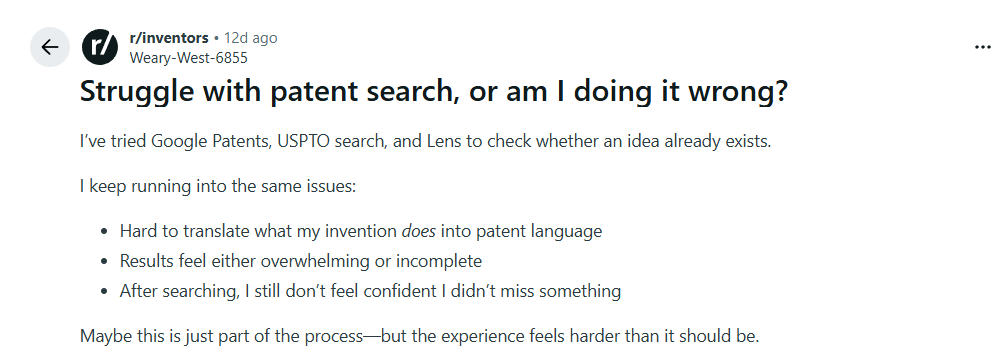
Source – Reddit
The real issue is that most tools use different NLP approaches, ranking logic, and training datasets. So one platform might understand your idea even if you don’t use “patent phrasing,” while another might struggle to surface the right references unless you already know the exact terms to search.
That is why we will now focus on capabilities, not buzzwords. The goal is simple: define the feature set that reliably supports your everyday work without creating more manual cleanup.
- Ability to Understand the Invention Without Needing the Right Keywords
- Surface the Most Relevant Prior Art First through intelligent relevance ranking
- Liberty to Search by Patent Number
- Surface Prior Art Beyond Patents
- Check Whether a Patent Is Truly Standard-Essential
- Run High-Stakes Searches Without Risk
Let’s take a deep dive!
1. Ability to Understand the Invention Without Needing the Right Keywords
The biggest friction in patent search is translation. Say, you have a technology idea that you describe in plain English. But patents are filled with technical terms and jargon.
And the reality is, most search tools quietly punish you for not using the “right” terms.
That is where a good tool that allows true semantic understanding matters. A good AI patent search platform will let you describe an invention in simple terms and still surface technically relevant prior art.
For example, imagine an inventor working on an energy management system where indoor temperature adjusts dynamically based on occupant temperature readings. If the room runs hot, the system cools more aggressively. If occupants are cold, the system dials back cooling. The core idea is comfort optimization based on sensed human temperature, without requiring manual input.
Chances are, if you run this query in most tools, you would have to guess terms like “thermal comfort index,” “occupant-centric HVAC control,” “physiological sensing,” or “adaptive setpoint modulation” to get meaningful results.
This is where dataset quality and ranking logic matter.
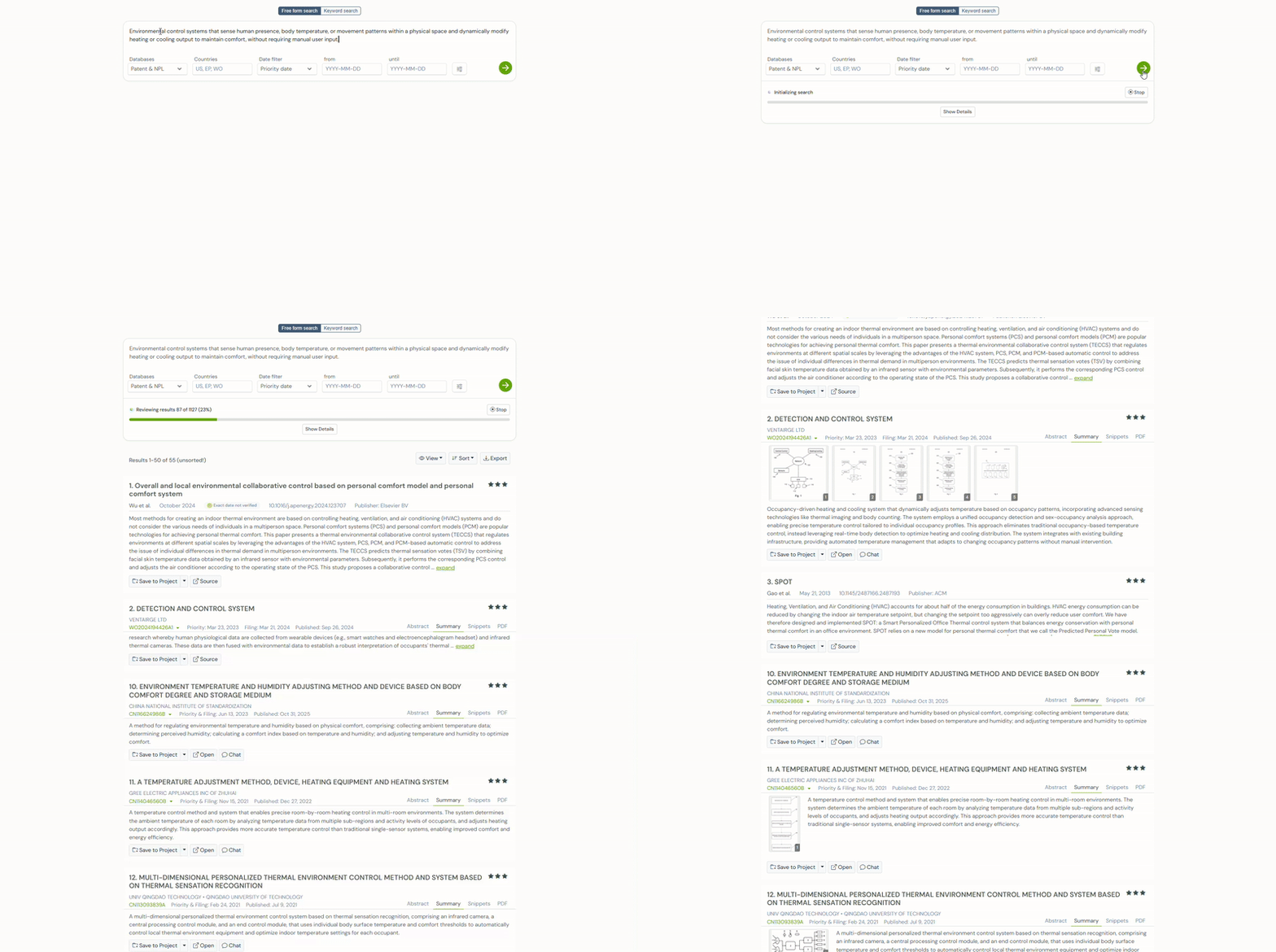
When we added the query to GPS, it surfaced a Chinese patent, CN11954514A in the top results that closely captured the idea.
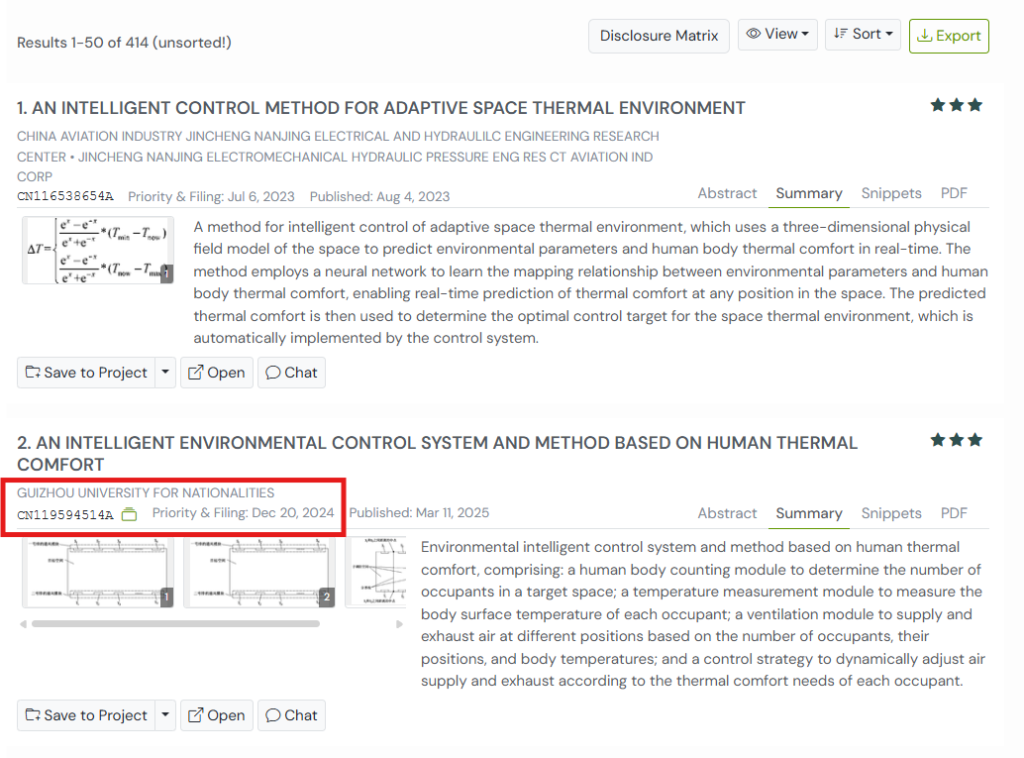
Next, let’s look at the second capability that separates an amazing AI search tool from one that actually works for expert searchers.
2. Surface the Most Relevant Prior Art First through Intelligent Relevance Ranking
One of the most common problems users face when using AI patent search tools is having to manually go through hundreds of results. While some tools offer ratings to indicate how closely they match the search query, relevance-based ranking is a real differentiator.
You see, traditional tools usually let you sort by filing date or priority date. That is helpful for timeline building. But it does not solve the real problem: finding the best matches first.
A strong AI patent search platform should let you sort results by relevance, so the most conceptually aligned references rise to the top.
This is where GPS performs well. It offers a sort by relevance view that prioritizes the closest matches to your invention, whether you are running a keyword-based search or a free-form search.
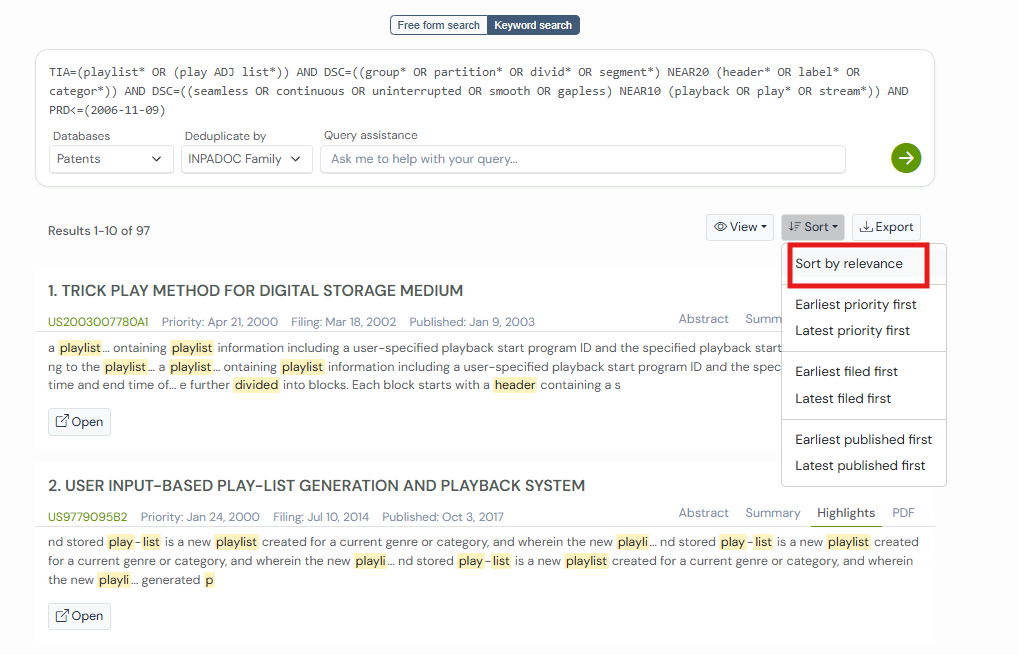
Moreover, it also makes it easier to steer the result set as your search intent evolves, so you spend less time scanning and more time validating the few references that actually matter.
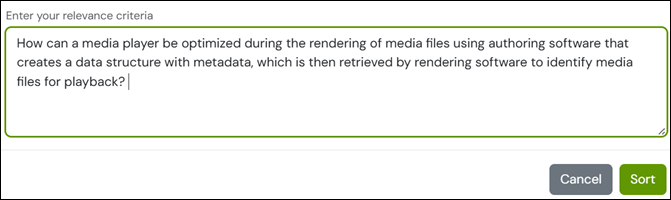
For instance, in the above keyword-based search, the user added a natural language query to surface patents that are more relevant to their use case. It helps tighten the search without restarting from scratch. You can learn more about the feature here.
3. Liberty to Search by Patent Number
For counsels, a lot of their work starts with a patent number at its core. Say, an issued patent shows up in a clearance conversation. There are chances it can get asserted. As a counsel, you would want to stress test the patent to determine if a licensing agreement should be made. If strong prior art surfaces, you can have the upper hand in negotiations or even choose to challenge the patent’s validity in court.
But why bother translating your patent into a query? This is where search by patent number becomes a practical feature.
Instead of forcing you to translate an issued patent into a perfect keyword query, a good platform should let you enter the patent number and do the heavy lifting: pull up the patent, surface the most relevant similar references, and make it easy to sort and narrow from there.
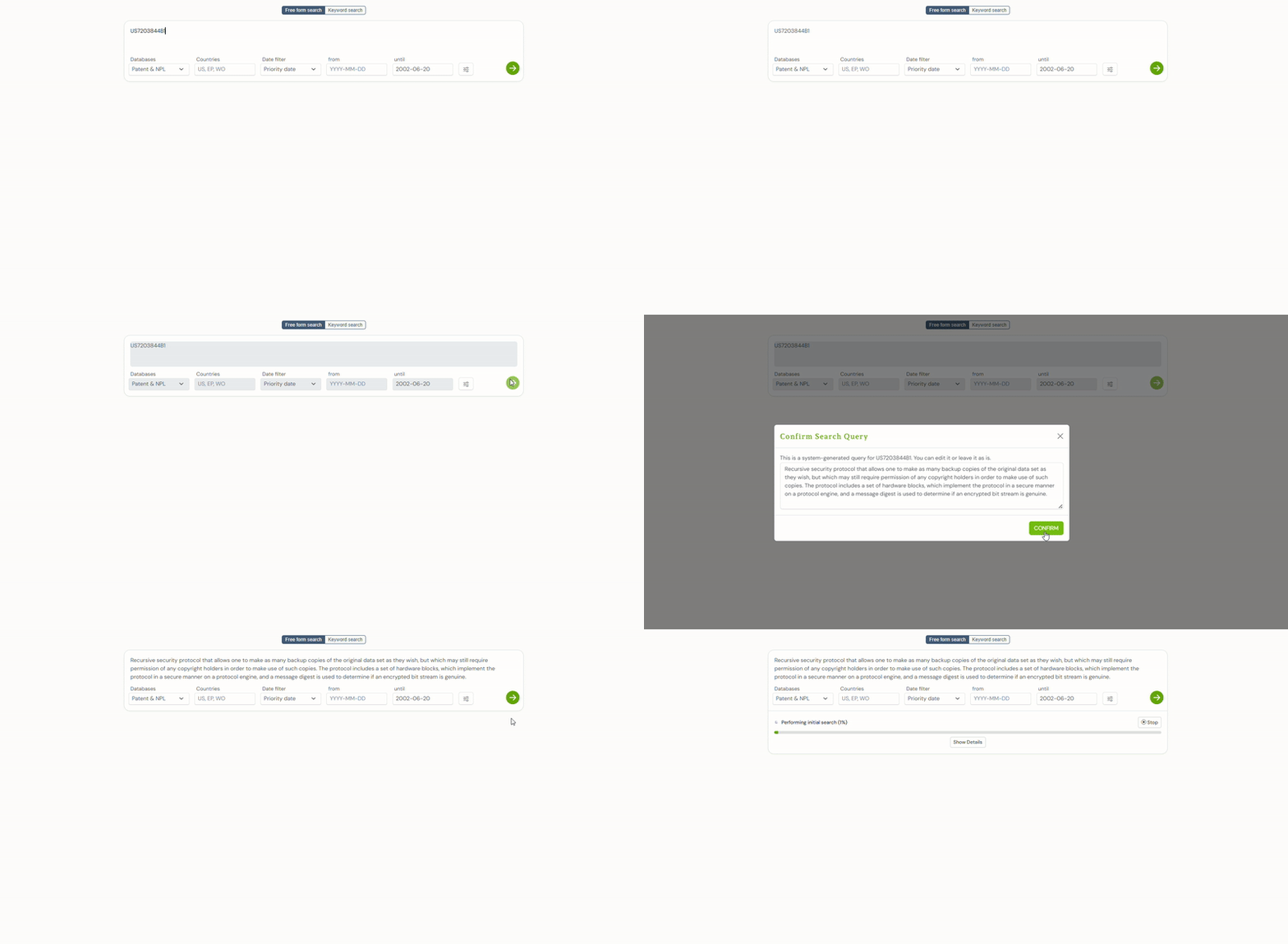
In GPS, you can enter a patent number, and the system pulls up the patent with a clear description and key metadata, such as the priority date. From there, GPS surfaces relevant patents around the same concept, and when you combine this with sort by relevance, you can quickly move from “a long list of patents” to the few references that actually matter.
An added advantage GPS offers is the Disclosure Matrix. Once you have a set of relevant references, GPS can lay them out in a matrix view so you can see which claim elements of the subject patent overlap with the references, without manually doing it across different tools.
4. Surface Prior Art Beyond Patents
Not all prior art exists inside patents. In many cases, the strongest references are found in academic papers, product manuals, whitepapers, or industry publications. Especially in fast-moving domains, ideas are often discussed publicly long before someone files a patent.
That is why non-patent literature (NPL) support is critical.
A serious AI patent search platform should not limit you to patents alone. It should allow you to search across scientific publications and other technical documents so your invalidity analysis is not artificially narrow.
That’s why we built the Global Patent Search Tool to provide access to a broad corpus of scientific documents, enabling you to surface prior art across both patent and non-patent sources.
This means when you are evaluating an invention or stress-testing a patent, you are not relying on patents alone – you are searching across the wider technical record.
5. Check Whether a Patent Is Truly Standard-Essential
When you are working in standards-driven technologies, like telecom or video, one question might be regularly a part of your workflow: Check if a certain patent is actually essential to the given standard?
Because not every patent declared as a Standard Essential Patent (SEP) is truly essential.
While standard-setting bodies like 3GPP, ETSI, and others allow assignees to declare patents as essential. But declarations are not the same as verification. In licensing discussions, portfolio valuations, or even M&A diligence, this distinction becomes critical. A patent that is genuinely essential to a standard carries far more weight than one that is merely declared as such.
Traditionally, checking essentiality is a manual exercise. You map each claim element of the patent against the relevant sections of the standard specification. If every required technical step is found in the standard, the patent may be essential. If key elements are missing, it is not.
This process is extremely time-consuming and difficult to scale, especially when you are reviewing hundreds of patents across different standards.
This is where GPS introduces a practical solution.
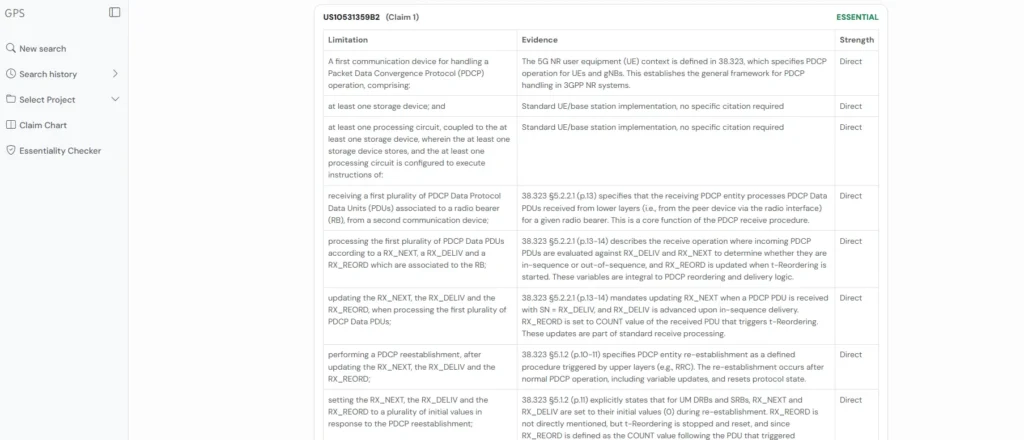
With the Essentiality Checker, you can input up to 20 patents at a time against a selected standard. GPS analyzes the patents against the standard documentation and provides an indication of whether the patents are essential to the standard or not.

Counsels can use the surfaced mappings to validate essentiality, reducing the time and effort spent on manual comparison.
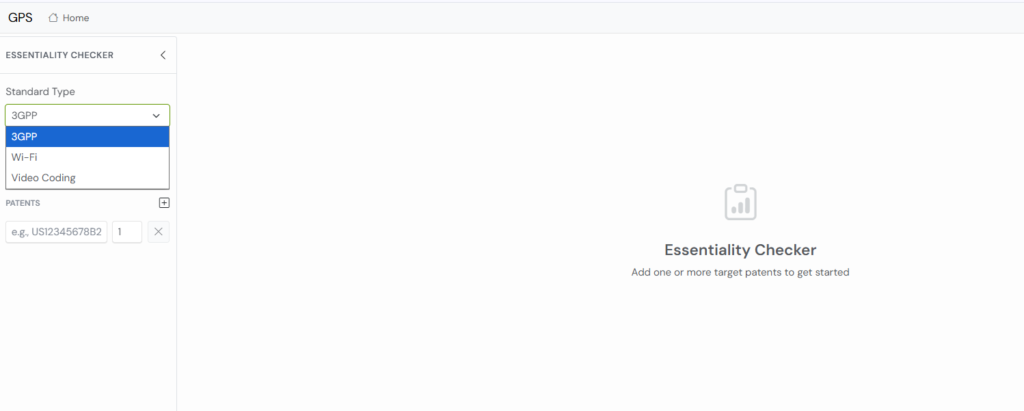
Right now, GPS supports essentiality checks for 3GPP, Wi-Fi, and Video Coding standards. However, we will continue to add more standards in the coming time.
6. Run High-Stakes Searches Without Risk
We understand that as counsels, you do not just run searches. You evaluate inventions, stress-test portfolios, and assess legal risk.
That means the data entered into any tool is often confidential, commercially sensitive, and sometimes pre-filing.
Security is foundational here. A serious AI patent search platform must be built with a privacy-first architecture. While there exist many tools in the market, not many disclose how user queries are handled, whether uploaded documents are stored, or whether customer data is used for model training. For legal teams, that ambiguity alone is a red flag.
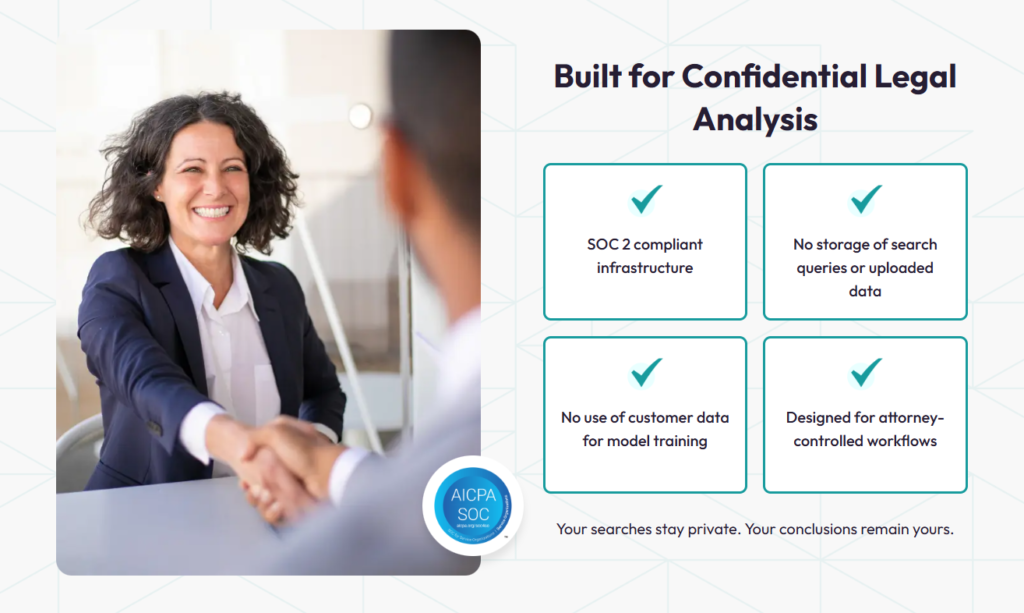
That’s why we built Global Patent Search with privacy and security at its core. The platform is SOC 2 compliant and designed for confidential legal analysis. Moreover, we do not store search queries, uploaded documents, nor do we use customer data for model training.
The platform is structured around counsel-controlled workflows, ensuring that your searches remain private.
Source – Global Patent Search
Now that we have had a look at the features, it ought to be mentioned that the definition of “best” varies from one use case to another. For an IP counsel, what might be defined as best might not fit the definition of best for a single inventor.
So while there are different AI patent search tools in the market, what might work for inventors might not work for you. The Global Patent Search tool, however, is built keeping the needs of IP counsels and attorneys in mind, so you get the best experience every time.
Let’s now look at why GPS is the best choice for you as an IP counsel.
Why Global Patent Search Is the AI Patent Search Platform You Need in 2026
There are dozens of tools in the market. But in 2026, the real differentiator is alignment.
We understand that, as an IP counsel, you do not need another nicer-looking search interface. You need a platform that understands how legal decisions are actually made, under time pressure, across multiple stakeholders, with real financial and litigation consequences.
While the tool does not replace legal judgment, it was built to support counsels make faster, more confident decisions. Whether you are testing novelty, stress-checking an asserted patent, evaluating portfolio strength, or assessing standard essentiality, GPS reduces translation friction and surfaces structured insights quickly.
Moreover, what makes GPS stand out is not any single feature. It is the way these capabilities work together to shorten analysis cycles without compromising rigor.
In 2026, AI patent search will be everywhere. But platforms built specifically for in-house counsel will not. If you are evaluating your next AI patent search platform, GPS is your top choice.
If you would like to give the tool a try, you can request access, and our team will get back to you via email.
Frequently Asked Questions
1. Can ChatGPT or other generative AI tools be used for patent search?
Generative AI tools can summarize concepts or suggest keywords. At best, they can also formulate queries. However, they are not connected to structured, continuously updated patent databases from which they could share results. Moreover, users who have tried Generative platforms have reported hallucinated citations or inaccurate references.
2. How accurate are AI-based patent search tools compared to traditional databases?
Accuracy depends on the underlying dataset and ranking logic. Traditional databases rely heavily on Boolean precision. AI-based platforms add semantic understanding, which reduces keyword dependency. The strongest tools combine both: semantic intelligence with structured filtering, so you get conceptual matches without sacrificing legal defensibility.
3. Is AI patent search suitable for validity and invalidity analysis?
Yes, but as a first-pass accelerator. AI tools can surface conceptually similar references quickly, helping you prioritize review. However, final validity opinions still require legal judgment and detailed claim mapping. You can think of AI search as shortening the discovery phase, not replacing legal analysis.
4. Does AI patent search replace professional patent searchers or attorneys?
No, it rather supports them. AI can reduce translation friction and accelerate prior art discovery, but it does not replace strategic judgment, claim interpretation, or litigation decisions.
5. Can AI tools identify standard-essential patents automatically?
AI tools can assist in essentiality assessment by comparing patent claims to standard documentation. However, essentiality ultimately requires structured mapping and review by legal teams.
6. How long does it take to get meaningful results from an AI patent search platform?
Most AI-powered platforms return initial results within minutes. The real time savings come from ranking quality, i.e., surfacing stronger matches earlier so you review fewer irrelevant documents. In practice, this can significantly shorten early-stage novelty or invalidity research cycles.