Caption Health, Inc. et al. v. University of British Columbia IPR2025-01422: The Case Overview
Caption Health, Inc. et al. v. University of British Columbia (IPR2025-01422) is an Inter Partes Review (IPR) proceeding before the Patent Trial and Appeal Board (PTAB) challenging U.S. Patent No. 10,751,029, owned by the University of British Columbia.
The challenged patent relates to the automated assessment of medical ultrasound image quality using machine learning techniques. At a high level, it addresses how ultrasound image sequences can be analyzed using neural networks to:
- evaluate image quality,
- identify clinically relevant or standard views, and
- provide guidance or feedback during image acquisition.
The claimed technology sits at the intersection of AI, medical imaging, and automated decision support—an area with a deep but fragmented prior-art landscape. As reflected in the IPR record, the cited references span multiple sources, including:
- U.S. and non-U.S. patent filings,
- academic research in medical imaging and ultrasound, and
- foundational machine-learning and computer-vision literature.
Distribution of References in the Official IPR Record for Caption Health, Inc. et al. v. University of British Columbia IPR2025-01422
The table below summarizes the references cited in the Petitioner’s Updated Exhibit List, grouped by category.
| Category | Count | Exhibits & Description |
| US Patents | 8 | Ex1001 (U.S. Patent No. 10,751,029) Ex1005 (Krishnan – 2005/0251013) Ex1006 (Aase – 2019/0076127) Ex1007 (Angelova – 10,013,640) Ex1018 (Pagoulatos – 2017/0262982) Ex1023 (Rajan – 5,906,578) Ex1024 (Lu – 2009/0074280) Ex1025 (Simopoulos – 2007/0055153) |
| Non-US Patents | 1 | Ex1008 (Paterson – WO2016/189313) |
| Cross-Domain References (General AI/CV) | 5 | Ex1021 (Donahue – Visual Recognition) Ex1022 (Caruana – Multitask Learning) Ex1027 (LeCun – Handwritten Digit Recognition) Ex1028 (Bouzerdoum – Image Quality Assessment) Ex1029 (Krizhevsky – ImageNet Classification) |
| NPL (Medical & Legal) | 16 | Medical/Technical Articles: Ex1009 (Chen – Fetal US), Ex1010 (Wu – FUIQA), Ex1012 (Itchhaporia – Cardiac ANN), Ex1013 (Chen – Segmentation), Ex1014 (Kong – Temporal Regression), Ex1016 (Chen – Standard Plane), Ex1017 (Miller – Review), Ex1020 (González – Echocardiogram), Ex1026 (Salomon – Quality Control). Legal Documents & Declarations: Ex1002 (Decl. Deo), Ex1003 (CV Deo), Ex1004 (Prosecution History), Ex1011 (Complaint), Ex1015 (Claim Construction), Ex1030 (Decl. Butler), Ex1031 (Decl. Manske). |
| Total | 30 | (Excluding Ex1019 Reserved) |
In IPR2025-01422, the record already shows that key building blocks were known before the priority date of the U.S. Patent No. 10,751,029. Neural network-based view classification, learned image quality assessment, and acquisition-time feedback all appear in the prior art.
The real question lies in how those pieces come together. Do earlier disclosures describe these functions operating as a unified system or workflow—particularly where image quality is explicitly tied to the detected view?
This is where a second-pass, semantically driven review using tools like Global Patent Search (GPS) becomes valuable. It helps surface disclosures that integrate view classification and quality scoring across image sequences, generate view-specific confidence measures, or drive feedback from learned quality metrics.
Crucially, these disclosures often appear under different terminology or outside ultrasound-specific literature, making them easy to miss in conventional searches.
| What is Global Patent Search (GPS)? Global Patent Search (GPS) is an AI-powered patent search platform designed to help users explore patents and non-patent literature using natural language and advanced search controls. It enables searches across a continuously updated global database, allowing users to retrieve technically related disclosures even when they are described using different terminology or appear across patents and research publications. |
What GPS Surfaces When You Run a Semantic Second Pass
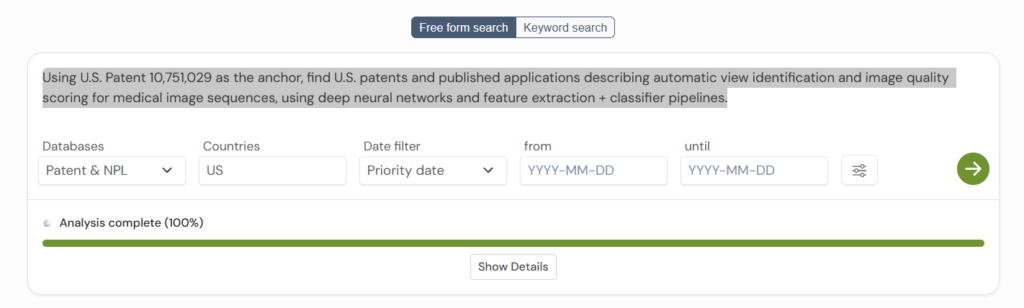
Using GPS, we conducted a search centered on U.S. Patent No. 10,751,029 and compared the results with the references cited in the IPR record.
Rather than focusing solely on references already cited during prosecution, a second-pass review helps test whether additional, thematically related disclosures exist outside the official citation set. Specifically, GPS can help surface:
- technically similar approaches described using different terminology across U.S. patent filings,
- non-patent literature that reflects foundational or applied work influencing the field,
- disclosures from adjacent technical domains that address analogous problems such as signal quality assessment, confidence scoring, or guidance under uncertainty, and
- non-U.S. patent filings that expand the prior-art view beyond domestic sources.
To organize this information meaningfully, we grouped the references into “common” and “uncommon” categories.
In this analysis:
- Common references are those appearing both in the official prosecution record and in GPS results.
- Uncommon references include those surfaced by GPS but absent from the official citation record, and vice versa.
“Uncommon” does not imply stronger or weaker art. It highlights areas where visibility may have been limited during earlier searches.
Prior-Art Search Results Around U.S. Patent No. 10,751,029
How prior art becomes visible depends in part on the search method applied. The following comparison examines the references associated with U.S. Patent No. 10,751,029 as they appear in the official IPR record and in a second-pass search using Global Patent Search (GPS).
Non-Patent Literature (NPL)
We begin with non-patent literature, where direct overlap appears between the official record and the GPS results.
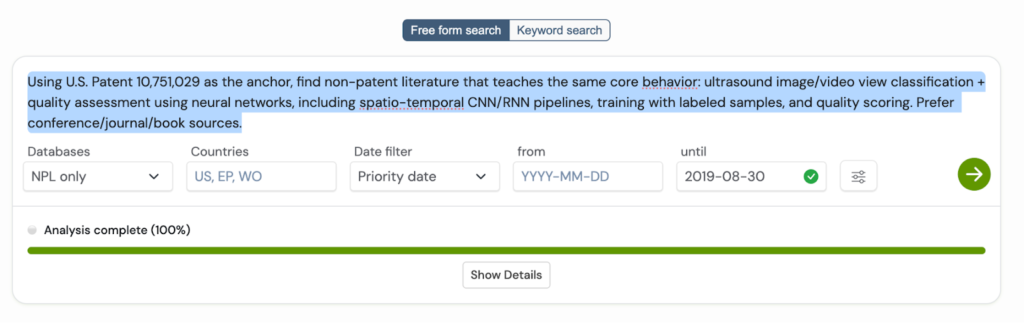
Based on the review of the surfaced documents, there are two specific academic articles that appear in both the official “Petitioner’s Updated Exhibit List” and the AI-powered search results from GPS.
While the search results contain numerous other papers regarding fetal ultrasound and neural networks (e.g., “Standard plane localization…” or “SonoNet”), only the two titles listed above match the specific exhibits cited in the petitioner’s list.
U.S Patents
We next compared U.S. patent publications appearing in both the official exhibit list and the GPS search results.
This comparison identified five U.S. patent references common to both sources.
Cross-Domain and Non-U.S. Patent References
We also compared the official IPR exhibit list and the GPS search results across cross-domain references and non-U.S. patent filings. In these categories, no common references were identified between the two sources.
Below is the complete table showing how official references and GPS results compare across categories.
| Match | Type | Official | GPS |
| Common | US Patents | • US2005251013A1 (Krishnan et al. / Siemens Medical Solutions) • US20190076127A1 (Aase et al. / General Electric Co.) • US20170262982A1 (Pagoulatos et al. / Echonous Inc.) • US20070055153A1 (Simopoulos et al. / Siemens Medical Solutions) • US11129591B2 (University of British Columbia) | |
| Common | NPL | • Ex1009: Chen, “Automatic Fetal Ultrasound Standard Plane Detection…” (2015) • Ex1010: Wu, “FUIQA: Fetal Ultrasound Image Quality Assessment…” (2017) | |
| Uncommon | US Patents | •Ex1007: US 10,013,640 (“Angelova”) •Ex1023: US 5,906,578 (“Rajan”) •Ex1024: US 2009/0074280 (“Lu”) | •US 2019/0228547 A1 – New York University •US 11,488,298 B2 – GE Precision Healthcare •US 2018/0140282 A1 – Hitachi Ltd •US 11,950,961 B2 – University of California •US 11,308,598 B2 – Sharif University of Technology •US 2019/0142390 A1 – Verathon Inc •US 11,033,250 B2 – Samsung •US 2006/0147107 A1 – Microsoft •US 12,329,571 B2 – Guangzhou Aiyunji Information Technology |
| Uncommon | NPL | •Ex1012: Itchhaporia (1996) •Ex1013: Chen (2016) •Ex1014: Kong (2016) •Ex1016: Chen I (2015) •Ex1017: Miller (1992) •Ex1020: González (2014) •Ex1021: Donahue (2014) •Ex1022: Caruana (1993) •Ex1026: Salomon (2008) •Ex1027: LeCun (1989) •Ex1028: Bouzerdoum (2004) •Ex1029: Krizhevsky (2017) | •ID 1: Dong et al. (2019) “A Generic Quality Control Framework…” •ID 2: Gao (2019) “Describing obstetric ultrasound video content…” •ID 4: Talebi (2018) “NIMA: Neural Image Assessment” •ID 26: Baumgartner (2016) “SonoNet: Real-Time Detection…” •ID 37: Xi (2019) “Deep learning for differentiation of benign and malignant…” |
| Uncommon | Cross-domain | Ex1021 (Donahue – Visual Recognition) Ex1022 (Caruana – Multitask Learning) Ex1027 (LeCun – Handwritten Digit Recognition) Ex1028 (Bouzerdoum – Image Quality Assessment) Ex1029 (Krizhevsky – ImageNet Classification) | • CN 113189994 A (Shanghai DC-Science) – AGV Guidance • JP H0991591 A (Fujitsu) – Parking Guidance • WO 2010/070147 A1 (Duvas) – Pollutant Mapping • US 2015/359163 A1 (Raven Ind) – Ag. Row Guidance • CN 109062200 A (Hangzhou Dianzi) – Robot Sensor Nodes • CN 105701578 A (Chongqing Univ) – Gas Plume Prediction • EP 4009072 A1 (IAV GmbH) – Vehicle Localization |
| Uncommon | Non US | • WO 2016/189313 (Paterson) | • EP 3346297 A1 (General Electric) – Medical Image Analysis • CN 112668602 A (Bosch) – Sensor Data Quality • CN 111161257 A (Zhongshan Ophthalmic) – Fundus Image Quality • CN 110428415 A (Shanghai United Imaging) – Medical IQA • CN 106856002 A (Shanghai Univ) – UAV Image Quality • JP 2005/129070 A (Hewlett-Packard) – Image Quality Eval |
A few things become clear when the references are viewed this way:
- The core technical themes (image quality, neural networks, and medical imaging) are well represented in the official list.
- Similar techniques appear in adjacent industries, often under different terminology.
- Non-U.S. filings and cross-domain disclosures broaden the landscape significantly.
- Without a structured search, many of these references are easy to miss early on.
This doesn’t mean every reference is legally relevant—but it does mean they’re worth knowing about.
How GPS Strengthens Prior-Art Analysis in Practice
GPS does not replace examiner searches, legal analysis, or professional judgment. It just supports them.
In practice, GPS works best as a second-pass verification layer. After an initial keyword- and classification-based search establishes the core prior-art set, GPS can be used to test whether semantically related disclosures exist that were described using different language or emerged in adjacent technical contexts.
Used this way, GPS helps in-house IP counsel and patent attorneys:
- see beyond strict keyword matches,
- identify thematic overlaps that may warrant closer review, and
- allocate time and resources more effectively before committing to exhaustive legal analysis.
The result is a clearer, more confident view of the prior-art landscape before conclusions harden and deeper analysis begins.

Explore Global Patent Search. Run a search and see what a semantic second look reveals.
Note: This article is not legal advice. The analysis and table presented here are based on a preliminary prior-art search conducted using Global Patent Search (GPS) and are intended solely for research and exploratory purposes. For any specific matter, qualified IP counsel or patent attorneys should conduct independent searches and apply their own professional judgment.