You talk about attending a concert, trying a new yoga class, or meeting friends over the weekend. A short while later, your phone shows an event or a suggestion involving people or activities that feels uncannily relevant.
It almost feels like your device is listening to you. And this doesn’t happen by chance.
Behind these seemingly intuitive recommendations lies a long line of patents focused on matching people, events, activities, and entities based on behavior, interests, location, and social awareness. One of the most significant among them is US9639608B2.
Filed in 2014, the patent defines a comprehensive recommendation system that shows how users, other people, and real-world experiences can be matched together based on inferred intent, contextual relevance, and location-aware thresholds.
The patent is currently under litigation, with Joto Inc. asserting it against companies such as TicketCenter.com and Vinted, UAB, underscoring how valuable this problem remains.
Using the Global Patent Search tool, we explore how this approach evolved over time, and how it compares to earlier recommendation systems.
What This Invention Is Really Trying to Fix
Most early recommendation systems faced one problem: they did not know when to stop. Everything looks relevant in isolation, so users end up seeing too many poorly timed or low-intent suggestions most of the time.
US9639608B2, filed by Inventor Daniel Freeman, approaches this problem by treating relevance as something that has to be earned. The system pulls in user data, event data, and social signals, but it does not immediately turn them into suggestions.
Each input is evaluated against context, such as current or intended location, recent behavior, and inferred intent. If those signals do not cross defined thresholds, nothing is shown.
The patent also allows relevance to shift over time. Interests can fade or strengthen based on engagement. Location can temporarily outweigh long-term preferences. Social connections can influence whether a recommendation appears or disappears.
Instead of locking users into fixed categories, the system adapts to how people actually behave, especially when the goal is to prompt real-world action rather than passive scrolling.
What Makes This System Work in the Real World
These are the key features that explain how US9639608B2 turns user and event data into more meaningful recommendations:
- The system learns what a person actually likes by watching what they do, not just what they say they like.
- It checks where the person is, or plans to go, before suggesting anything nearby.
- It avoids showing too many suggestions by only showing something when it feels clearly relevant.
- It can recommend events, people, or both together, depending on what fits the situation.
- It looks at social connections in the background to see if friends or familiar people might be involved.
- It improves over time by paying attention to what users click on, attend, or ignore.
Together, these features aim to reduce guesswork in recommendations and focus on showing users options that actually feel timely, relevant, and worth acting on in the real world.
Location plays a bigger role than most people realize. Systems that tailor content based on physical presence borrow heavily from ideas first formalized in location-based content delivery models like those explored in US8977247B2.
How Earlier Systems Tried to Solve the Same Problem
Long before US9639608B2, other systems were already trying to make recommendations feel less random. Some focused on user interests. Others leaned on social connections or event data. Each approach solved a small piece of the problem, but rarely the full picture.
Using the Global Patent Search tool, we can quickly spot these earlier attempts and see how they connect. Looking at them side by side makes it easier to understand what changed and what stayed the same.
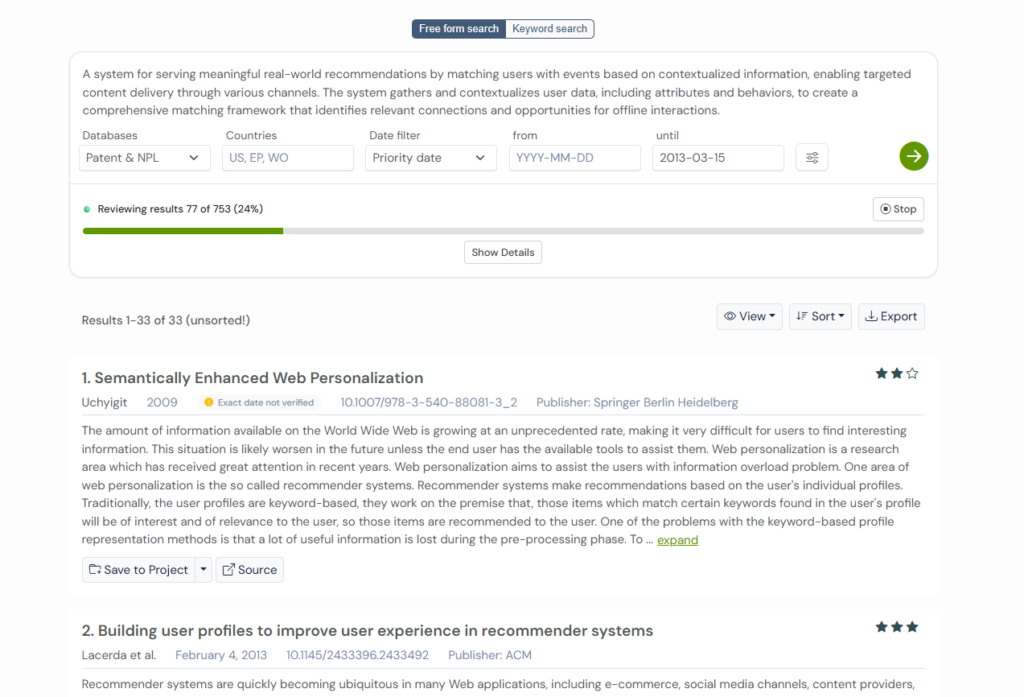
Let’s explore some of them.
1. JP2009163443A
Anyone who has attended a seminar or networking event knows the feeling. You meet a few interesting people, exchange a quick conversation, and then everyone disappears into their own circles. Later, you struggle to remember who you spoke to, why you connected, or how to continue that relationship. Most event-based connections fade before they really begin.
JP2009163443A, published in 2009, was designed to solve this problem by helping people build and maintain friendships around real-world events. Instead of leaving connections to chance, the system uses basic profile information such as occupation, interests, and background to identify participants who are likely to find each other useful before the event even starts.

If two participants show mutual interest in meeting, the system introduces them during the event without immediately revealing identities. Only after both people meet and confirm interest does the system allow the relationship to be formally registered. This extra step ensures that friendships are based on real interaction, not just online matching.
The idea connects closely to US9639608B2. Both focus on moving beyond surface-level social signals and using context, intent, and real-world interaction to form meaningful connections. JP2009163443A concentrates on event-based friendships, while US9639608B2 expands this concept into a broader recommendation system covering people, events, and activities.
Why this patent is important
It introduced an early structure for matching people at events based on shared attributes and intent, while also addressing the common problem of connections fading after the event ends.
2. EP2877935A1
You carry your phone everywhere, and it quietly observes a lot about your day. Where you go, how long you stay, when you leave work, when you slow down, and when you tend to explore. Yet most apps still treat every moment the same, offering suggestions that ignore timing, routine, or even basic context.
EP2877935A1, filed in 2013, was created to fix that gap. Instead of reacting only to a user’s current location, the patent focuses on understanding patterns in user’s daily behavior. By using mobile device data, it builds a picture of a person’s routine and personality over time. A weekday afternoon, a late-night weekend, or a commute home are treated as very different situations, even if they happen in the same place.
The system breaks user behavior into small “context slices” based on time, location, and activity. These slices are then used to model habits, predict future behavior, and decide which recommendations are actually worth showing. Over time, feedback from what users accept, ignore, or act on helps refine those recommendations further.
This idea connects closely to US9639608B2. Both patents focus on context-aware relevance rather than static preferences. EP2877935A1 emphasizes routine and personality modeling through mobile data, while US9639608B2 applies similar thinking to matching users, events, and experiences in real-world settings.
Why this patent is important
It introduced a practical way to model everyday routines and personality traits from real behavior, helping recommendation systems move beyond location-only or category-based suggestions.
Reliable navigation does not always depend on a constant internet connection. Similar thinking appears in offline navigation systems that blend stored maps with live signals, as seen in US9549388B2.
3. US10769221B1
Anyone who has used a matching or dating platform knows the pattern. You carefully set your preferences, swipe through profiles, send a few messages, and still end up with suggestions that feel off. What people say they want and how they actually behave rarely match.
US10769221B1, filed by PlentyOfFish Media, addresses this gap by watching what users do instead of relying only on what they declare. The system tracks actions such as who a user views, who they message, how often they reply, and even who they ignore. These behaviors are treated as stronger signals than profile checkboxes.

The matching logic also looks outward. If multiple users message the same profiles, their behavior is used as a proxy to identify shared interests.
This allows the system to recommend new matches based on patterns across similar users, not just individual preferences. Availability, location, likelihood of response, and engagement history all influence which matches are surfaced.
This aligns closely with US9639608B2. Both move beyond static profiles and focus on intent inferred from real actions. US10769221B1 applies this idea within networked matching services, while US9639608B2 extends it to broader recommendations tied to real-world relevance and timing.
Why this patent is important
It formalized the idea that user behavior is often a more accurate indicator of intent than stated preferences, helping matching systems surface connections that are more likely to lead to real interaction.
4. CN101828167A
As mobile phones became content hubs, operators faced a familiar problem. Users were surrounded by music, games, videos, and services, but promotions were often mistimed, irrelevant, or incompatible with their devices. Showing more options did not increase engagement. Showing the right ones did.
CN101828167A, published in 2010, focuses on solving this by combining multiple recommendation techniques into a single system. Instead of relying on just one signal, the system looks at user attributes like demographics and device type alongside real behavior such as browsing history, purchases, and usage patterns.
Each recommendation is assigned a confidence score and then filtered based on rules like device compatibility, past purchases, and frequency limits.
The system is designed to work at scale for mobile operators. It can push recommendations through portals, SMS, or other mobile channels, and it continuously learns from what users click, ignore, or buy. Group behavior, peer patterns, and network relationships are also used to improve targeting when individual data is limited.
This approach connects to US9639608B2 through its emphasis on relevance over volume. While CN101828167A focuses on promotional and content delivery within mobile ecosystems, US9639608B2 extends similar ideas into real-world discovery by factoring in context, timing, and user intent more directly.
Why this patent is important
It established an early framework for combining attributes, behavior, and filtering logic to deliver fewer but more actionable recommendations, especially in mobile environments with limited attention and screen space.
Systems that move beyond keywords and try to understand intent have been evolving for years. A deeper look at patents that made digital assistants smarter, including US9130900B2, shows how early designs approached semantic reasoning.
5. JP2013008331A
Social platforms make it easy to connect on paper. Shared hobbies, similar tastes, mutual friends. Yet many of these suggested connections never turn into real conversations, let alone meaningful relationships.
JP2013008331A, published in 2013 by Yahoo Japan, takes a different approach. Instead of relying mainly on profile similarities, the system looks at what users actually do over time. Every action performed through a device is treated as a signal. This includes attending events, browsing content, making purchases, watching videos, or interacting with services.
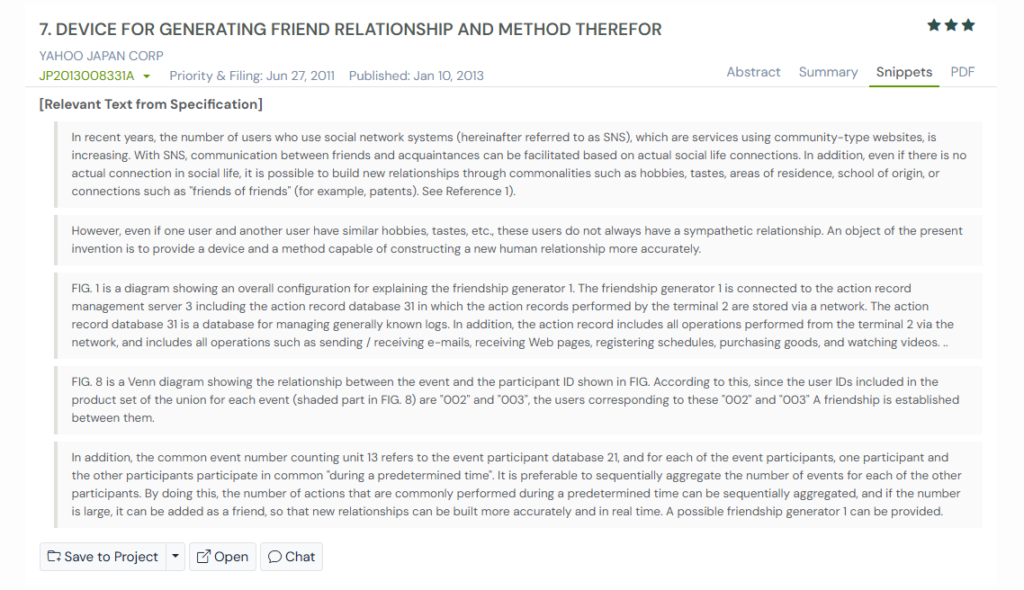
The system tracks these actions and looks for overlap. When two users repeatedly participate in the same events or activities within a given time window, that shared behavior becomes the basis for suggesting a connection. The more often their actions intersect, the stronger the signal that a real relationship might make sense.
This idea aligns closely with US9639608B2. Both move away from static profiles and focus on behavior, timing, and shared context. JP2013008331A emphasizes repeated co-participation in events and activities, while US9639608B2 applies similar logic to recommending people, events, and opportunities based on broader real-world relevance.
Why this patent is important
It showed that shared actions over time are often a stronger indicator of potential connection than stated interests, helping social systems form relationships that feel more natural and timely.
How These Systems Think About Connection and Relevance
Taken together, these patents show how recommendation systems evolved from profile-based matching to behavior-driven, context-aware decisions. Each one tackles a slightly different problem, but all move toward the same idea: real actions matter more than stated preferences.
| Patent | Core Problem Addressed | Primary Approach | Connection to US9639608B2 |
| JP2009163443A | Event connections fading after the event | Matches participants before and during real-world events using shared attributes | Anticipates US9639608B2’s focus on real-world context by grounding recommendations in physical events and mutual intent |
| EP2877935A1 | Irrelevant suggestions despite rich mobile data | Models routines and personality from time-based behavior patterns | Aligns with US9639608B2 by treating timing and situational context as critical to recommendation relevance |
| US10769221B1 | Mismatch between stated preferences and real intent | Infers intent from messaging, viewing, and response behavior | Closely mirrors US9639608B2’s reliance on observed actions rather than declared interests |
| CN101828167A | Overwhelming and mistimed mobile promotions | Combines multiple recommenders with confidence scoring and filtering | Shares US9639608B2’s philosophy of reducing noise and surfacing only high-likelihood, actionable recommendations |
| JP2013008331A | Weak social matches based on profile similarity | Builds connections from repeated shared actions over time | Reinforces US9639608B2’s emphasis on shared behavior and temporal overlap as signals of meaningful connection |
Seeing the Bigger Pattern Using GPS
Reading across hundreds of patents can get tedious. Each document explains its own logic, but rarely shows how the idea fits into what came before or why it matters now. That context is exactly what gets lost when patents are viewed in isolation.
This is where Global Patent Search becomes valuable. Instead of treating patents as standalone filings, GPS helps map how recommendation and matching systems gradually shifted toward behavior, context, and real-world relevance.
Using GPS, you can explore patents like US9639608B2 more effectively by:
- Starting with the patent number to surface earlier patents and non patent literatutre in the same problem space.
- Skimming concise summaries to understand intent without diving into dense claims.
- Identifying which ideas persisted, merged, or were refined over time
- Opening full specifications only when deeper technical detail is actually needed
This way, GPS turns patent research into a structured exploration instead of a guessing game.
If you want to understand how ideas like context-aware matching and behavior-based recommendations developed before reaching US9639608B2, run the patent through Global Patent Search tool today and follow the full trail.
Frequently Asked Questions
1. How do modern recommendation systems understand user intent?
Modern recommendation systems infer intent by observing real user behavior over time. This includes what users click, view, search for, ignore, or return to repeatedly. Timing and frequency matter as well. These behavioral signals often reveal what a user is likely to act on more accurately than profile details or stated preferences alone.
2. Why is context important in recommendation technology?
Context helps determine whether a recommendation is relevant at a specific moment. Factors like location, time of day, current activity, and user availability influence whether a suggestion makes sense right now. A recommendation can be accurate in theory but still fail if it appears at the wrong time or in the wrong situation.
3. What is the difference between profile-based and behavior-based matching?
Profile-based matching relies on declared information such as interests, age, or preferences entered by the user. Behavior-based matching looks at actual actions, including clicks, searches, and engagement patterns. Because people often behave differently from how they describe themselves, behavior-based systems usually produce more realistic and actionable recommendations.
4. How do systems decide which recommendations are worth showing?
Most systems assign relevance scores to potential recommendations based on factors like past engagement, likelihood of response, and contextual fit. Low-confidence or repetitive suggestions are filtered out. Only options with a higher probability of leading to user action are shown, helping reduce noise and improve overall recommendation quality.
Disclaimer: The information provided in this article is for informational purposes only and should not be considered legal advice. The related patent references mentioned are preliminary results from the Global Patent Search tool and do not guarantee legal significance. For a comprehensive related patent analysis, we recommend conducting a detailed search using GPS or consulting a patent attorney.