
Think about how many devices inside a modern home speak completely different languages. A thermostat might use ZigBee, a door lock might run Bluetooth, a smart meter might rely on its own low-power protocol.
Yet from the user’s point of view, everything is supposed to work together instantly. That seamlessness doesn’t happen because all devices agree on one protocol. It happens because something sits in the middle translating for everyone.
That is where US8488624B2 comes in. The patent, in simple terms, lets the devices in a home network communicate regardless of how they transmit data.
Today, this patent isn’t just theoretical. It’s active, enforced, and currently at the center of multiple lawsuits filed by Unwired Global Systems LLC against companies operating in the connected-device ecosystem.
To understand how this technology emerged, and how similar innovations evolved across home networking, we used the Global Patent Search (GPS) tool to trace its lineage and related inventions.
Breaking Down What US8488624B2 Actually Does
A huge problem with home gadgets is how they all use different protocols to communicate. One device speaks ZigBee, another is on Bluetooth, another uses some mystery protocol the manufacturer invented on a Friday evening.
Somehow, all of them are expected to work together inside the same home network. Without help, they absolutely can’t.
The patent basically steps in as the translator everyone needed. Instead of forcing developers to write a separate decoding system for every single protocol, the invention creates a middle layer that understands whatever a device sends.
A packet arrives in its native language, the frame engine looks at a metadata map, and then breaks the packet into clean, platform-independent pieces. Once that translation is done, the rest of the system can read the data without caring about the original protocol.
The Standout Features of US8488624B2
Here are the standout features that make this invention work the way it does:
- Protocol-neutral decoding: The system can take a packet from any device like ZigBee, Bluetooth, or a custom protocol, and translate it into one common format without needing separate decoders.
- Metadata-based interpretation: Instead of hardcoding rules, it uses metadata maps to understand how each packet is structured, making the system flexible and easy to update.
- Platform-independent data objects: Once decoded, all information becomes clean, universal data objects that any app or controller can read and modify without worrying about the underlying protocol.
- Smooth handling of complex packet structures: Whether a packet has nested fields, multiple layers, or mixed formats, the frame engine can break it down reliably and rebuild it when needed.
- One simple interface for all devices: Developers interact with a single API, not five different protocol stacks, making integration faster, cleaner, and far less painful.
- Reduced load on smart-home devices: The heavy decoding work moves to the middleware, allowing low-power devices to stay simple while still working seamlessly within the home network.
When all these capabilities come together, the result is a home network that finally speaks one unified language.
You can also see this kind of unified handling in today’s smart speakers, where a single command interface quietly manages multiple device protocols behind the scenes.
Other Innovations in the Same Space As US8488624B2
Once you understand the subject patent, the next question becomes obvious: who else has been building similar ideas?
Smart-home networks didn’t evolve through a single invention. They’re shaped by a cluster of patents working toward the same goal of making devices talk smoothly across different protocols and formats.
To map that wider landscape, we turned to the Global Patent Search tool. GPS helped us trace the closest technologies, spot overlapping ideas, and identify the patents that share the same spirit of device-agnostic communication.
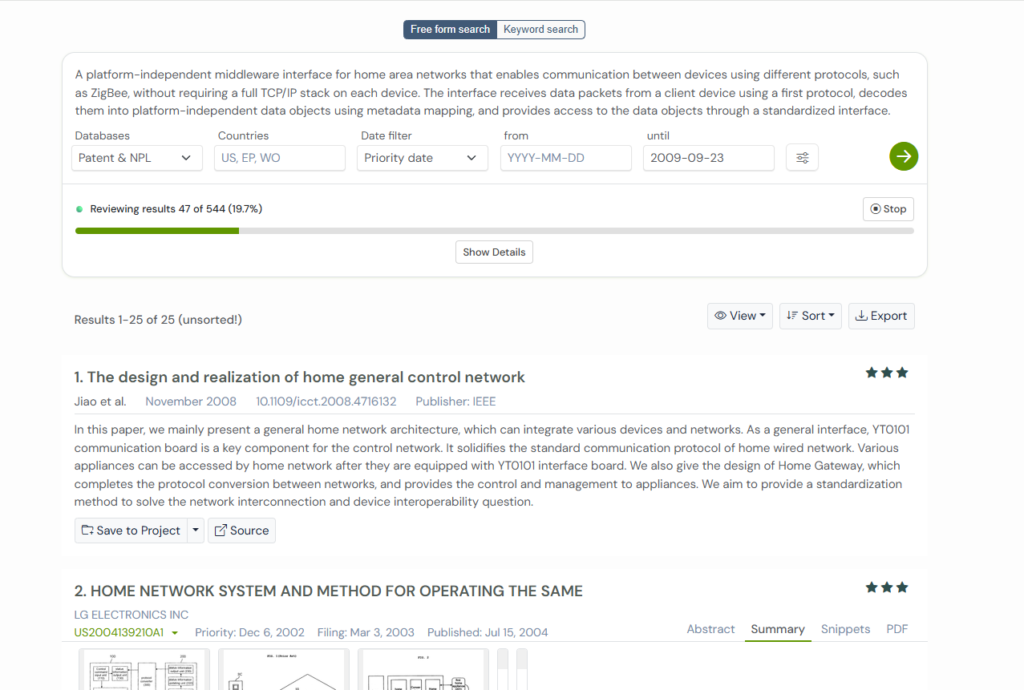
Here are five similar patents that add important context to the story.
1. US2004139210A1 – Home Network System and Method for Operating the Same
US2004139210A1, filed by LG Electronics in 2003, came from a time when home appliances were just starting to go digital. Every device had its own protocol, and nothing communicated smoothly.
LG’s idea was to add a protocol converter between the home server and the appliances so that everything could interact without needing to share the same communication standard.
Inside the system, the home server sends commands in its own protocol, the appliances respond in theirs, and the converter rewrites everything in real time. It acts like a universal interpreter that lets old and new devices coexist on the same network without manual tweaks or custom integrations.
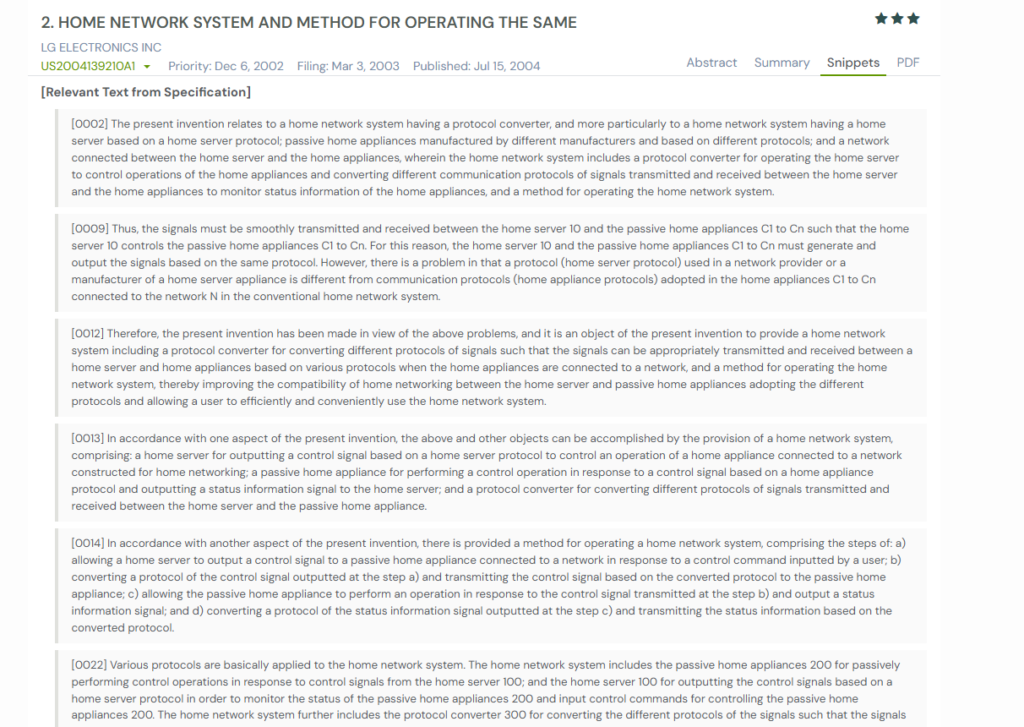
Both the patents aim to solve the same headache of too many devices and too many protocols. LG focuses on translating signals back and forth. The subject patent goes a step further by decoding packets into platform-independent data objects, making the system even more flexible.
Why It Matters in the Wider Smart Home Evolution Tech
LG’s approach shows the early foundation of smart-home interoperability. It highlights how the industry moved from simple protocol conversion toward deeper, more intelligent data translation. This is the direction the subject patent pushes even further.
This kind of translation becomes even more critical in wireless environments where devices operate on entirely different signalling rules, like those seen in foundational wireless inventions such as US9031537B2.
2. US2003016682A1 – Gateway for Devices Using Different Middlewares
US2003016682A1, filed by Samsung Electronics in 2002, looked at a very real problem in early smart homes – devices weren’t just using different protocols but they were built on completely different middlewares.
One device relied on HAVI, another on UPnP, and none of them understood each other’s messages. Samsung’s answer was a gateway that carried multiple middleware inside it, so devices didn’t need to change anything at their end.
Inside this setup, the gateway receives a message, interprets it using the sender’s middleware, converts it into the middleware of the target device, and forwards it.
It works like a multilingual operator who listens in one language and responds in another. So even if you plugged in a new device with a brand-new middleware, you only needed to update the gateway, not every device in your home.
This is where it parallels our subject patent. Samsung solves cross-device communication by translating middleware formats, while the subject patent takes it further by breaking packets into platform-independent data objects.
Samsung solves the language mismatch at the middleware layer; the subject patent removes the concept of middleware altogether.
Why It Matters in the Wider Smart-Home Evolution
Samsung’s invention marks a big step in the industry’s effort to handle a growing list of incompatible devices. It shows how early systems tried to patch gaps with middleware translation and how newer designs, like the subject patent, shift toward deeper, metadata-driven translation.
Even in modern smart-home systems, infrared still plays a key role in close-range device control. To understand how IR signaling became the backbone of remote interactions, here’s a detailed look at the evolution of infrared remote controls.
3. KR20060021605A – System for Bridging Protocols in Multihomed Networks
KR20060021605A, filed by Daewoo Electronics in 2004, looks at a home network problem that’s even bigger than mismatched protocols inside a single system.
Homes were starting to include multiple networks at once like power-line networks, IP networks, wireless networks, each running completely different rules. Devices inside these networks couldn’t talk to each other at all. Daewoo’s idea was a bridging system that figures out which protocol the receiving device uses and converts the communication request before sending it through.
Inside this design, the home gateway becomes the brain. It keeps a memory of all the protocols in the house, plus a list of all connected devices. When a device sends a communication request, the gateway looks up the destination device’s protocol, rewrites the data accordingly, and delivers it over the correct network module.
Power-line device talking to a Wi-Fi device? No problem. IP device sending a command to a PLC appliance? Also fine. The gateway acts like a full protocol bridge across all parallel home networks.
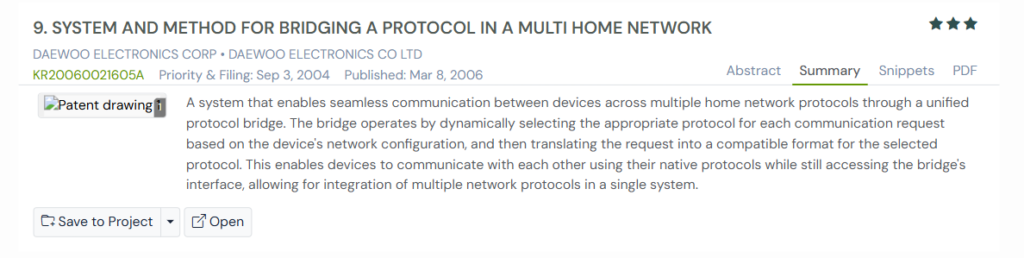
Here’s where it lines up with US8488624B2. Daewoo’s invention focuses on converting communication requests based on the receiving network’s protocol, while the subject patent goes deeper by turning packets themselves into platform-independent data objects.
One bridges entire networks, the other unifies data at the object level. But both aim to break down the walls between incompatible home-network technologies.
Why It Matters in the Wider Smart-Home Evolution
The patent shows the moment home networks stopped being single-protocol systems and became real, mixed ecosystems. It highlights the need for smarter gateways that can bridge not just devices, but entire network types.
Once homes started carrying multiple network types, power-efficient signalling systems became just as important, especially in devices relying on smarter refresh and update cycles.
A deeper look at remote browser-based home security systems can be found in our analysis of Patent US8914526B1, which breaks down how extranet-connected gateways enable real-time monitoring and control of home environments.
4. EP1693989A2 – Service Framework for Home Network
EP1693989A2, filed by Samsung Electronics in 2005, imagines a home network where devices don’t just communicate; they deliver intelligent services through a unified layer.
Instead of each device relying on its own middleware or protocol, Samsung introduces a service framework that sits above everything. This framework uses an “intelligent service module” to understand what a service needs to do, and then coordinates the underlying devices to make it happen.
To keep all these different devices in sync, the framework uses middleware wrappers. Each wrapper decodes and generates messages so the framework can communicate with middlewares like UPnP or others without needing to learn their internal rules. Think of it as a universal translator plus a manager: it interprets messages, organizes device profiles, and ensures services run correctly across mixed local networks.
This ties closely to US8488624B2. Samsung’s framework tries to unify communication by wrapping and translating middleware formats, while the subject patent pushes deeper by converting packets into platform-independent data objects.
One standardizes services and middleware behavior; the other standardizes the underlying data itself. They both work on different layers with the same ambition, to make systems feel unified no matter how many protocols are involved.
Why It Matters in the Wider Smart-Home Evolution
EP1693989A2 shows how early smart-home systems started shifting from device-centric communication to service-centric design.
Instead of managing each device separately, Samsung built a framework that understands services, profiles, and metadata. When placed next to the subject patent, you can clearly see the progression: from wrapping middlewares, to bridging entire networks, to unifying data models.
For a deeper look at how home networks recognize trusted devices, see our analysis of US8037161B2 and similar device-identification patents.
5. US2005188050A1 – Binding Information Appliances Across Different Middlewares
US2005188050A1, filed by Son Young-S., Moon Kyeong-D., and Park Kwang-R. in 2004, focused on a very practical smart-home problem.
You see, even if devices are on the same network, they still can’t work together when each one relies on its own control middleware. Be it a TV, a third-party media player, or a smart speaker – all of them speak different control languages.
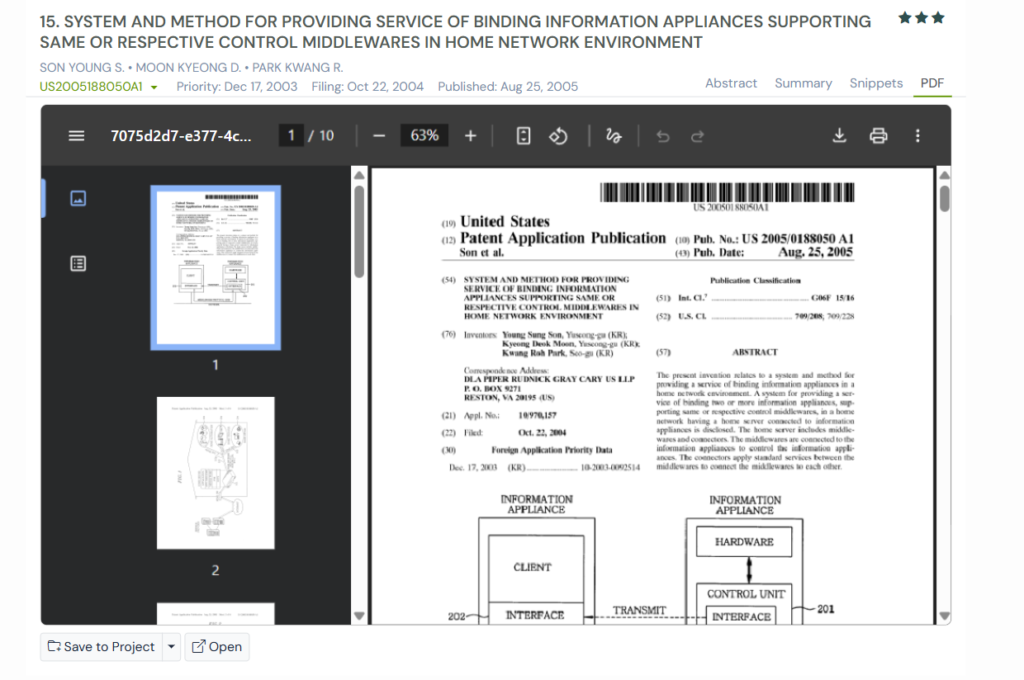
The patent proposes a home server that sits in the middle, understands all these middlewares, and lets devices bind together so they can share control information and work as a unified system.
The design uses middleware-specific interfaces for each appliance. These interfaces manage control commands, status updates, and device behaviors. When two appliances need to work together, a connector module steps in. It takes control information from one device, translates it, and passes it to the other device’s middleware interface.
The home server also keeps a dynamic list of all devices, their middleware types, and their capabilities. So users can pick any device, and the server ensures it can be controlled properly.
This lines up neatly with US8488624B2. US2005188050A1 focuses on binding control operations across different middlewares, while the subject patent tackles the deeper challenge of translating data itself into platform-independent objects.
Both the patents aim to make devices interoperable, but they do it at different layers of the stack.
Why It Matters in the Wider Smart-Home Evolution
This patent marks the stage where home networks started caring about how devices work together, not just how they communicate.
It shows the move toward server-driven coordination, dynamic device lists, and middleware-agnostic control.
How These Patents Stack Up Against Each Other
Before we lay everything out side-by-side, it helps to zoom out for a second. Each of these patents tried to solve the same fundamental problem of too many devices, too many protocols, and not enough harmony. But each approached it from a slightly different angle.
Some focused on middleware, some focused on entire networks, and some focused on service frameworks or device binding.
Looking at them together makes the evolution obvious. You can see where the industry started, where it struggled, and how ideas gradually shifted toward more flexible, data-driven models.
Now let’s break down how all five compare to the subject patent.
| Patent | Core Focus | Overlap With the Subject Patent | Role in the Bigger Smart-Home Picture |
| US2004139210A1 – LG’s Home Network System | Converting protocols between a home server and appliances so devices with different communication formats can work together. | Tackles compatibility by translating protocols; the subject patent tackles it by converting packets into platform-independent data objects. | Shows the early shift from device-specific communication to centralized protocol translation. |
| US2003016682A1 – Samsung’s Middleware Gateway | Gateway that carries multiple middlewares and translates messages between devices using HAVI, UPnP, or others. | Addresses interoperability at the middleware level; the subject patent eliminates dependency on middleware altogether. | Marks a move toward “middleware bridging” as homes started filling with mixed-brand devices. |
| KR20060021605A – Bridging Protocols in Multihomed Networks | Bridging communication across entire network types (power-line, IP, wireless) by converting requests into the correct protocol. | Similar goal of unification, but focuses on network-level protocol bridging; the subject patent focuses on deeper data-model unification. | Represents the jump from single-protocol homes to multi-network smart-home ecosystems. |
| EP1693989A2 – Service Framework for Home Networks | Unified service framework using middleware wrappers, intelligent services, and profile management to control diverse devices. | Wraps and translates middleware behavior; the subject patent translates underlying data, removing middleware constraints. | Shows the industry evolving toward service-driven home automation rather than device-driven control. |
| US2005188050A1 – Binding Appliances Across Middlewares | Home server binds devices with different middlewares so they can share control information and operate together. | Unifies control logic across middlewares; the subject patent unifies the underlying data objects that power those controls. | Highlights the push toward seamless cross-device coordination inside one home network. |
How the Global Patent Search Tool Maps the Bigger Story
Each patent shows a small slice of how home networks became smarter. One focuses on protocol conversion, another on middleware, another on cross-network bridging. But the real clarity comes only when you zoom out and see how these ideas connect, overlap, and evolve over time.
That’s exactly where the Global Patent Search tool becomes invaluable. Instead of treating these inventions as isolated problem-solvers, GPS helps you trace how early protocol bridges, middleware wrappers, device-binding interfaces, and service frameworks gradually led to systems like our subject patent.

Here’s how GPS helps make sense of that evolution.
Start from one building block: Type in the subject patent number or describe the concept of invention, for eg. protocol-independent data modelling. GPS instantly pulls up earlier attempts at protocol conversion, middleware translation, and network-level bridging.
See how ideas layer on top of each other: Most results comes with quick snippets showing the overlap, where a gateway acted as a translator, where a wrapper unified middleware behavior, or where a home server bound devices across different control standards.
Watch the progression unfold: With a few clicks, you can move from early, rule-based protocol converters to more sophisticated frameworks that manage services, profiles, and metadata across entire networks.
Spot cross-domain innovations: Sorting through GPS reveals patents not just in home networking, but in adjacent areas like IoT device coordination, remote access, metadata mapping, and distributed control systems.
By pulling these threads together, the Global Patent Search tool turns scattered technical breakthroughs into one clear narrative of how home-network interoperability evolved.
If you want to explore the same landscape, GPS makes it surprisingly easy. Try the tool today!
Disclaimer: The information provided in this article is for informational purposes only and should not be considered legal advice. The related patent references mentioned are preliminary results from the Global Patent Search (GPS) tool and do not guarantee legal significance. For a comprehensive related patent analysis, we recommend conducting a detailed search using GPS or consulting a patent attorney.
Frequently Asked Questions
1. Why do smart home devices use so many different communication protocols?
Different devices are built for different jobs. Each protocol has strengths and weaknesses, so manufacturers choose the one that best fits the device’s needs.
2. What is the role of a gateway in a multi-protocol home network?
A gateway is the central brain that receives messages from devices using different protocols, converts them, and routes them to the correct destination. It prevents the need to install every protocol on every device and keeps the network scalable as new device types are added.