
We’ve all had that moment when a great idea or important detail from a call slips away hours later. Emails and messages can be searched. But spoken conversations? They vanish as soon as the call ends.
That’s the problem Patent US9792361B1 set out to solve.The patent describes a system that allows your phone to capture and remember everything you say. It can record calls, meetings, or voice notes, then automatically turn them into searchable text.
What makes it more interesting is that users can choose to share some of those recordings publicly, transforming private moments into shared knowledge.
To see where this idea fits into the evolution of voice intelligence, we explored similar patents using the Global Patent Search tool. The results show a clear pattern: technology is steadily moving toward making voice as searchable and structured as everything we type.
Breaking Down Patent US9792361B1
US9792361B1 reimagines the phone as more than a communication tool. It turns it into a personal memory system that listens, learns, and organizes everything you say.
At its core, the patent describes how a phone can automatically record voice inputs, from calls, meetings, or quick notes, and transform them into searchable text. Every word is enriched with metadata like time, location, and speaker identity, giving each conversation its own context and meaning.
Once processed, everything is stored in a private, centralized archive. You can search by keyword, recall a specific discussion, or filter by when or where it happened. It’s like having an indexed database of every idea you’ve ever spoken aloud.
And the system goes beyond memory. It includes privacy controls that let users decide what stays private and what can be shared with others, thus opening the door for collaborative voice-based knowledge sharing.
In short, US9792361B1 bridges two worlds: the spontaneity of speech and the structure of searchable data.
Core Features of Patent US9792361B1
When you look closely at the structure of US patent 9792361B1, a few core features define why this patent stands out. Each of them shows how the invention transforms ordinary voice capture into intelligent, searchable memory.
Automatic Multi-Source Recording: The system can record across contexts, from phone calls and meetings to quick personal notes. It makes the act of remembering effortless, ensuring nothing valuable gets lost once you hang up or step away.
Speech-to-Text Intelligence: Every spoken word is automatically converted into text. This transcription layer bridges human memory and machine recall, turning fleeting thoughts into searchable data.
Context-Rich Metadata: Each word carries its own metadata: time, date, location, and even who was speaking. This means you don’t just find what was said, you see when, where, and by whom.
Centralized Search Repository: All conversations and notes live in one searchable archive. You can type a phrase and instantly retrieve the call or meeting where it was mentioned.
Location-Based Sharing: Adds a collaborative twist by linking voice recordings to specific locations. For instance, creating shared alerts or community updates that tie sound to place.
Speaker Differentiation: Recognizes and separates multiple speakers in a conversation, giving each person an accurate transcript. This feature is critical in meetings or group discussions.
Advertising Integration: The patent even anticipates monetization. By inserting context-aware ads into transcripts, it imagines a model where memory itself can sustain its ecosystem.
Together, these features turn a simple phone into a personal historian that captures, categorizes, and recalls every word with precision.
If you’re interested in another major litigation involving search-intent technology, you may want to explore our detailed analysis of HyperQuery LLC’s enforcement of Patent US9529918B2, which also revolves around intent-based search processing and dynamic result delivery.
Patents Addressing Similar Recording and Search Challenges as the Photographic Memory Phone Patent
Every major idea is built on a trail of earlier experiments, and US9792361B1 is no exception.
To understand where this “photographic memory” phone fits in, we turned to the Global Patent Search (GPS) tool to trace related inventions.
What we found were earlier attempts to solve the same problem: how to capture, transcribe, and make sense of spoken content across devices and networks. Each one brought a unique piece to the puzzle, slowly shaping the world where voice could finally be treated like searchable data.
1. US6850609B1 – The Multi-Channel Recorder That Heard Everyone Clearly
Published in 2005, US6850609B1 set out to fix a common problem in voice systems: losing track of who said what in a conversation.
The patent introduced a way to record each speaker on a separate audio channel. A speech recognition engine then transcribed those voices one by one and stitched them together into a single, time-aligned transcript. The result was a meeting record that stayed clear, searchable, and accurate from start to finish.
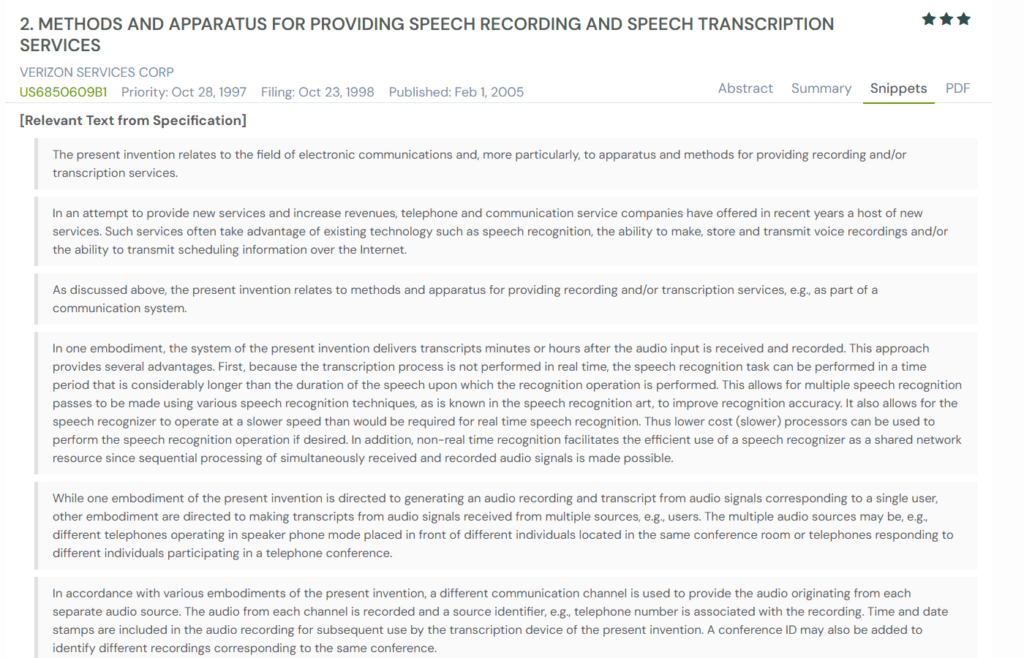
This approach gave businesses a reliable way to capture every word of a conference call without confusion or overlap. It turned recordings into data that could be analyzed and shared across teams.
When compared with US9792361B1, the link is easy to see. Both aim to make spoken words as searchable as written ones.
US6850609B1 focused on enterprise conferencing, while US9792361B1 extended the idea to personal phones, adding features like metadata tagging, private storage, and community sharing.
The Bigger Picture
US6850609B1 marked one of the first real attempts to treat speech as information rather than fleeting sound. It showed that conversations could be broken down, labeled, and stored with the same precision as digital documents.
That shift laid the groundwork for modern transcription systems and personal voice archives, exactly the vision US9792361B1 brought into everyday life.
2. KR20020082172A – Recording Anytime, Anywhere
Published in 2002, KR20020082172A introduced the idea of true freedom in voice recording. It described a mobile system that let users record phone calls or voice memos from any location and play them back whenever they wanted.
The focus was on convenience. No special equipment, no fixed setup; just the ability to capture sound wherever you were. The system stored recordings in a portable database, making them easy to access or replay directly from a mobile terminal.
When compared with US9792361B1, the connection becomes clear. Both inventions revolve around accessibility.
KR20020082172A made recording effortless; US9792361B1 went further by making every recorded word searchable. It added automatic transcription, metadata tagging, and the option to organize or share recordings, transforming simple voice notes into structured knowledge.
The Bigger Picture
This patent mattered because it untethered voice capture from the office desk. It was among ;the first to imagine voice recording as a mobile, on-demand experience; an early step toward the hands-free, voice-first world we now take for granted.
It helped lay the foundation for a future where recording, recalling, and searching conversations could all happen in one place: your phone.
Recommended Read: Curious how voice tech evolved from lab research to daily life? Check out our article on the evolution of Voice Assistant technology.
It traces the journey of voice recognition through decades of patents, leading to the systems that power Siri, Alexa, and Google Assistant today. It’s a fascinating look at how voice moved from lab experiments to everyday life, and how each innovation brought us a little closer to machines that truly understand us.
3. KR20040067180A – The Personal Voice Vault
Published in 2004, KR20040067180A described a new kind of personal recording service that worked through both mobile and landline networks. Instead of depending on local storage or bulky hardware, users could call a representative number, record a conversation or memo, and later access it through a website or phone interface.
The system managed everything through a web server, a central database, and a Computer Telephony Integration unit. This allowed users to store recordings for as long as they wanted, convert them to text, or even send reminders and messages automatically at scheduled times.
When viewed next to US9792361B1, the overlap is clear. Both inventions aimed to give users total control over their spoken data. KR20040067180A focused on reliable access and lifetime storage, while US9792361B1 added automation, i.e., transcribing, tagging, and making those recordings searchable in real time.
The Bigger Picture
This patent mattered because it brought personal recording into the network era. It made voice capture and storage possible without specialized hardware, using only a phone and a web connection.
The idea of separating the act of recording from the device itself became a crucial step toward cloud-based voice systems.
4. KR20010018222A – When Call Recording Became a Service
Filed in 1999 , KR20010018222A described one of the earliest network-based call recording systems. It allowed users to record live phone conversations directly through the telecom network without needing any special hardware or recording device.
Subscribers could choose between two options: record every call automatically or start recording only when they pressed a specific key. Once recorded, the conversation could be replayed later through the same network service.
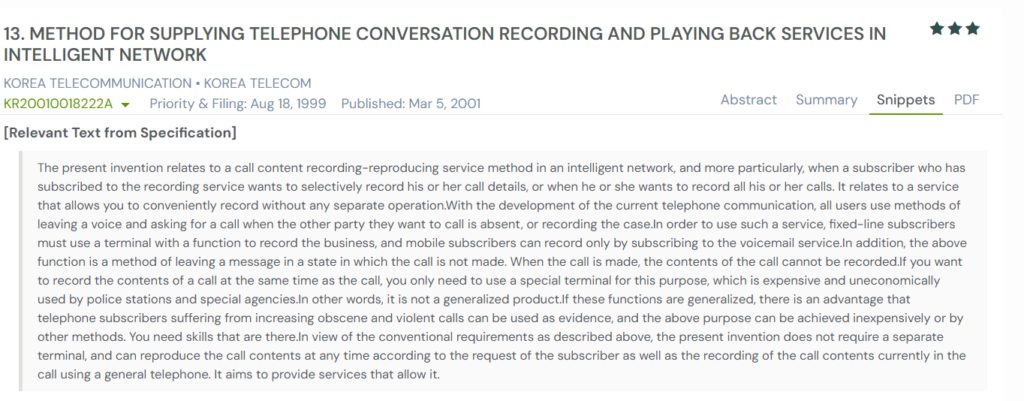
The entire system ran on an intelligent network architecture that handled authentication, routing, and playback. It gave ordinary users access to what was once an enterprise-only capability, such as documenting calls for safety, business, or legal reasons.
When compared with US9792361B1, the difference lies in focus. KR20010018222A made call recording simple and accessible. US9792361B1 made it intelligent: layering transcription, metadata, and search to create a digital memory of everything spoken.
The Bigger Picture
This patent mattered because it turned voice recording into a telecom service instead of a device feature. It was an early glimpse of cloud-style functionality, where the network itself handled storage and playback.
That shift paved the way for modern mobile apps and assistants that let you capture, replay, and retrieve spoken information without relying on physical recorders.
5. KR20030073436A – The Bridge Between Devices and the Cloud
Filed in 2002, KR20030073436A introduced a universal recording system that worked across every kind of phone, be it landline, mobile, or even public booths. It solved one of the hardest problems of its time: recording calls without needing special hardware.
The system converted analog voice data into TCP/IP packets and transmitted them to a web server, where each conversation was stored as a file. Users could then log in, replay, or download their recordings from anywhere. It didn’t matter what phone they used or where they were calling from; the system handled it all.
Technically, it combined Computer Telephony Integration, web servers, and smart interface devices that detected line voltage changes to trigger recording automatically. This enabled an early form of “cloud sync” before that term even existed.
In comparison, US9792361B1 was built on the same foundation but expanded its reach. It didn’t just store audio, it understood it. By adding transcription, metadata tagging, and search capabilities, it turned conversations into structured, retrievable memory.
The Bigger Picture
This patent mattered because it brought true universality to voice recording.
It removed the hardware barrier and pushed recording into the network and web era. That shift from local tapes to digital archives laid the groundwork for everything from smart speakers to in-car assistants that now store, analyze, and act on what we say in real time.
The relevance of this technology is also reflected in ongoing litigation. In June 2025, assignee Mimzi LLC filed lawsuits against several automakers, including Ford, Honda, and Mercedes-Benz over features in Apple CarPlay and in-car systems that allow users to report traffic hazards, share arrival times, and search for nearby locations.
These cases underline a growing trend: as voice-driven, context-aware systems become more embedded in daily tech, the patents behind them are becoming prized assets and frequent legal battlegrounds.
Comparison Snapshot: How Earlier Patents Shaped the “Photographic Memory” Patent
Here’s how earlier inventions aligned technically with US9792361B1 and evolved across different real-world applications.
Comparison Snapshot: How Earlier Patents Shaped the “Photographic Memory” Phone
| Patent | Core Innovation | Technical Overlap with US9792361B1 | Vertical Impact |
| US6850609B1 | Multi-channel recording and transcription system for conference calls, capturing each speaker separately and merging them into a synchronized transcript. | Both patents aim to make speech searchable and structured. US6850609B1 focuses on enterprise conferencing, while US9792361B1 brings similar intelligence to personal devices with metadata tagging and searchable archives. | Sets the stage for enterprise-grade meeting transcription and later influenced AI-based collaboration tools like Zoom IQ and Otter.ai. |
| KR20020082172A | Mobile-based recording system allowing on-demand capture and playback of voice calls or memos from any location. | Shares the goal of easy, portable voice capture. KR20020082172A enables recording freedom; US9792361B1 advances it through automatic transcription, metadata enrichment, and search functions. | Drove early thinking behind mobile voice memo apps and personal audio journals that evolved into smartphone assistants. |
| KR20040067180A | Personal voice-storage platform with web access, lifetime recording retention, and optional text conversion. | Both focus on user control and data management. KR20040067180A builds secure storage; US9792361B1 adds real-time transcription, metadata, and intelligent retrieval. | Helped transition recording from device-based to network-based models, a foundation for today’s cloud recording services. |
| KR20010018222A | Telecom-integrated call recording service that lets users record or replay calls without special hardware. | Shares the idea of centralized, network-level storage. US9792361B1 evolves it with richer layers of speech recognition, contextual tagging, and searchability. | Signaled the start of recording as a service. A precursor to cloud telephony and enterprise voice analytics. |
| KR20030073436A | Universal call recording across landline, mobile, and public phones, transmitting voice as digital packets to web-based storage. | Both emphasize platform-agnostic recording. KR20030073436A focuses on data transmission; US9792361B1 builds understanding on top of it with transcription, speaker ID, and privacy layers. | Pushed recording into the digital-network era, influencing later innovations in unified communications and smart-assistant ecosystems. |
Find the Hidden Connections Between Patents with GPS
The Global Patent Search tool helps reveal how different patents contribute to a broader goal, from call recording systems to intelligent transcription engines and speaker-specific metadata tagging.
Here’s how we can use the tool effectively:
1. Begin with the patent number: Enter the subject patent number into GPS. You can also try keywords like “voice transcription,” “call recording system,” or “searchable voice memory.” This narrows your search to patents tackling similar challenges.
2. Review relevant snippets: Instead of reading full claims, GPS shares the summary and highlights the most relevant technical excerpts from claims or specification of the patent in question. These often point how the core innovation overlaps with the subject patent oir technology.
3. Identify similar innovations: You can use GPS to uncover patents and non patent literature based on similar idea. For example, patents that deal with centralized audio storage, location-aware recordings, or user-controlled privacy settings.
5. Expand across application areas: Voice recording and transcription technology appears across telecom, mobile apps, customer service, and safety alerts. GPS helps you follow those threads beyond their original classification codes. You can further focus on more such patents by using Sort by Relevance feature of GPS. Learn more about it here.
Turning conversations into searchable memory isn’t just a technical milestone. It’s a new way of thinking about how we use voice, data, and recall. As this patent shows, the line between communication and information is growing thinner, and the tools we build to manage it are getting more sophisticated.
With so many overlapping ideas in this space, finding clarity matters. That’s what Global Patent Search does best. It doesn’t just find similar patents. It helps you see how they connect, how they differ, and where the real innovation happens.
Want to improve your patent search workflow? Try Global Patent Search tool today and uncover better insights in less time.